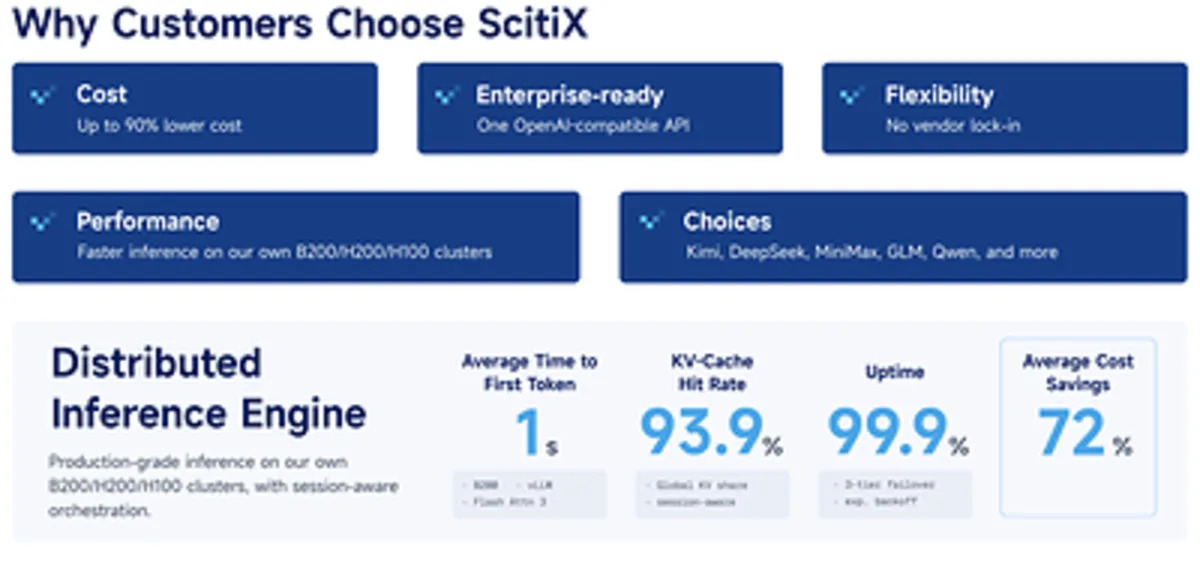
ScitiX has launched a production-ready inference platform designed for enterprises deploying multiple AI models at scale.
Running on NVIDIA infrastructure, the platform processes over 1 trillion tokens daily with approximately one-second response time and 99.9% uptime, offering neutral routing across models rather than locking customers into a single provider.
The system is already in use by demanding production workloads, including those from RadixArk.
What happened
ScitiX unveiled a production inference platform on August 16, 2026, running on NVIDIA B200, H200, and H100 infrastructure. The platform processes over 1 trillion tokens daily, achieves an average time-to-first-token of approximately one second, maintains a cache hit rate exceeding 90%, and delivers 99.9% uptime.
Why it matters
Enterprises moving from AI experimentation to live workloads need infrastructure that balances performance, cost, and compliance across multiple models. ScitiX positions its platform as a neutral routing layer that abstracts model orchestration complexity while giving customers granular control—rather than locking them into a single provider. This matters for organizations running open-source, fine-tuned, or third-party models simultaneously.
What to watch
The platform is live today and already powers demanding inference workloads, including those from RadixArk, the commercial team behind SGLang. Key capabilities include intelligent model routing with automatic failover, session-aware context reuse to reduce redundant compute, fault-tolerant execution, private deployment environments, zero-retention data policies, and full-stack observability dashboards.
Ask the AI about this article →
ScitiX's entry into the production inference market reflects a wider shift in how enterprises approach AI deployment. Rather than treating inference as a supporting function bolted onto existing ML pipelines, the company is positioning it as the operational core—the component that ultimately determines whether AI workloads run reliably, cost-effectively, and compliantly at scale. This framing is significant because it acknowledges a real pain point: organizations experimenting with models in the lab often struggle when moving to production, where multiple models need to coexist, failures must be gracefully handled, and data residency or zero-retention policies become non-negotiable.
The platform's neutrality—serving as a routing layer rather than a model monopoly—is a deliberate architectural choice that addresses customer lock-in risk. By supporting open-source, fine-tuned, and third-party models through a standardized API, ScitiX is positioning itself not as a model provider but as the orchestration backbone. The operational metrics the company reports (1 trillion tokens daily, 99.9% uptime, >90% cache hit rate) suggest the system is built to handle production scale from day one. The fact that RadixArk, already running SGLang in production, has chosen to migrate demanding scenarios to ScitiX implies the platform delivers material improvements in responsiveness and reliability over what the market was offering before.
AI-summarized, only the topics you pick — one digest a day via Email, Slack, or Discord.
Free · takes 30 seconds · unsubscribe anytime
Ask AI anything about this article. Q&As are published on this page for other readers too.
Anthropic is privately hoping to file for its initial public offering by the end of this month, targeting a ra…

Broadcom is reportedly seeking to borrow up to $100 billion in debt financing to support growth efforts at Ant…

As AI technology matures, the bottleneck in the industry is moving beyond semiconductor constraints like GPUs…

Elice Group, a South Korean AI infrastructure provider, announced the launch of the country's first AI data ce…

On August 12, AT&T's Chief Data and AI Officer said OpenAI models power about 25% of the telecom's total AI us…

On August 11, IBM announced a multi-year $240 million agreement with Together AI to deploy NVIDIA HGX B300 sys…