AIToday

Robot Simulation Becomes Core to Physical AI Training

Hugging Face Blog4h ago
Robot Simulation Becomes Core to Physical AI Training

Key takeaway

Robot simulation has become foundational to training physical AI systems, replacing expensive real-world data collection with GPU-accelerated synthetic experience generation. As the field matures, the focus has shifted from raw speed to which shared infrastructure—such as the Newton physics engine or Isaac Lab 3.0—will become standard layers that different simulation engines build on top of.

Summaries like this, in your inbox every morning.

Sign up free →

3 Key Points

  • What happened

    Robot simulation has shifted from a debugging tool to a central part of AI model development. Teams now use simulation to generate perception datasets, train reinforcement learning policies, collect demonstrations, and test policies against rare scenarios—tasks that would be slow, expensive, or risky to do in the real world.

  • Why it matters

    Physical AI systems need real-world interaction data to learn (understanding what happens when a cup slips or a gripper contacts an object wrong), but collecting such data is costly and risky. Simulation lets developers generate thousands of hours of robot experience at a fraction of real-world collection cost, using GPU parallelism to accelerate data generation. This shifts the bottleneck from hardware collection to computational throughput.

  • What to watch

    The simulation ecosystem is fragmenting into specialized engines—MuJoCo for dynamics accuracy, Isaac Lab 3.0 for GPU-scaled learning, Newton for differentiable physics, Drake for contact-implicit optimization. Developers choose based on whether they need synthetic data scaling, reinforcement learning support, sensor fidelity, or specific robot types (humanoids, dexterous manipulators, aerial vehicles). Newton, developed by NVIDIA, Google DeepMind, and Disney Research through the Linux Foundation, integrates MuJoCo Warp and offers multiple solvers for different physical systems.

In Depth

The core challenge in building physical AI systems is data availability. Unlike large language models and vision-language models, which train on internet-scale datasets, robotics and physical AI systems lack abundant real-world data. A robot must learn the consequences of physical interactions—what happens when a cup slips, a cable bends, or a gripper contacts an object at the wrong angle. Collecting this data in the real world is slow, expensive, risky, and sometimes impractical because tasks can be destructive.

Simulation provides a solution by enabling developers to generate large amounts of photorealistic, physically grounded data. By teleoperating robots in simulation and leveraging GPU parallelism, developers can generate thousands of hours of robot experience at a fraction of the cost of real-world collection. This capability has transformed simulation from a peripheral debugging tool into a central component of the model development pipeline. Teams now use simulation to generate perception datasets, train reinforcement learning policies, collect demonstrations, augment real-world data, benchmark models, and test policies against rare or adversarial scenarios. Industrial research labs and academic groups are increasingly building or contributing to simulation engines that meet these new requirements.

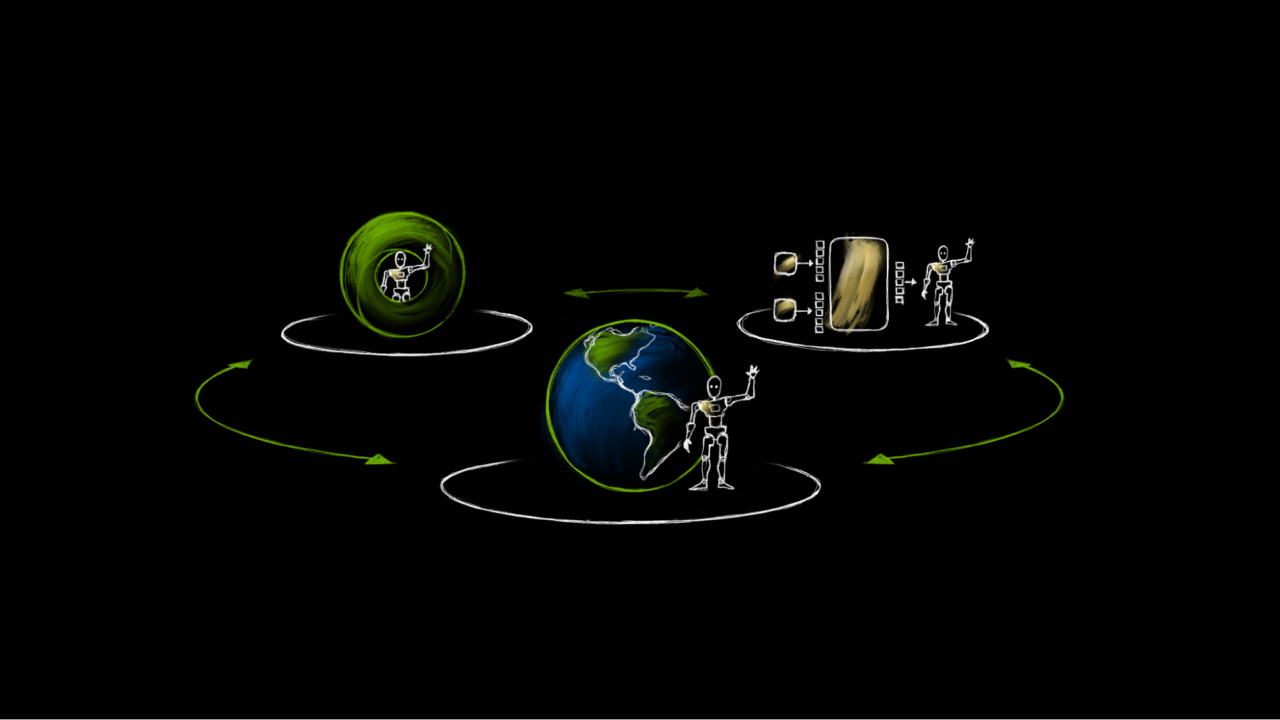
The article describes a three-computer paradigm that underpins modern physical AI systems: a training computer (a large GPU cluster for processing data and training foundation models), a simulation computer (a GPU workstation or cluster using GPU-accelerated physics and RTX rendering to generate robot experience and sensor data), and an on-robot computer (an edge device such as a NVIDIA Jetson AGX Thor-class system that runs the trained policy during deployment). Each plays a different role depending on latency, throughput, accuracy, and deployment requirements.

Developers face choices about which simulation engine to use based on several factors: whether they need scalable synthetic data generation workflows, support for reinforcement learning, specific sensor types, 3D asset format compatibility, and environmental fidelity. The article reviews four major engines. MuJoCo, short for Multi-Joint dynamics with Contact, is a fast, accurate, open-source physics engine emphasizing precise dynamics, contact-rich motion, and model-based optimization—designed around physical correctness rather than visual realism or massive GPU-parallel simulation. MuJoCo Warp (MJWarp) is a GPU-accelerated implementation of MuJoCo written in NVIDIA Warp that brings MuJoCo-style physics into a batched GPU setting, optimized for reinforcement learning and large-scale policy training by simulating many worlds in parallel and reducing CPU-GPU transfer bottlenecks. Isaac Sim is an open-source robotics simulation framework built on NVIDIA Omniverse using OpenUSD as its core layer, providing high-fidelity physics through PhysX, photorealistic RTX rendering, and robotics-focused sensor simulation for cameras, depth, lidar, radar, and synthetic data generation. Isaac Lab 3.0 is an open-source, GPU-accelerated, agent-ready framework for robot learning designed to train and evaluate policies at scale, and in version 3.0.0 it decoupled from Isaac Sim and Omniverse to become a lightweight, multi-backend framework where developers can choose between Isaac Sim with PhysX and RTX rendering for photorealistic workflows or lightweight headless Newton physics for high-throughput simulation.

Newton is an open-source, GPU-accelerated, extensible, and differentiable physics engine developed by NVIDIA, Google DeepMind, and Disney Research, and managed through the Linux Foundation. It is built on NVIDIA Warp and OpenUSD and integrates MuJoCo Warp as a key physics backend. In the broader simulation ecosystem, Newton acts as a modern physics layer for robot learning frameworks such as Isaac Lab and MuJoCo Playground. Newton provides multiple solver implementations rather than prescribing one numerical method: SolverMuJoCo and SolverFeatherstone use generalized coordinates for articulated rigid-body systems; SolverSemiImplicit, SolverXPBD, and SolverKamino use maximal-coordinate formulations; SolverVBD is an implicit solver supporting rigid bodies, particles, cloth, and soft bodies although with limited joint support; SolverImplicitMPM targets particle-based continuum materials; and SolverStyle3D specializes in cloth simulation. The appropriate solver depends on the physical system being modeled and its required capabilities.

Other engines serve specific niches: PyBullet remains useful as a CPU baseline for quick prototyping; DART and ODE are still used as Gazebo back-ends; Drake is the gold standard for contact-implicit trajectory optimization and rigorous numerics rather than throughput. The article notes that none of these engines is the answer to "I need 4,096 humanoids on one GPU." The article concludes that robot simulation has quietly become one of the most important layers in the modern embodied AI stack. As models move from static datasets into physical interaction, the ability to generate high-quality, scalable, and diverse simulated experiences is no longer optional but foundational. The key question for the field in 2026 is not "which engine performs the fastest" but "which pieces of the stack are likely to become the shared infrastructure that different engines would build on top of."

Context & Analysis

The article frames simulation as having undergone a fundamental shift in robotics and physical AI. Historically, simulators were peripheral tools—used mainly for debugging geometry, testing controllers, or visualizing motion. Today, simulation has moved into the core model development loop because physical AI systems face a critical bottleneck that large language models do not: data scarcity. While LLMs and vision-language models train on internet-scale datasets, robotics systems must learn from real physical interactions, which are inherently expensive and risky to collect at scale. Simulation bridges this gap by enabling developers to generate large volumes of synthetic, physically grounded data through GPU parallelism—a capability that fundamentally changes the economics of robot learning.

The emergence of multiple specialized engines reflects this maturation. The article presents simulation choices as application-specific: MuJoCo for precise dynamics and contact modeling, Isaac Lab 3.0 for GPU-accelerated reinforcement learning at scale, Drake for rigorous numerical optimization, Newton for differentiable and backend-agnostic physics. This fragmentation suggests that the field is not converging on a single engine but rather evolving toward a layered stack where lower-level physics libraries (Newton, MuJoCo Warp) provide reusable infrastructure that different learning frameworks (Isaac Lab, MuJoCo Playground) build on top of. The article explicitly poses this as the key question for 2026: not "which engine is fastest" but "which pieces of the stack are likely to become shared infrastructure."

The creation of Newton—jointly developed by NVIDIA, Google DeepMind, and Disney Research and managed through the Linux Foundation—signals industry recognition that a common physics layer could accelerate the entire field. By offering multiple solver implementations rather than prescribing one numerical method, Newton accommodates diverse physical systems (rigid bodies, particles, cloth, soft bodies) and learning paradigms, positioning itself as a possible standard layer beneath competing simulation frameworks.

FAQ

Why is simulation so important for robot learning?
Collecting real-world robot interaction data is slow, expensive, risky, and sometimes impractical because tasks can be destructive. Simulation provides photorealistic, physically grounded data generation at scale; developers can generate thousands of hours of robot experience using GPU parallelism at a fraction of real-world collection cost.
How do I choose between different simulation engines?
Developers should consider whether they need scalable synthetic data generation, reinforcement learning support, specific sensor types, 3D asset format compatibility, and environmental fidelity. MuJoCo is best for dynamics accuracy and contact modeling; Isaac Lab 3.0 for GPU-scaled policy training; Drake for contact-implicit trajectory optimization; Newton for differentiable, backend-agnostic physics.
What is Isaac Lab 3.0 and how does it differ from Isaac Sim?
Isaac Lab 3.0 decoupled from the Isaac Sim and Omniverse dependency to become a lightweight, multi-backend robot learning framework. Developers can choose to use Isaac Sim with PhysX and RTX rendering for photorealistic workflows, or run lightweight headless Newton physics for high-throughput simulation.

Get AI news like this every morning

AI-summarized, only the topics you pick — one digest a day via Email, Slack, or Discord.

Free · takes 30 seconds · unsubscribe anytime

Discussion

No discussion yet for this article

Stay ahead with AI news

Get curated AI news from 200+ sources delivered daily to your inbox. Free to use.

Get Started Free

Free · takes 30 seconds · unsubscribe anytime

1 minute a day. The AI essentials.

200+ sources · Email / LINE / Slack

Get it free →