What happened
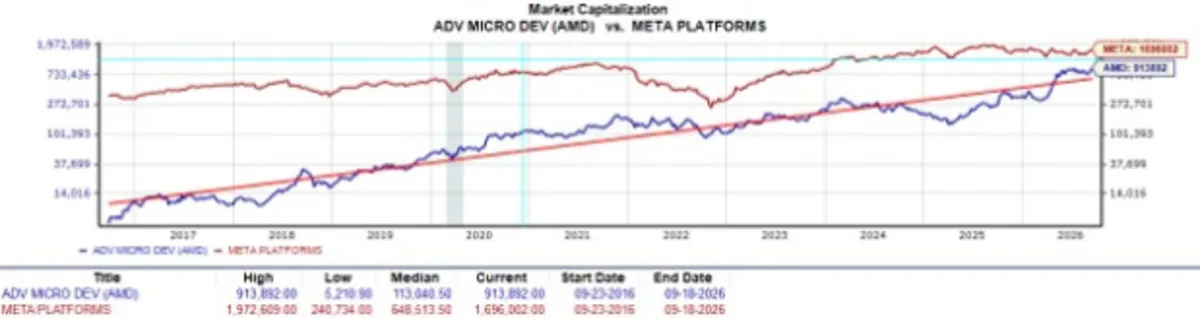
AMD and Meta Platforms each surged roughly 10% on Monday, with AMD reaching a $1 trillion market-cap threshold for the first time and Meta's Muse AI assistant climbing to the top of Apple's U.S. App Store.
Why it matters
The rally suggests investors are rewarding both AI chip demand and consumer AI products, and Muse gives Meta a tangible example of how its AI spending could extend beyond advertising, though Meta still faces questions over returns on that spending.
What to watch
After AMD's +180% YTD run and record highs of over $600 a share, much of the optimism is increasingly reflected in the stock, while Meta trades at a 23X forward earnings multiple and has faced pressure from rising costs and heavy capital spending.
WHO IT HITSInvestors holding or weighing AI semiconductor and mega-cap tech names will read the move as a signal on how much AI optimism is already priced in, while Meta shareholders get a concrete consumer-product data point for judging its AI spending.
Summaries like this, in your inbox every morning.
The two gains tell different stories. AMD's move reflects growing confidence that it can capture a larger portion of the AI-compute market alongside Nvidia, helped by demand for server CPUs and by its Instinct AI accelerators and EPYC processors. Meta's rally has a sharper company-specific catalyst: Muse, launched earlier this month, quickly became the top free app in Apple's U.S. App Store.
That traction matters because Meta has faced persistent questions over whether its enormous AI infrastructure investments will generate adequate returns. Muse gives investors a tangible example of how that spending could extend Meta beyond its core advertising business. The article notes that more capable AI agents could require substantially greater CPU resources, potentially expanding the addressable market for AMD's EPYC server processors.
The stakes now hinge on whether the momentum holds. AMD has already run up 180% year-to-date and hit record highs of over $600 a share, so much of the optimism looks increasingly priced in. Meta, by contrast, trades at a 23X forward earnings multiple and has faced pressure this year from rising costs and heavy capital spending — meaning its case may rest on whether Muse's early traction can turn into durable revenue.
For example, today's edition would include:
AI-summarized, only the topics you pick — one digest a day via Email, LINE, or Slack.
Free · 30 seconds with Google · unsubscribe anytimeWhat is AIToday? →
Ask AI anything about this article. Q&As are published on this page for other readers too.
Amazon blocked Meta's Muse agent from its marketplace and said Muse fails to identify itself as an agent by em…

SpaceX introduced Grok 4.7, which averaged $4.69 per task on CursorBench 4.0, ahead of GPT-5.6 Sol and Fable 5…

Tesla's robot team ran intensive supplier audits across China's Yangtze River Delta last week, covering Ningbo…

Gartner predicted in June 2026 that 70% of mainframe modernization projects begun in 2026 will fail, and point…

Headwaters began offering SyncLect Agent Garden on September 18, 2026, drawing on Teams meetings and existing…

Kewpie used Devin, an AI agent from Cognition AI supplied through DeNA AI Link, to write Plant Simulation mode…