What happened
On Sept. 1, Deere introduced JD, an AI assistant in its operations center that lets farmers ask about their own data — fuel use, yields, machine performance, harvest timing.
Why it matters
The tool deepens farmers' reliance on Deere for understanding their own operations, not just their equipment, which could reinforce its existing market position.
What to watch
Deere says farmers should stay in control of their data and understand how it is used — the test is whether those controls hold up as the company's software role grows.
WHO IT HITSFarmers and farm operators who use Deere equipment are directly affected, since the JD assistant draws on their own machine and field data, and the tools they use to interpret it now come from the same company that sold them the equipment.
Summaries like this, in your inbox every morning.
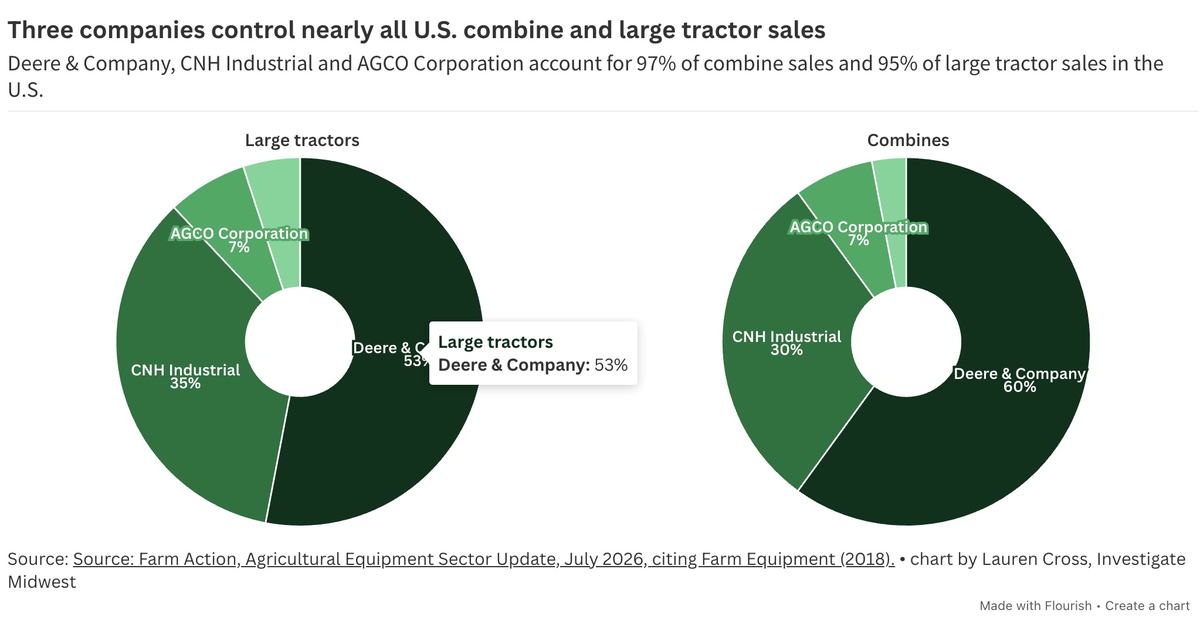
John Deere's move into farm data and AI sits alongside two separate pressures the article describes. One is its place in the equipment market: Farm Action says Deere accounts for nearly 35% of U.S. agricultural machinery sales, with an even stronger grip in large tractors and combines. The other is a set of concerns about what happens when a company that already dominates hardware also supplies the software and analytics that make sense of a farm's own data.
Farm Action's July 2026 report frames this as an industry-wide pattern, arguing that major equipment manufacturers are acquiring companies in precision agriculture, AI, automation and data analytics, and in doing so are becoming technology platforms rather than just machinery makers. The group says this expands dominant firms' control across the digital stack of modern farming, from field data to machine operation. The natural follow-on question, as the article puts it, is whether farmers who depend on Deere for both equipment and the tools that interpret their data give the company another way to strengthen its market position.
That question carries extra weight because Deere's control over part of the equipment business is already under antitrust scrutiny. In July, the Federal Trade Commission and five states reached a proposed settlement over allegations that Deere restricted access to repair tools, software and parts, which would require Deere to provide the same repair resources available to its authorized dealers. How the data-and-AI push is ultimately received may hinge on whether the proposed repair settlement is seen as addressing competition concerns, or whether regulators and farm groups treat the software layer as a separate and still-open question.
For example, today's edition would include:
AI-summarized, only the topics you pick — one digest a day via Email, Slack, or Discord.
Free · 30 seconds with Google · unsubscribe anytimeWhat is AIToday? →
Ask AI anything about this article. Q&As are published on this page for other readers too.
ServiceNow introduced AI Control Tower, Context Engine, and Shift Zero, tools for managing AI agent access, id…
At an IMTS media panel in Chicago, Honeywell Technologies CTO Mehul Patel predicted companies will eventually…
Morgan Stanley analyst Matthew Cost began covering Booking Holdings with an Overweight rating and a $230 price…

CEO Jim Taiclet told a Morgan Stanley panel Lockheed will pair the F-35 and advanced missiles with cheaper aut…
Lockheed Martin completed a Riyadh summer internship for Saudi university students in AI, robotics and advance…

Banks provided a $22 billion chip loan to a Blackstone and Alphabet AI cloud venture, according to a source ci…