What happened
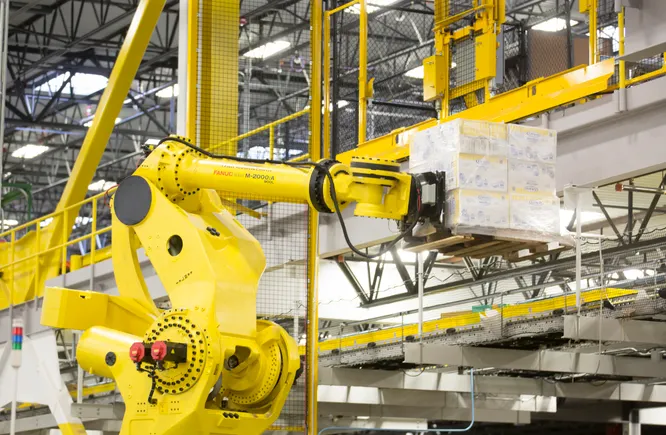
At an IMTS media panel in Chicago, Honeywell Technologies CTO Mehul Patel predicted companies will eventually stop talking about AI because it becomes routine, and Fanuc America CEO Mike Cicco said AI's effect on physical robots is still at the starting line.
Why it matters
Patel's prediction implies AI's value will be judged by whether factory systems run reliably on their own, not by how often AI is named in strategy decks.
What to watch
Fanuc's claimed protection layer, which Cicco said sits between what a robot is told and what it does, is the test of whether autonomous factory work earns trust. Watch how Fanuc's robot total grows past the 1 million reached in 2023.
WHO IT HITSManufacturing operations and plant-floor IT leaders evaluating agentic and no-code tools are the audience most directly affected, since the panel described factory robots and existing enterprise systems such as Oracle or SAP becoming entry points for AI-driven automation.
Summaries like this, in your inbox every morning.
The IMTS panel put a concrete forecast on a familiar question: when does AI stop being a topic and start being plumbing? Patel framed it as a natural endpoint, where systems not only predict what will happen but explain why and recommend action, with humans still in the loop in certain industries and guardrails strong enough for the system to operate without human intervention. That is a striking claim precisely because it treats the disappearance of AI talk as success, not as a loss of momentum.
The other panelists described the mechanics that could get manufacturing there. Cicco said Fanuc America has seen "exponential growth" in robot orders as AI demand rose, and that Fanuc's May partnership with Google Cloud brought the Gemini Enterprise platform and robotics software Intrinsic into its robots. He described workers writing needed parts on paper, handing it to automation technology that sends it to the cloud and digitizes instructions for the robot — a shift away from hard-coded programming toward flexible operator commands. Others on the panel extended that thread to no-code and low-code, including "point and click" interfaces, and to workers moving from data analysis toward deciding what to do with the information.
The caution is that the same panel was asked about worst-case scenarios, after Anthropic CEO Dario Amodei warned on CNN that "AI could kill us all." Patel and Cicco answered with control systems and protection layers rather than with slowdowns. Whether that reassurance holds is likely to hinge less on panel predictions than on whether those layers keep working as more robots are linked to a single cloud brain — a test that will play out on factory floors, not in conference rooms.
For example, today's edition would include:
AI-summarized, only the topics you pick — one digest a day via Email, Slack, or Discord.
Free · 30 seconds with Google · unsubscribe anytimeWhat is AIToday? →
Ask AI anything about this article. Q&As are published on this page for other readers too.
ServiceNow introduced AI Control Tower, Context Engine, and Shift Zero, tools for managing AI agent access, id…
On Sept. 1, Deere introduced JD, an AI assistant in its operations center that lets farmers ask about their ow…
Morgan Stanley analyst Matthew Cost began covering Booking Holdings with an Overweight rating and a $230 price…

CEO Jim Taiclet told a Morgan Stanley panel Lockheed will pair the F-35 and advanced missiles with cheaper aut…
Lockheed Martin completed a Riyadh summer internship for Saudi university students in AI, robotics and advance…

Banks provided a $22 billion chip loan to a Blackstone and Alphabet AI cloud venture, according to a source ci…