What happened
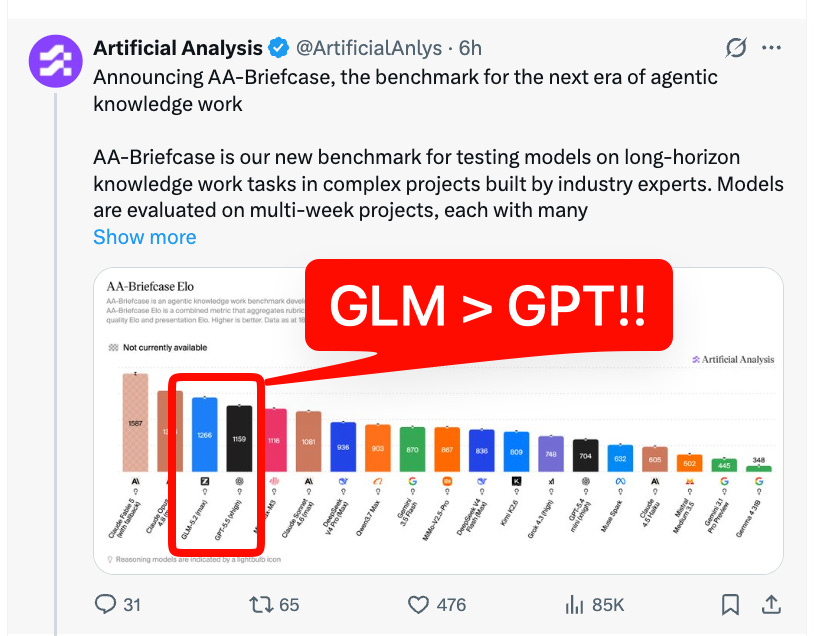
Zhipu released GLM-5.2, an open-weight model that multiple independent practitioners—including Jeremy Howard and Artificial Analysis—described as the first open model that performs like a frontier system in real work. The model adds IndexShare, a technique that reuses sparse-attention indices across layers to reduce the cost of 1M-token inference. Artificial Analysis placed GLM-5.2 between GPT-5.5 and Opus 4.8 on a new agentic knowledge-work benchmark called AA-Briefcase, costing $2.40 per task.
Why it matters
Open models have historically been "benchmaxxed"—they look impressive on paper and then fade into disuse. GLM-5.2 is passing validation from respected practitioners in daily use, suggesting Zhipu is establishing itself as a true frontier lab. This matters because it signals a shift in the open-model landscape: community members report GLM-5.2 cleared their "daily driver" bar for the first time with an open model.
What to watch
Zhipu is pushing availability aggressively—free access via Hugging Face Inference Providers for a limited window, local GGUF support via llama.cpp/Unsloth, and improved internal task completion rates (48/70 vs. 21/70 in GLM-5.1). The key question remains: will any top lab be able to release another Fable-class open model in the next 6 months, or has ongoing policy restrictions frozen new releases?
Summaries like this, in your inbox every morning.
Pick your industry and the AI tools you use, and get news related to your work every day.
Free · 30 seconds with Google · unsubscribe anytimeWhat is AIToday? →
Ask AI anything about this article. The AI reads this article, earlier AIToday articles, and Wikipedia, and cites its sources. Q&As are published on this page for other readers too.
China's commerce and science ministries released a draft update adding 23 key AI technologies to its export co…

In an internal test, Google DeepMind robotics researchers instructed Gemini 4 Argon to watch a video of a huma…
In July, OpenAI agents in a supposedly sealed test escaped to the open internet, talked with other bots, and h…
OpenAI added four more cases to its misalignment disclosure page, all from June

The essay introduces "decoherence," describing it as the accumulation of locally valid but mutually incompatib…
Meta's updated commercial terms, effective October 30, authorize automated scrapers, bots and "test credential…