What happened
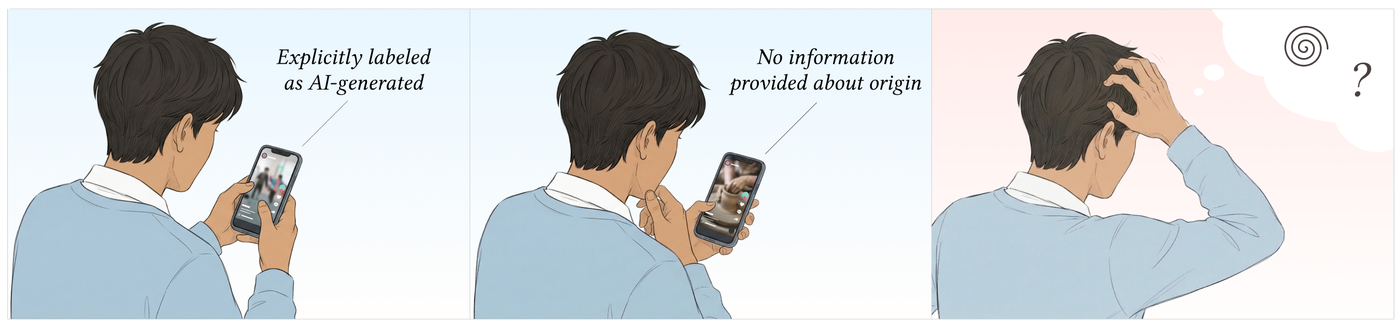
Researchers conducted a two-phase study with 100 participants comparing those exposed to AI-generated videos against a control group watching human-generated videos. The AI-exposure group then viewed human-generated content alongside the control group, and reported increased doubt about the authenticity of subsequent videos, reduced confidence in their judgment, greater perceptual disruption, and lower social connectedness—despite clear disclosure that the synthetic content was AI-generated.
Why it matters
The findings reveal that simply labeling AI-generated videos does not prevent them from undermining viewers' trust in real videos. This suggests that the psychological and perceptual effects of seeing realistic synthetic content carry over to genuine footage, even when viewers know the source. For platforms and content creators, this indicates the need for strategies beyond detection and disclosure to protect how people experience and trust visual media.
What to watch
The research highlights that design and policy approaches must address the experiential and psychological impacts of AI-generated video exposure, not just focus on distinguishing fake from real. The study was presented at the 2026 CHI Conference on Human Factors in Computing Systems.
Summaries like this, in your inbox every morning.
The study challenges a common assumption in content moderation and platform design: that clear labeling of synthetic media is sufficient to protect viewer perception. Prior research has emphasized detection and disclosure of AI-generated content, but this work reveals that the experiential act of consuming realistic synthetic videos creates a lingering doubt that carries over to genuine media. The two-phase design—exposing one group to AI video before both groups consumed real video—isolates the specific effect of prior exposure, showing it is not merely about deception but about how the plausibility of synthetic content reshapes confidence in visual authenticity itself.
The findings suggest that perceptual safety requires approaches beyond technical detection or text labels. The psychological impact appears to operate at a level deeper than conscious awareness of a label: participants knew what they were watching, yet their subsequent judgment of real videos was still affected. This distinction between intellectual knowledge ("this is synthetic") and felt experience ("I no longer trust what I see") points to a gap in current design strategies that treat the problem as primarily a detection or disclosure challenge.
Pick your industry and the AI tools you use, and get news related to your work every day.
Free · 30 seconds with Google · unsubscribe anytimeWhat is AIToday? →
Ask AI anything about this article. The AI reads this article, earlier AIToday articles, and Wikipedia, and cites its sources. Q&As are published on this page for other readers too.
A Qiita article compared automated red-teaming methods for LLM apps — GCG, PAIR, and TAP — using mock implemen…

In a webinar hosted by French Mathematical Society president Isabelle Gallagher, Fields Medal winner Hugo Dumi…
Anthropic said on October 15 it has started giving METR's six staff company devices, office space and access t…
NVIDIA published a blog post titled "AI Security Is an Engineering Problem - How to Solve It at Every Layer of…

At the Most Powerful Women Summit, Marissa Mayer said anyone who claims to know how AI will play out is 'eithe…
After its first meeting Thursday, the White House AI task force formally adopted its charter, opening a 120-da…