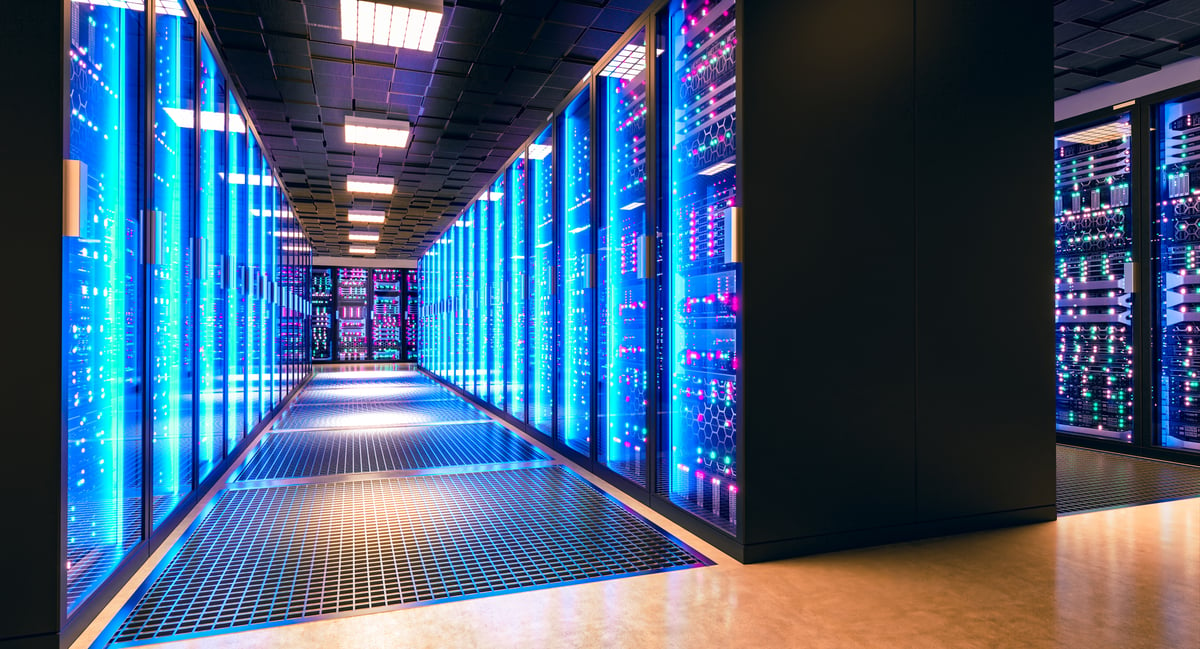
Hundreds of billions of dollars are flowing into AI infrastructure—data centers, GPUs, and related equipment—creating two rival groups: hyperscalers like Microsoft and Amazon, and specialized neocloud companies like CoreWeave and Nebius. While neocloud companies are posting rapid revenue growth, they carry heavy debt loads ($34.66 billion(約5.5兆円) at CoreWeave, $9.47 billion(約1.5兆円) at Nebius) that could strain them if the AI boom slows, whereas hyperscalers have profitable core businesses and are developing custom chips to reduce GPU costs, positioning them as the clearer investment.
Summaries like this, in your inbox every morning.
Sign up free →What happened
Two groups dominate AI infrastructure investment. Hyperscalers—Microsoft, Amazon, Meta Platforms, and Alphabet—are spending hundreds of billions on data centers and GPUs. Neocloud companies like CoreWeave and Nebius, which build specialized GPU data centers, are posting explosive revenue growth but have taken on substantial debt: CoreWeave has $34.66 billion(約5.5兆円) in long-term debt, and Nebius has borrowed $9.47 billion(約1.5兆円).
Why it matters
Neocloud companies benefit from cost advantages by specializing in AI workloads, but their debt load creates interest expenses that could strain them if the AI boom slows before they become profitable. Hyperscalers, by contrast, are investing from strength—they dominate cloud services, have profitable core businesses to fund capex, and are developing custom AI chips to reduce reliance on expensive GPUs, making their path to profitability clearer.
What to watch
Whether neocloud companies can recoup their investments and service their debt while turning a profit remains uncertain. Hyperscalers' ability to develop custom chips and leverage their existing cloud businesses to monetize AI spending will determine if they maintain their advantage over pure-play neocloud bets.
Companies across the technology sector are engaged in an unprecedented arms race to build AI infrastructure, spending hundreds of billions of dollars on data centers, GPUs, and related equipment. The competitive landscape has split into two distinct groups with very different financial profiles and investment thesis.
Hyperscalers—Microsoft, Amazon, Meta Platforms, and Alphabet—are pouring capital into AI from positions of institutional strength. These companies already dominate the global cloud services industry and have highly profitable core businesses generating the cash flows needed to fund expansive capex. Because they control existing cloud infrastructure and customer relationships, they have a direct pipeline through which to monetize AI services. The article notes that many hyperscalers are now developing custom AI chips designed to reduce their dependence on Nvidia's GPUs for training and operating their AI models, a move that could significantly lower their future computing costs and improve margins on AI services.
Neocloud companies—CoreWeave and Nebius are cited as leading examples—have positioned themselves as specialists in GPU-optimized data centers built specifically for AI workloads. This specialization delivers cost advantages over the more generalized data center infrastructure that hyperscalers operate. As a result, neocloud companies are posting what the article describes as "explosive growth" and "eye-popping revenue" as pure-play bets on the AI compute cycle. However, funding this rapid expansion has forced these companies to take on substantial debt. CoreWeave has accumulated $34.66 billion(約5.5兆円) in long-term debt, and Nebius has borrowed $9.47 billion(約1.5兆円). The debt load creates growing interest expenses that pose a risk if the AI boom moderates before these companies achieve profitability.
The article argues that hyperscalers emerge as the superior investment. Because they have diversified, profitable businesses and are not dependent on debt to fund growth, they can weather any slowdown in the AI cycle. More importantly, their ability to develop custom chips and their existing cloud customer bases give them a more direct path to monetizing the hundreds of billions in capex they are deploying. Neocloud companies, while showing impressive growth metrics, face the challenge of proving they can recoup massive infrastructure investments, service their debt, and ultimately turn a profit—all while the timing and duration of the AI boom remain uncertain.
The current AI capital expenditure boom has created a clear bifurcation in infrastructure investing. Hyperscalers are betting on their dominance in cloud services to absorb and monetize AI workloads, leveraging their existing profitable businesses to fund massive capex without heavy borrowing. Neoclouds, meanwhile, have identified a niche—specialized GPU data centers optimized for AI—and are scaling aggressively to capture the rampant demand for AI compute. However, this strategic split reveals a critical vulnerability: neocloud companies are funding growth almost entirely through debt, accumulating liabilities that grow in direct proportion to their expansion. The article suggests that while neocloud revenue growth appears eye-popping in the short term, the sustainability of these gains depends on both the durability of the AI boom itself and the companies' ability to achieve profitability before interest expenses become unmanageable. Hyperscalers, by contrast, have begun developing custom AI chips, which—if successful at scale—could reduce their reliance on expensive third-party GPUs and unlock a cleaner path to monetization. This suggests that the capex competition may ultimately be won not by the pure-play infrastructure specialists, but by those with existing revenue streams and the cash to ride out a potential slowdown.
AI-summarized, only the topics you pick — one digest a day via Email, Slack, or Discord.
Free · takes 30 seconds · unsubscribe anytime
No comments yet. Be the first to share your thoughts!
Log in to join the discussion




Get curated AI news from 200+ sources delivered daily to your inbox. Free to use.
Get Started FreeFree · takes 30 seconds · unsubscribe anytime
