What happened
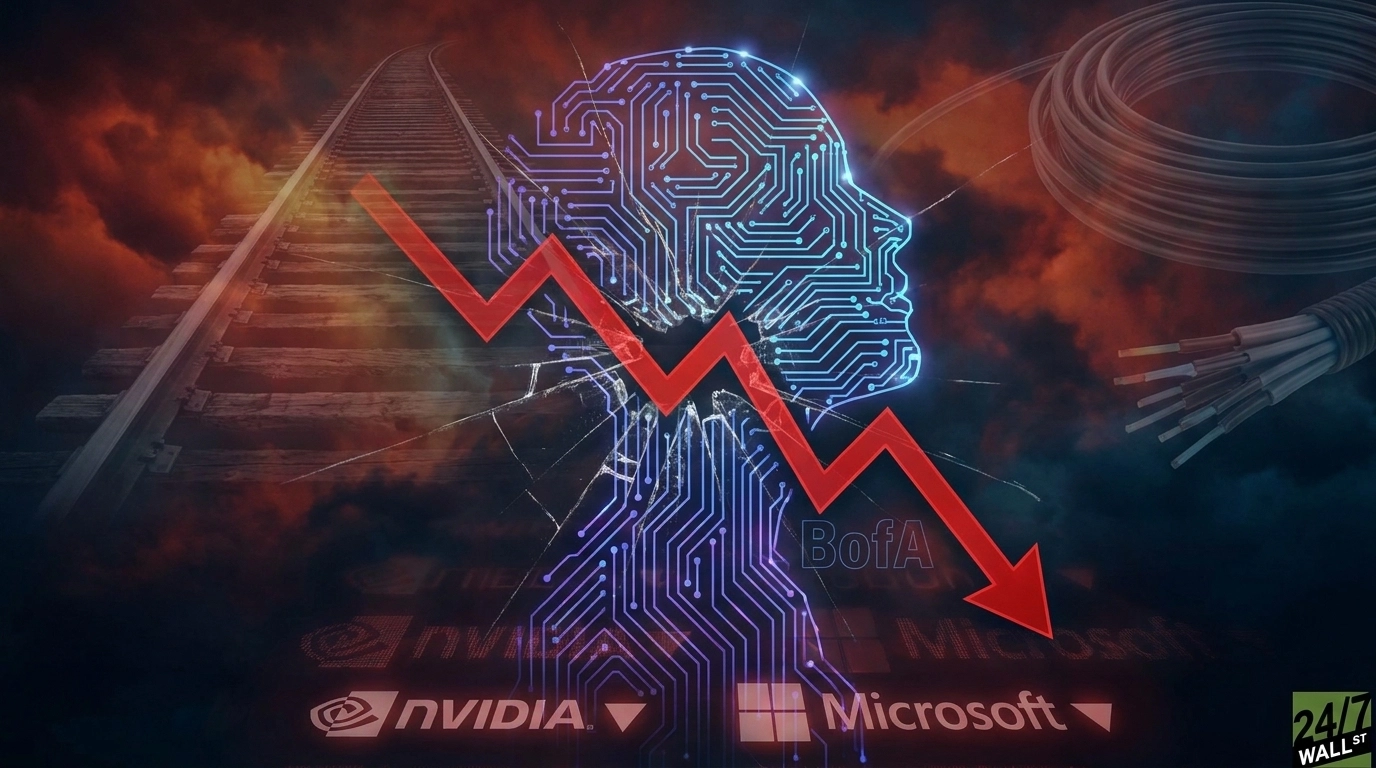
Bank of America strategist Sebastian Raedler said 12-month forward hyperscaler capex expectations rose from $330 billion in early 2025 to $1 trillion, and warned the pattern echoes past capital cycles.
Why it matters
Raedler argues the technology can succeed while AI stock investors still earn poor returns, as falling token prices and rising spending squeeze the companies funding the buildout.
Summaries like this, in your inbox every morning.
Bank of America's note places the current AI spending wave alongside two earlier buildouts that transformed the economy yet left many financiers poorer: 1870s railroads and 1990s fiber networks. In both cases, strong profits drew a wave of investment until capacity exceeded demand, prices fell, and returns on capital sank. Raedler sees the same mechanics in AI, where hyperscaler capex expectations have climbed to $1 trillion from $330 billion in early 2025.
The report points to a specific squeeze: average token prices have fallen around 50% since the summer, so revenue can stall even as usage booms. Business AI spending data from Ramp cited in the note show spending has faded slightly since August while token volumes keep rising. Raedler called this monetization disappointment in the face of intense competition the precise failure mode seen in past capital cycles.
The market reaction was visible. The Nasdaq 100 fell 2.5%, and the Philadelphia semiconductor index posted its eighth straight loss, its longest run since 2008. Among individual names, NVIDIA slid 1.43% to $214.13 and Microsoft fell 1.93% to $529.05. Raedler's warning targets investor returns and stops short of a crash forecast, leaving the tension between falling token prices and rising capex budgets as the central issue for AI stock holders.
Pick your industry and the AI tools you use, and get news related to your work every day.
Free · 30 seconds with Google · unsubscribe anytimeWhat is AIToday? →
Ask AI anything about this article. The AI reads this article, earlier AIToday articles, and Wikipedia, and cites its sources. Q&As are published on this page for other readers too.
On John Collison's Cheeky Pint podcast, Zuckerberg and Wang said a 44-minute call and a memo led to Meta Super…
Alphabet CIO Ruth Porat told Fortune it is "illogical" to call the AI buildout a capacity-constrained bubble…
Danaher announced a collaboration with NVIDIA combining its instruments, automation and workflow software with…
CoreWeave is funding a large AI cloud buildout with heavy borrowing — a US$50b debt load, distressed bonds and…

Deutsche Bank Research predicts superintelligent AI could outperform human experts across virtually every cogn…

TECO Electric and Machinery participated in Energy Taiwan on October 14, showcasing smart microgrid solutions…