What happened
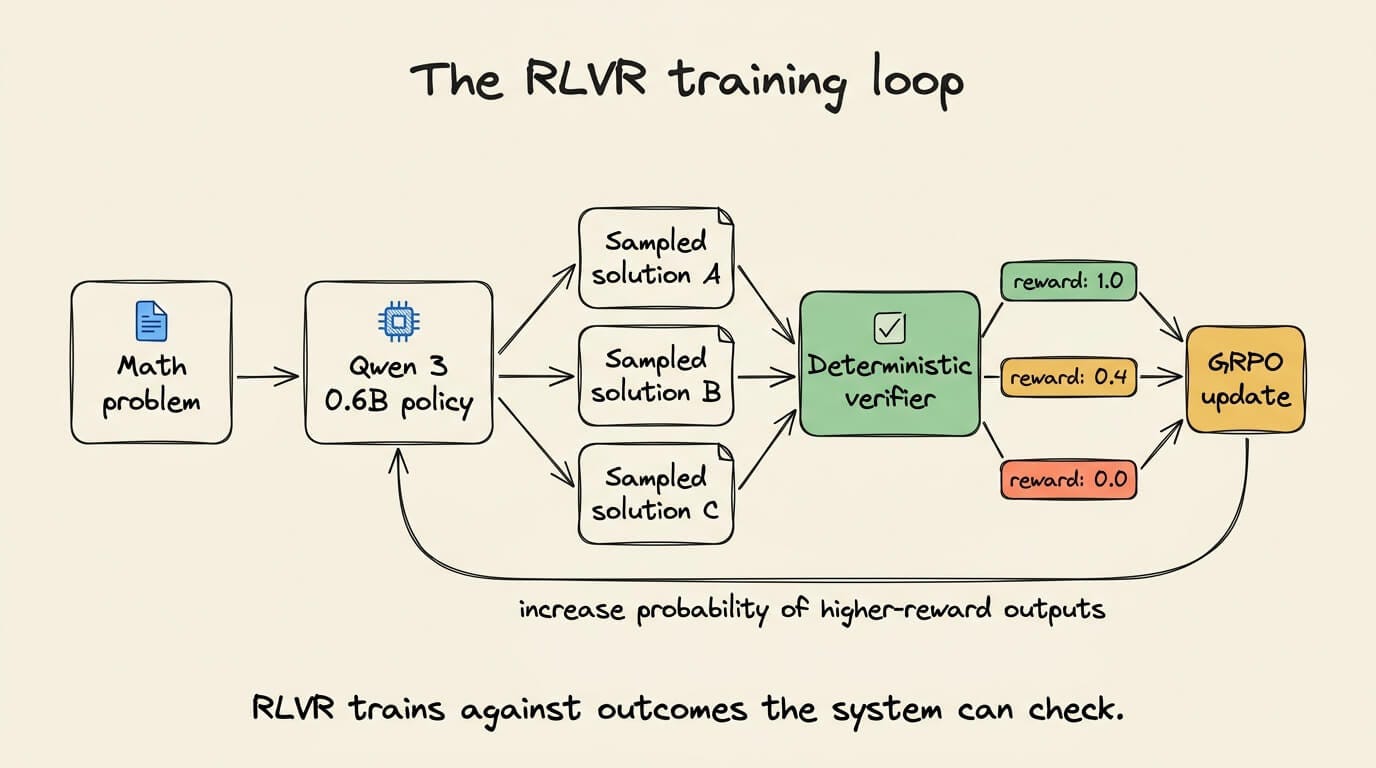
A walkthrough uses a custom four-signal reward (correctness 0.6, parseability 0.2, format 0.1, reasoning 0.1) to train Qwen3 0.6B via RLVR on SageMaker AI. A paired AWS comparison reports base MATH 0.406 vs fine-tuned 0.507.
Why it matters
The reward function is executable task specification — a loose parser or exploitable scoring rule can reward the wrong behavior, so teams adopting RLVR likely need versioning, tests, and separate metric monitoring.
Summaries like this, in your inbox every morning.
RLVR is a practical alternative when an answer can be checked by code — for a math problem the verifier only needs the final number, so no reasoning trace has to be curated. That is the gap this walkthrough explores: supervised fine-tuning (SFT) requires target completions, while RLVR only needs a scorer. The method here, Group Relative Policy Optimization (GRPO), was introduced in the DeepSeekMath paper and removes the separate value model used in PPO by basing updates on relative rewards within a sampled group.
The concrete trade-off is that the verifier becomes part of the task specification. A loose parser, an incomplete test suite, or an exploitable scoring rule can reward the wrong behavior, and the local tests described cover the scorer, not the learned model. The walkthrough's advice follows from this: graph correctness and formatting separately, watch whether response length rises faster than accuracy, and treat the reward function as product logic with tests, version control, and metric-level monitoring.
The measurement story matters as much as the training. The lab's own notebook does not evaluate the base model, so a single execution cannot support a before-and-after claim — that is why the reference comparison (0.406 to 0.507) is attributed to AWS's paired artifact, with a caution that exact values may vary across runs. The remaining SageMaker AI operations are mechanical: register the verifier as a versioned Evaluator, deploy to an ml.g5.xlarge endpoint, and run a five-prompt smoke test that shows the streaming path works, though that sample is too small to characterize throughput.
Pick your industry and the AI tools you use, and get news related to your work every day.
Free · 30 seconds with Google · unsubscribe anytimeWhat is AIToday? →
Ask AI anything about this article. The AI reads this article, earlier AIToday articles, and Wikipedia, and cites its sources. Q&As are published on this page for other readers too.
Anthropic's Claude Code 2.1.294 fixed natural-language prompt and agent hooks that were allowing operations th…

Over three days (Oct 7–9, 2026) Masayoshi Uehara wired ChatGPT's dots into real Gmail, Calendar, Drive, GitHub…
Checking official help pages, the author found all three export full history as raw JSON-style data, ChatGPT a…
WIRED's Boone Ashworth used Google Labs' newly launched Playground to build three games in one day, including…
CNBC published a piece looking at AI agents like Muse that can shop for consumers, and what that means for ret…

TheStreet reported that Morgan Stanley's test of the Roblox AI game maker revealed a catch