What happened
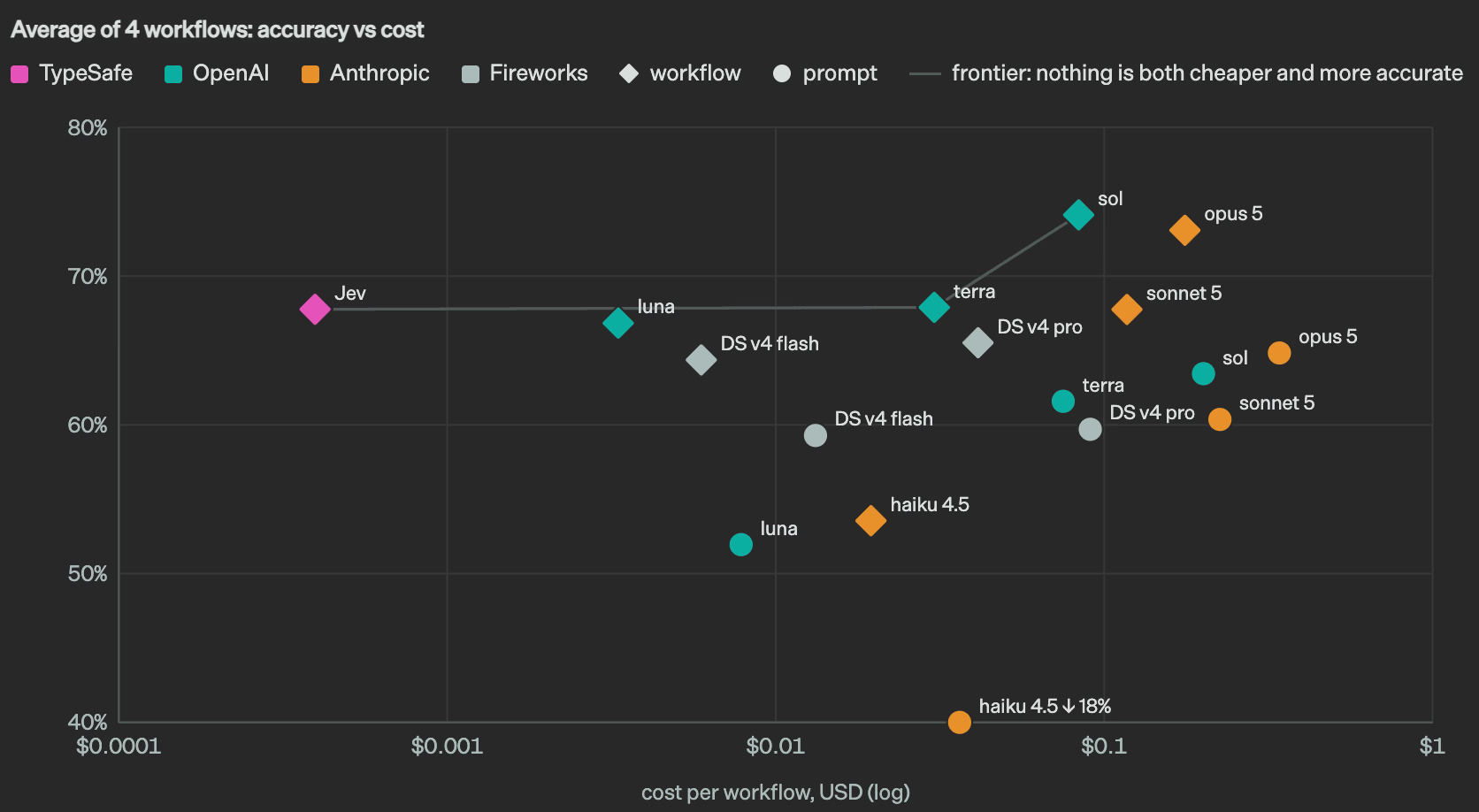
TypeSafe AI Inc. emerged from stealth yesterday with $40 million in seed funding led by DCVC Management Co. LLC, valuing it at a reported $200 million, for Jev, a model that returns structured decisions instead of text.
Why it matters
This gives developers a faster and more predictable AI component for tasks that need judgment, and it claims up to 100 times the speed and lower cost of frontier models.
What to watch
The company says Jev delivers results in less than 100 milliseconds and costs 39 cents per 1,000 workflows, but those figures have not been independently verified and will vary by workload and comparison method. Jev is currently available only through an early-access waitlist.
WHO IT HITSEngineering leads at insurance, security and back-office software teams — who need AI outputs predictable enough to plug into automated workflows — are the clearest audience for Jev's structured decisions and confidence thresholds; broader adoption hinges on how well its confidence scores track real accuracy on each team's data.
Ask the AI about this article →
Summaries like this, in your inbox every morning.
TypeSafe AI's pitch rests on a tension the company says is built into today's large language models: the same qualities that make them good at talking to people — flexible phrasing, confident answers — work against them when they are embedded in software that needs consistent, machine-readable outputs. The startup says that mismatch forces applications to rely on human review. Jev is its answer: a model that accepts structured questions and returns typed answers with probabilities and a confidence measure, which a developer can use to decide whether to proceed automatically, seek more information or refer a case to a person. In insurance underwriting, for instance, the company says Jev could estimate the likelihood that a property catches fire and route an ambiguous case to an underwriter.
The company's leadership carries OpenAI credentials: Diogo Almeida worked on reinforcement learning from human feedback, InstructGPT, ChatGPT and GPT-4 at OpenAI before founding TypeSafe in 2024, and he told Forbes that popular generative AI models have been optimized to please humans. DCVC Management Co. LLC led the seed round, which Forbes reported valued TypeSafe at $200 million. TypeSafe says the largest opportunity for Jev is in high-volume processes — classifying service requests, evaluating invoices, triaging security alerts and reviewing the results of AI agents — where a specialized decision model could act as a control layer while a language model handles drafting.
The stakes hinge on whether Jev's confidence scores actually track accuracy on real customer data, something TypeSafe itself says developers must test. The company's speed and cost comparisons — less than 100 milliseconds per result, 39 cents per 1,000 workflows — come from its own tests and have not been independently verified, and the company notes they will vary by workload, network location and comparison method. Since Jev is available only through an early-access waitlist, the near-term question is whether early users find the constrained output reliable enough to embed in production, which could make this style of decision model a complement to, not a replacement for, the language models it is measured against.
For example, today's edition would include:
AI-summarized, only the topics you pick — one digest a day via Email, Slack, or Discord.
Free · 30 seconds with Google · unsubscribe anytimeWhat is AIToday? →
Ask AI anything about this article. Q&As are published on this page for other readers too.
Northwest Bancshares CFO Doug Schosser told theCUBE he weighs AI proposals against three tests — customer impa…
Dell is building private cloud solutions for enterprise AI, and an interview cited up to 65% in cost savings v…

Huawei's Heart Voice Community published minutes of a talk in which supervisory board chairman Guo Ping told n…

Microsoft raised its quarterly dividend by seven cents to $0.98 per share, payable December 10 to shareholders…

Daily Dose of Data Science published a walkthrough showing modern fine-tuning with GRPO (Group Relative Policy…
Nikkei reports that Byond is offering support for building AI agents that specialize in cumbersome sustainabil…