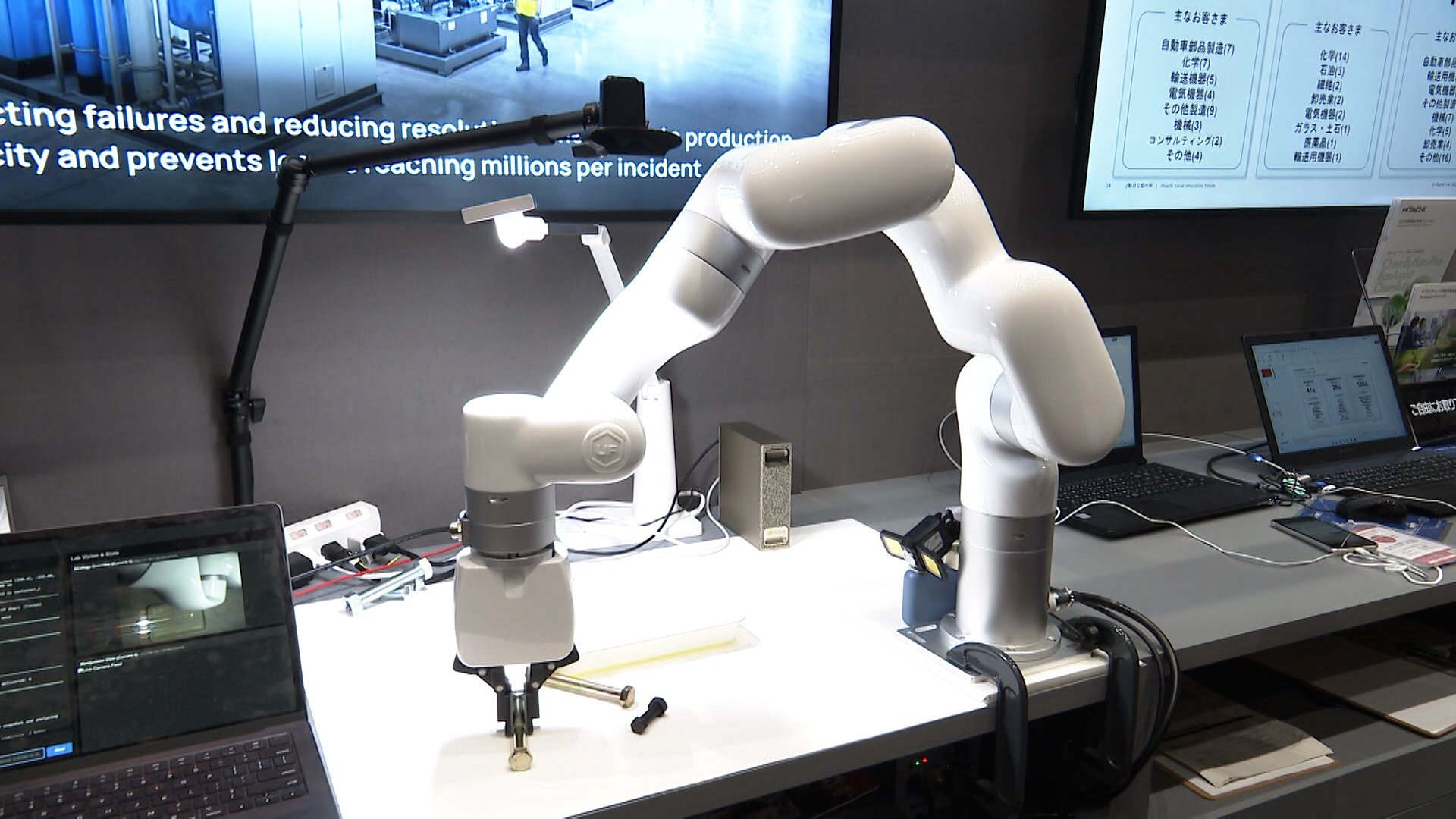
What happened
Hitachi is holding its largest exhibition, "Hitachi Social Innovation Forum 2026 JAPAN," featuring over 50 technologies, including robots with physical AI for wiring and autonomous transport robots.
Why it matters
Hitachi's CEO, 德永俊昭, cites projections that Japan will face a shortage of 11 million workers by 2040, positioning this autonomous digital infrastructure as the company's new vision for social infrastructure.
What to watch
Whether Hitachi can move from showcasing these technologies to actual deployment, particularly for the nuclear plant inspections done remotely by robots and the AI-optimized factory operations for sites with labor shortfalls.
WHO IT HITSHitachi's initiative directly targets industrial sectors in Japan dealing with labor shortages, such as manufacturing and energy. These businesses stand to gain from AI-run factories and remote inspection capabilities, which could reduce their reliance on human workers.
Ask the AI about this article →
Summaries like this, in your inbox every morning.
Hitachi is positioning itself as a leader in creating a future-ready social infrastructure in Japan, a response to the country's anticipated demographic pressures. The event, a key venue for displaying the company's technological direction, highlights a dual approach: adapting existing physical infrastructure and introducing new autonomous systems. This includes an emphasis on both simulation and physical robotics.
The strategy acknowledges that communication and experience-based knowledge currently form the foundation of many production sites. By leveraging AI and digital twins, Hitachi aims to enable continuous operations without requiring staff to be physically present at every stage, especially for routine checks or handling intricate tasks with the appropriate precision.
Ultimately, the success of this vision depends on translating these demonstrations into practical, scalable solutions. The projected 11 million worker deficit provides a compelling business case, but the adoption of AI in established industrial environments will hinge on its operational reliability and demonstrable cost-effectiveness. These technologies are likely to be evaluated on their capacity to integrate with existing infrastructure and improve overall safety, not just to replace manual labor.
For example, today's edition would include:
AI-summarized, only the topics you pick — one digest a day via Email, Slack, or Discord.
Free · 30 seconds with Google · unsubscribe anytimeWhat is AIToday? →
Ask AI anything about this article. Q&As are published on this page for other readers too.
Perplexity CEO Aravind Srinivas told CNBC on September 4 that banks like Morgan Stanley and JPMorgan want "air…

Pampa Energía plans a facility of up to 500 megawatts in Neuquén province, seeking investors with first contra…

Meta will no longer factor AI dashboards or token counters into engineer performance reviews, executives Maher…

Bechtel Corporation and Cyberhawk formalized their partnership to scale iHawk drone analytics and AI-assisted…
SoftBank introduced an AI system for video interview screening in May 2020, cutting screening time by about 70…

OpenAI's Astra model is now available, beating the ARC-AGI-3 benchmark and scoring the highest on Zapier's Aut…