
What happened
At ISUCON2026 the author's team merged 658 PRs via parallel Codex agents, but stalled around 120,000 points and finished 94th of 856 teams with a 145,523 score.
Why it matters
In practice the rebuilt Claude harness reached 575,333 points on the third try with no human direction — far above the 145,523 official run, suggesting harness design mattered more than parallelism.
Summaries like this, every morning.
The post-mortem is in practice mode. At ISUCON2026 itself, the author's team leaned on tightly split agent roles — issue filing, implementation allocation, measurement, deployment and benchmarking, monitoring — with Codex running as many as 20 in parallel, merging 658 PRs and peaking at 111 merges in an hour. That machinery kept changes flowing, but the score plateaued near 120,000 in the second half. The diagnosis he arrived at the next day was that the team had a mechanism for making changes but none for deciding what to change.
His early fixes followed a predictable pattern: each failure produced a new rule or tool in the harness. That worked up to a point, but in the second practice attempt the agent rejected rebuilding the memory-resident design at T+0:30 and later failed to revisit the decision even when its own stated conditions were met. He came to attribute this to too much documentation — the numbers needed for a decision were scattered across 5–6 files.
The pivot was to stop adding and start consolidating. The harness now centers on one main agent that asks no questions of humans, runs benchmarks itself from the first round, and decides structural questions when information is sufficient rather than on a clock. In the third attempt the agent chose a memory-resident design at T+0:27 after reading user behavior on its own, and the score climbed from 41,289 at T+1:30 in the first attempt to 510,209 in the third. He still sees two gaps: fine-grained tuning know-how, and getting the agent to keep searching for the next move while time remains — at T+2:54 it wrote "final form" with more than four hours left before the freeze.
Pick your industry and the AI tools you use, and get news related to your work every day.
Free · 30 seconds with Google · unsubscribe anytimeWhat is AIToday? →
Ask AI anything about this article. The AI reads this article, earlier AIToday articles, and Wikipedia, and cites its sources. Q&As are published on this page for other readers too.
Innovaccer added SpaceXSI's Grok Voice model to its Gravity Voice AI agents for routine health-system calls li…

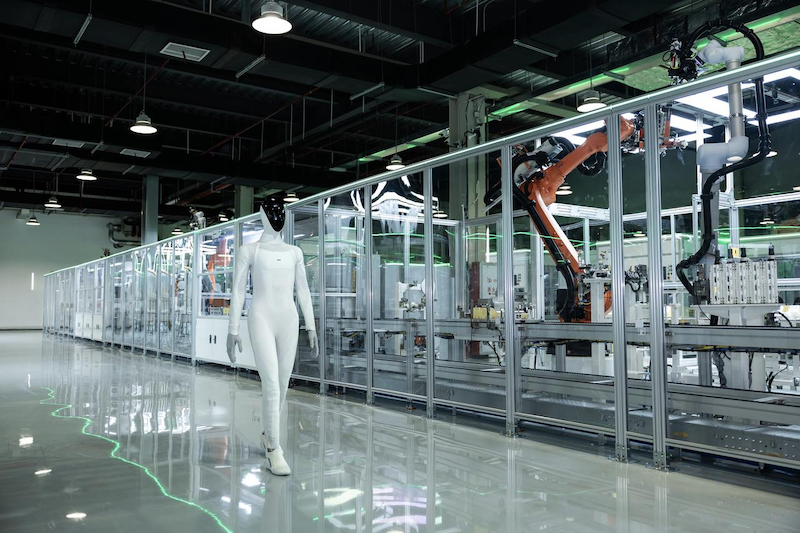
XPeng will hold its 2026 AI Day on November 25 in Guangzhou, themed "Origin," its eighth annual technology sho…
Meta Chief AI Officer Alexandr Wang said an AI model played a major role in the Riemann Hypothesis proof sketc…

Z.ai released GLM-5.4 on Nov 23 to all GLM Coding Plan users

The guide maps four model-adaptation methods — prompt engineering, RAG, fine-tuning and continued pre-training…
OpenRouter ran Qwen3.8 27B through fp16, fp8 and fp4 endpoints from providers including Cerebras, Parasail, Co…