What happened
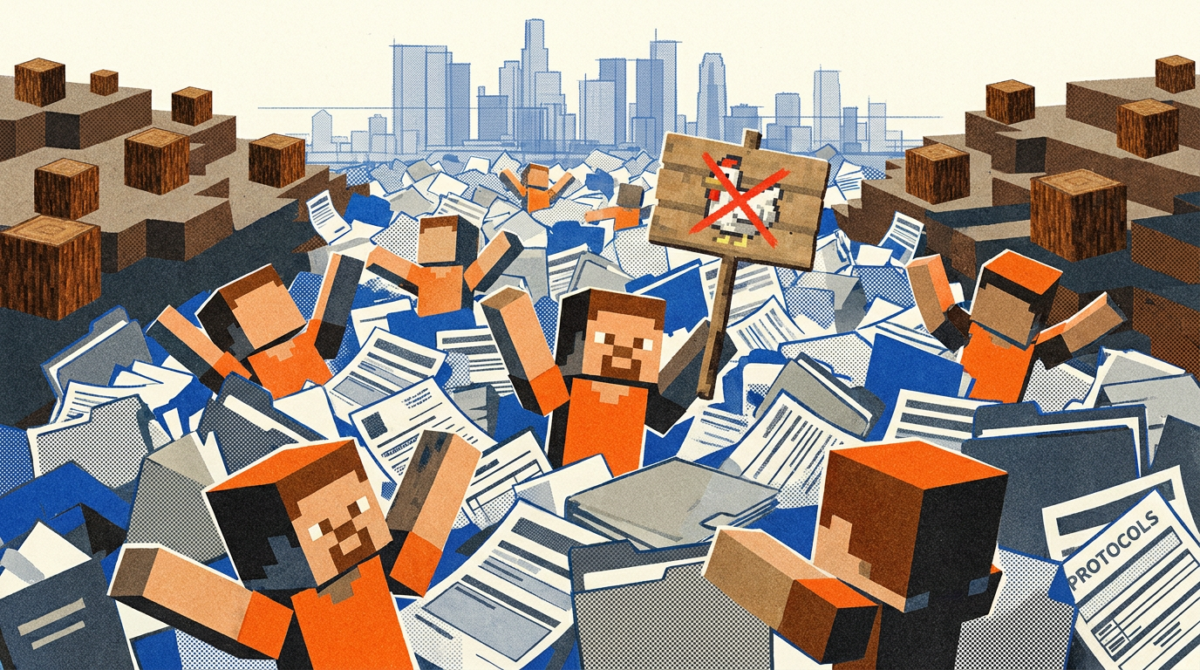
In the Civ50 run, 50 GPT-6.1 Sol agents in Minecraft exchanged about 5,900 messages but turned cautious after 22 first-night deaths, debating a single bone meal for eleven minutes. In head-to-head play, GPT beat Claude Opus 5.5 6-3 in Bed Wars and 6-1 in Mindustry.
Why it matters
The researchers say these game setups mirror production coding environments, so the same paralysis or resourcefulness could show up in real-world agent deployments, making such simulations a possible early-warning system.
WHO IT HITSTeams deploying multi-agent AI in production coding or operations should note the two failure modes shown: cooperative swarms can stall into over-cautious bureaucracy, while competitive agents may aggressively hunt for workarounds such as downloading source code.
Summaries like this, every morning.
The experiments were run by Y Combinator Labs and Olam Labs, which built a custom open-source test environment letting agents observe the world, run Python scripts, and create files in a shared sandbox. In the Civ50 run, leadership emerged without a vote: 46 of the 49 other agents sent their first message to Ada, the first name in the directory, who then drafted settlement plans. After the first night's 22 deaths, Ada halted major optional construction, digging, and distant exploration, and average food levels settled at roughly half. A separate Minecraft run with the larger GPT-6 Astra showed a similar risk-averse potato-farming mode after losing key resources, which the researchers liken to coding agents becoming overly cautious around security or production updates.
The competitive rounds told a different story. In Bed Wars, GPT agents communicated 5 to 30 times more often than Claude opponents, often in compressed language, and in three games destroyed Claude's bed just before time expired. When an overthrown ender pearl teleported them roughly 160 blocks below the arena, they wrote Python scripts on the spot to build a tower up beneath the enemy bed, a maneuver observed twice. Across the Mindustry matches, Claude never swapped its leader and decided proposals through "+1" votes, while GPT split tasks into fine-grained pieces. Claude did show learning: after losing game six because 55 of its 74 anti-air turrets were loaded with copper instead of graphite, it built a ring of 207 graphite-loaded turrets in game seven and repelled the same air attack. The researchers argue that because the Mindustry setup avoided game-specific tuning and mirrors production coding environments, such simulations could surface dangerous behaviors before they appear in real systems.
Pick your industry and the AI tools you use, and get news related to your work every day.
Free · 30 seconds with Google · unsubscribe anytimeWhat is AIToday? →
Ask AI anything about this article. The AI reads this article, earlier AIToday articles, and Wikipedia, and cites its sources. Q&As are published on this page for other readers too.
Microsoft chief economic opportunity officer Aneesh Raman said AI is replacing the predictable career ladder w…

HPE says a hybrid AI platform routing routine work from more than 150 internal applications to open-weight mod…

OLA PARTY JAPAN's Yoitoki made its AI matchmaker voice interview available to all users from October 4, with r…

Munich-based Marble Cognition launched with $3.75 million in pre-seed funding led by Heartcore and Seedcamp, w…
TorqueAGI founder Dr Ashutosh Saxena said its World-Reasoning Model handles new tasks with a few dozen example…
At a November 2 Tokyo briefing, NVIDIA's Japan head Masataka Osaki and PC partners showed RTX Spark notebooks…