AIToday

Hand-coded weights match trained models' scaling, but fall short in efficiency

Alignment Forum6h ago
Hand-coded weights match trained models' scaling, but fall short in efficiency

Key takeaway

Researchers hand-coded neural network weights for a specific memorization task and found that the resulting models' capacity to memorize facts scales linearly with parameter count, just like trained models do. However, the hand-coded weights were less efficient than those learned through training, suggesting that while architecture determines the scaling relationship, the training process finds better solutions within that constraint.

Summaries like this, in your inbox every morning.

Sign up free →

3 Key Points

  • What happened

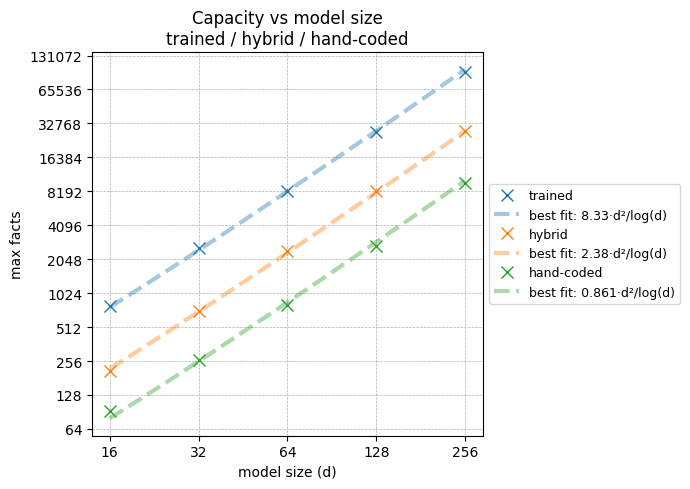
    Researchers hand-coded weights for single-layer MLPs (neural networks) designed to memorize labels for two-token input sequences. The models' ability to memorize facts with 90% accuracy scaled linearly with parameter count, matching the scaling behavior of trained models with the same architecture.

  • Why it matters

    The finding shows that manual weight construction can reproduce the scaling properties of learned models, suggesting that the linear relationship between parameters and memorization capacity is a fundamental property of the architecture rather than unique to training. However, hand-coded models still underperformed trained ones by an unspecified factor, indicating that the training process produces more efficient weight configurations than manual design.

  • What to watch

    The research touches on how neural networks encode and scale information capacity—a question relevant to understanding both how AI systems learn and how their limits are set by design rather than accident.

In Depth

Researchers conducted an experiment to understand the relationship between neural network architecture, parameter count, and memorization capacity. They hand-coded the weights of single-layer MLPs—networks with one hidden layer and an input-output structure—rather than training them with gradient descent. The task was narrow and well-defined: each model had to memorize correct labels for two-token input sequences.

The key finding was that the number of facts the hand-coded models could memorize with 90% accuracy scaled roughly linearly with the models' parameter count. This scaling behavior matched what is observed in trained models using the same architecture, suggesting that the linear relationship is not a quirk of the training process but rather a fundamental property of how this class of networks can encode information.

However, the researchers also found that their hand-coded models underperformed trained models in absolute efficiency terms. While both scaled linearly with parameters, the hand-coded models' scaling prefactor—the multiplicative constant that determines how many facts can be memorized per parameter—fell short of trained models' by a measurable factor. This gap reveals that although architecture determines the form of scaling (linear, in this case), the training process discovers more efficient weight configurations than manual design can achieve.

Context & Analysis

The research addresses a fundamental question in neural network science: whether the scaling laws observed in trained models are intrinsic to architecture or artifacts of the training process. By constructing weights by hand rather than through gradient descent, the researchers isolated the architectural contribution to scaling behavior. The finding that both approaches scale linearly suggests the relationship is robust—a property of how MLPs can theoretically encode information—rather than an accident of learning dynamics.

Yet the gap in efficiency between hand-coded and trained weights indicates that training algorithms discover weight configurations that are substantially better at using available parameters. This gap points to a real constraint: even when we understand the scaling law, realizing it efficiently still requires the optimization process that training provides. The work thus carves out a middle ground: architecture determines the form of scaling, but training determines how well that scaling is achieved.

FAQ

What task were the hand-coded models designed to perform?
The models were designed to memorize labels for input token sequences of length two, achieving 90% accuracy on memorized facts.
How did hand-coded weights compare to trained models?
Both showed roughly linear scaling of memorization capacity with parameter count. However, hand-coded models had a lower scaling prefactor (efficiency multiplier), meaning trained models achieved better performance relative to their size.

Get the latest Large Language Models news every morning

AI-summarized, only the topics you pick — one digest a day via Email, Slack, or Discord.

Free · takes 30 seconds · unsubscribe anytime

Discussion

No comments yet. Be the first to share your thoughts!

Log in to join the discussion

Related Articles

Stay ahead with AI news

Get curated AI news from 200+ sources delivered daily to your inbox. Free to use.

Get Started Free

Free · takes 30 seconds · unsubscribe anytime

1 minute a day. The AI essentials.

200+ sources · Email / LINE / Slack

Get it free →