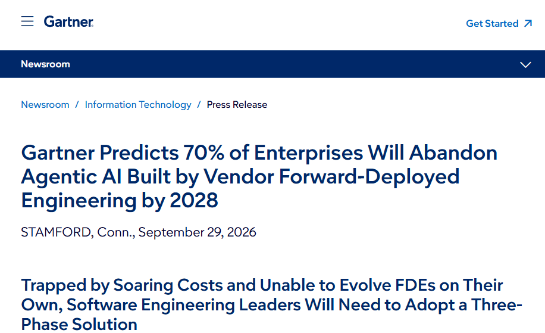
What happened
Gartner predicted that 70% of AI agents built through vendors' forward-deployed engineering will be abandoned unused by enterprises by 2028, and that under 20% of vendors will reflect ongoing customer needs in core products.
Why it matters
The prediction signals that many agent projects may fail structurally before any technical failure, with vendor-led development not translating into lasting enterprise use, and that consulting services are increasingly sold under the FDE label.
What to watch
The test is whether vendors follow Gartner's three FDE principles, including clear exit strategies from the start; the abandoned share is a 2028 forecast, not a current count.
WHO IT HITSEnterprise IT teams and business units commissioning AI agent projects through vendor-led engineering are the ones most exposed if those agents are later abandoned. Software vendors' professional services and solution engineering groups may face scrutiny over whether their FDE offerings are genuine forward-deployed engineering or relabeled consulting.
Summaries like this, in your inbox every morning.
Gartner's forecast sits on a shift in how software vendors package AI work. The article explains that FDE originally meant vendor engineers embedding at a customer site to jointly develop services tailored to that customer's problems. But Mukul Saha, a senior director analyst at Gartner, points out the term is now widely used as a label for implementation, professional services, solution engineering, or AI consulting.
Gartner therefore frames the risk as structural rather than technical. It says many projects will fail structurally before they fail technically, because they do not meet its three FDE principles: using FDE only for problems that require deep product expertise, rapid adaptation, and tight integration of the vendor's technology and operating environment; embedding FDE into internal business experts, engineers, and end users so important knowledge is shared and reflected in the work; and clarifying the exit strategy from the start.
The prediction that under 20% of vendors will reflect ongoing customer needs into their core products suggests the benefit of FDE may stay one-off rather than compound. For enterprises commissioning agent projects, the stakes appear to hinge on whether the engagement is genuine FDE or relabeled consulting, and on whether a clear exit strategy exists from day one.
Pick your industry and the AI tools you use, and get news related to your work every day.
Free · 30 seconds with Google · unsubscribe anytimeWhat is AIToday? →
Ask AI anything about this article. The AI reads this article, earlier AIToday articles, and Wikipedia, and cites its sources. Q&As are published on this page for other readers too.
NetApp's Jen Prenner said legacy data can be made AI-usable without re-architecting it, and NetApp announced p…

Taiwan's National Science and Technology Council (NSTC) launched two research programs targeting silicon photo…

SpaceX launched a prototype satellite for Alphabet's Project Suncatcher carrying four Tensor Processing Units…

Mistral AI CEO Arthur Mensch unveiled Mistral Large 4 (ML4) at AI Everything Abu Dhabi, a 1.05 trillion-parame…

Vercel COO Jeanne DeWitt Grosser said the company's inbound sales agent evolved from a 1,000-line prompt to 14…

Mistral released a public preview of Mistral Large 4, a trillion-parameter model with 49 billion active parame…