AIToday

Brain waves join robot training data arsenal

TechCrunch AI2h agoSend on LINE
Brain waves join robot training data arsenal

Key takeaway

Encord, a data-tooling company, is testing whether brain-wave measurements can improve robot training data. The startup wears headsets that track both eye movement and brain activity while pilots perform physical tasks, aiming to capture mental states like error and intent. The trial comes as robotics companies face a critical shortage of real-world training data—a constraint that may matter more to physical AI progress than model design itself.

Summaries like this, in your inbox every morning.

Sign up free →

3 Key Points

  • What happened

    Encord, a company that builds data tools for AI model training, is running a trial with Zander Labs—a German neuroscience startup—to tag robot training data with brain-wave measurements. Pilots wearing headsets that track both eye movement and brain activity perform physical tasks like pulling blocks from a Jenga tower, creating annotated training data that captures mental states such as error, intent, and surprise.

  • Why it matters

    The robotics industry faces a severe shortage of real-world physical training data—the constraint that may now matter more than model architecture itself. Encord's internal analysis suggests it will take a data set roughly five times the size of YouTube's video corpus to teach robots manipulation at the scale LLMs achieved with internet text. Since physical data must be manufactured rather than scraped, the cost and scarcity of high-quality labeled training data has become a business bottleneck; brain-wave signals could reveal which moments matter most for model training, potentially improving efficiency.

  • What to watch

    Encord is conducting this as a trial to evaluate whether brain-wave-tagged data actually improves robotic model performance before deciding to scale. The company's San Leandro warehouse is also experimenting with other new data modalities, including forearm sensors that detect electrical signals in muscles to create 3D hand-position data. Encord draws egocentric video from factories globally and uses remote-operated robotic arms (leader-follower rigs) to generate task-specific training data.

In Depth

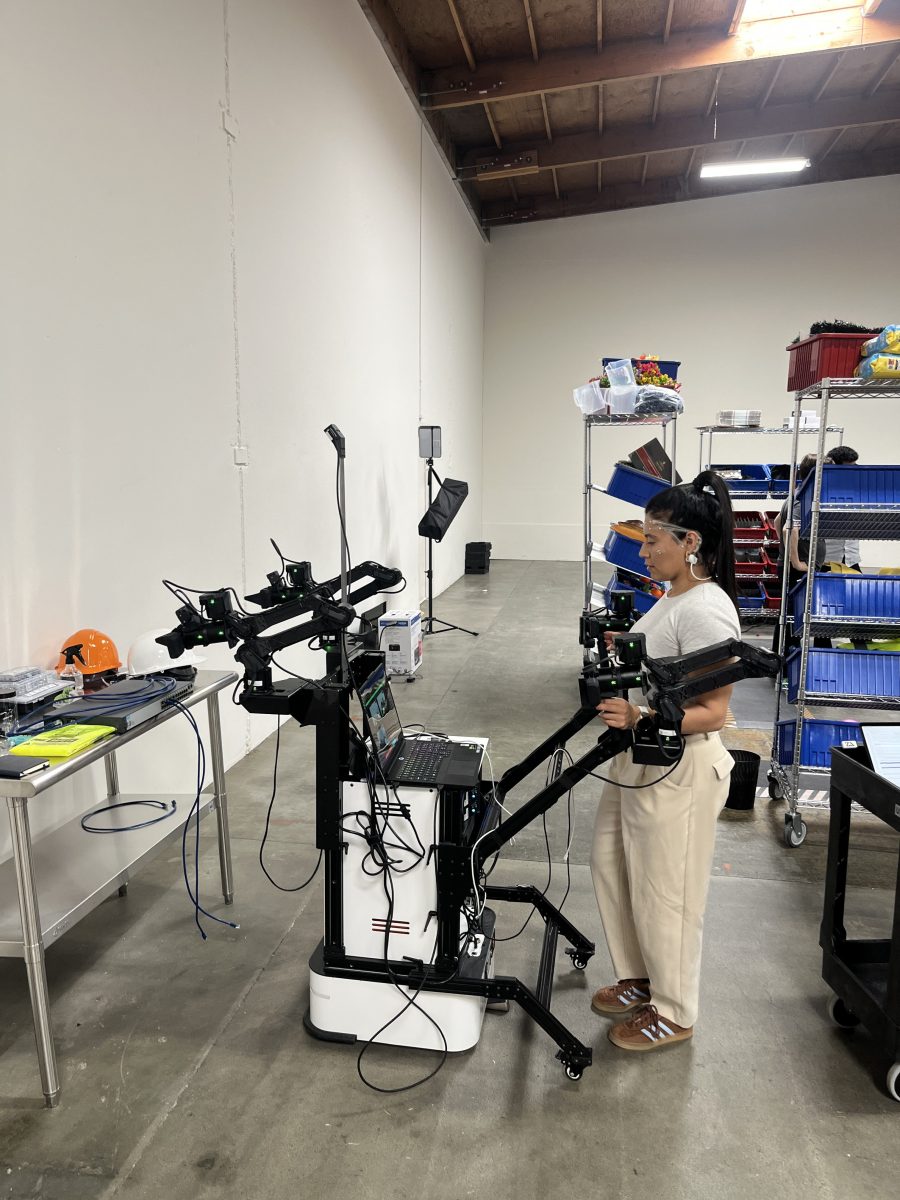
In a warehouse in San Leandro, California, Andrew Ceja, one of Encord's pilots (the company's term for robotic trainers), carefully pulled wooden blocks from a Jenga tower while wearing a headset equipped with a camera that tracks his eye movement. But this headset included an additional innovation: sensors measuring his brain waves as he worked. Encord, a data-tooling company founded to help machine-vision applications annotate data, partnered with Zander Labs, a German neuroscience startup, to test whether brain-activity measurement could enhance training data for robots.

The trial emerged from a fundamental recognition: the robotics industry faces an acute shortage of real-world physical training data. As Vineeth Velmurugan, Encord's head of robot learning and a veteran of OpenAI's robot lab and warehouse-automation firm Berkshire Grey, explained, "The data simply does not exist." When Encord's robotics customers began pursuing end-to-end learning for manipulation, the company realized it would have to manufacture training data rather than simply manage it. Velmurugan estimates that robots will require a training data set roughly five times the size of YouTube's entire video corpus to achieve the kind of breakthrough that LLMs reached—a scale that explains why data generation has become its own business.

Zander's contribution centers on mental-state inference. According to Lucas Gehrke, a Zander neuroscientist supervising the work, the amount of brain activity used during a given task offers clues about when models need to deploy their highest-effort computation. Encord's plan is to build an initial brain-wave-tagged data set, run it through customer robotics models, and evaluate whether it actually improves performance before scaling up. In parallel, the San Leandro facility pursues other data modalities: pilots operate paired robotic arms (leader-follower rigs) to generate data for specific manipulation tasks—pouring coffee, stacking poker chips, plugging and unplugging ethernet cables from server backs—while another emerging modality uses forearm sensors to detect electrical muscle signals, allowing the company to infer 3D hand position when video alone cannot capture it. Encord annotates all its data sets with dense physical descriptions ("right hand tightens bolt") to aid LLM-based models in understanding task content. Velmurugan's analysis suggests this kind of annotation is worth 100 times as much as unannotated egocentric data for training specific tasks, and costs only 20 times more to produce. Yet that 20-fold cost multiplier, while economically favorable compared to the value gain, remains a substantial barrier—fundamentally different from the near-zero cost of scraping internet text for LLM training. Both pilots Ceja and Infante came from Scale, another AI data annotation firm, and the dozen or so workers at the facility form part of a burgeoning workforce manufacturing the building blocks for physical AI models.

Context & Analysis

The constraint limiting physical AI has shifted from model architecture to the sheer scarcity of real-world training data. Unlike large language models, which were built on text scraped from the internet at near-zero cost, robots require hands-on, physically grounded training data that must be deliberately manufactured. Encord's pivot from simply managing customer data to producing it reflects this new reality: the company realized that as robotics firms attempted end-to-end learning for manipulation tasks, "the data simply does not exist." This economic shift—from collection to manufacturing—changes the entire equation for physical AI development.

Encord's experiment with brain-wave measurement represents an attempt to increase the informational density of each training sample. By capturing not just video but also the pilot's mental states (error detection, intent, surprise), the company hopes to create a richer signal for model training. Velmurugan's claim that such dense annotation is worth 100 times as much as raw video, while costing only 20 times more, suggests a genuine efficiency gain—but "20 times more" remains a substantial cost barrier. The company's multi-modal approach—combining egocentric video, remote-operated robotic arms, muscle electrical signals, and now brain waves—reflects a broader bet that the next competitive advantage in robotics will belong to whoever can manufacture the highest-fidelity training data most efficiently.

FAQ

What does the brain-wave headset measure?
The headset, built by Zander Labs, measures brain activity to deduce mental states like error, intent, and surprise. Zander's neuroscientist Lucas Gehrke explained that the amount of brain activity at any point during a task offers clues for model builders trying to figure out when they need to deploy their highest-effort models.
How much more expensive is annotated physical training data compared to raw video?
Velmurugan estimates that densely annotated data (with physical descriptions like "right hand tightens bolt") is worth 100 times as much as unannotated egocentric video for training specific tasks, and costs only 20 times more to produce.
How much training data would robots need to match what LLMs achieved?
Velmurugan says it will take a data set roughly five times the size of YouTube's video corpus to break through—a scale that helps explain why data generation itself has become a business and not just a research problem.

Get the latest Robotics news every morning

AI-summarized, only the topics you pick — one digest a day via Email, Slack, or Discord.

Free · takes 30 seconds · unsubscribe anytime

Discussion

No comments yet. Be the first to share your thoughts!

Log in to join the discussion

Related Articles

Stay ahead with AI news

Get curated AI news from 200+ sources delivered daily to your inbox. Free to use.

Get Started Free

Free · takes 30 seconds · unsubscribe anytime