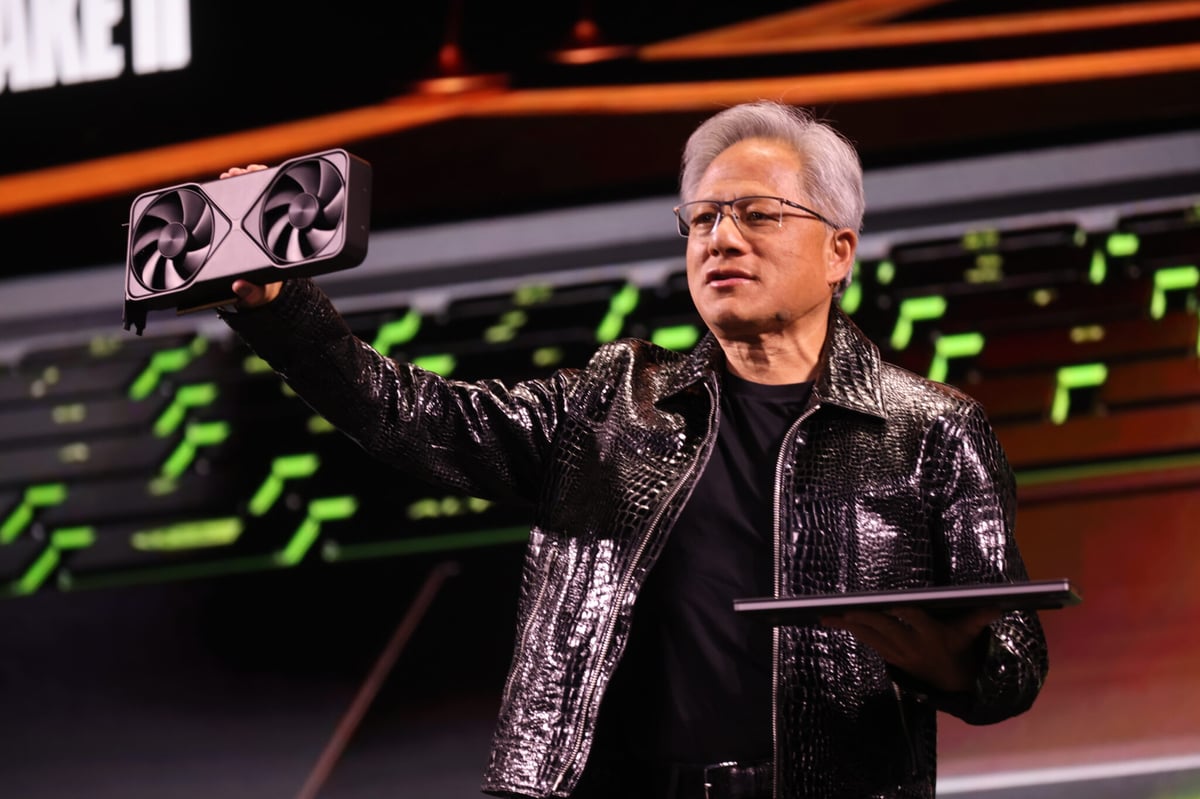
Japan announced it will purchase 27,500 Nvidia chips to build an AI computing hub launching in 2028, marking a strategic effort to develop domestic AI infrastructure for robotics and autonomous systems. Japan's AI market is projected to grow from $15.6 billion(約2.5兆円) in 2025 to $123.9 billion(約20兆円) by 2032, creating potential opportunities for investors interested in Japanese automation and robotics companies through funds like the Global X Robotics and Artificial Intelligence ETF.
Summaries like this, in your inbox every morning.
Sign up free →What happened
Nvidia announced Japan will purchase 27,500 Nvidia chips for a computing hub expected to launch in 2028, designed to support AI-robotics integration. CEO Jensen Huang stated during a Tokyo event that 'Japan must own, improve, secure, and deploy Japan AI.'
Why it matters
Japan's AI market is forecast to grow from $15.6 billion(約2.5兆円) in 2025 to $123.9 billion(約20兆円) by 2032, signaling a major shift toward domestic AI infrastructure. For U.S. investors, the Global X Robotics and Artificial Intelligence ETF (BOTZ) offers exposure to Japanese automation and robotics companies positioned to benefit from this buildout.
What to watch
BOTZ's largest holding is Japanese manufacturer Keyence (9.6% of the ETF), which makes sensors and machine vision systems. Three other Japanese companies—Fanuc, SMC, and Daifuku—also rank in the ETF's top 10 holdings. Over the last 12 months, BOTZ is up just over 9%, compared with 35% for the broader Global X Artificial Intelligence and Technology ETF (AIQ).
Nvidia's CEO Jensen Huang announced a major deal: Japan will purchase 27,500 Nvidia chips for a computing hub designed to support AI-robotics development and expected to launch in 2028. During a Tokyo event, Huang emphasized the strategic rationale, stating, "Japan cannot outsource its national intelligence. Japan must own, improve, secure, and deploy Japan AI." The infrastructure is intended to enable machines to interact with the world by combining AI with robotics capabilities.
Japan's AI sector, though currently modest, is positioned for substantial growth. Fortune Business Insights projects the Japanese AI market will expand from $15.6 billion(約2.5兆円) in 2025 to $123.9 billion(約20兆円) by 2032—nearly an 8-fold increase. This growth trajectory reflects Japan's commitment to becoming a self-sufficient AI power rather than depending on overseas platforms.
For U.S. retail investors seeking exposure to Japan's AI transformation, the Global X Robotics and Artificial Intelligence ETF (BOTZ) offers a practical option, as direct investment in Japanese companies presents logistical challenges. The ETF's largest holding is Keyence, a Japanese manufacturer accounting for 9.6% of the fund's net assets. Keyence produces sensors and machine vision systems for automation, helping assembly lines operate efficiently by identifying objects and recognizing defects. Three other Japanese companies rank in BOTZ's top 10 holdings: Fanuc, which focuses on industrial automation and robotics with over 1 million robots installed globally; SMC and Daifuku, both involved in automation and robotics.
BOTZ's recent performance has lagged comparable AI-focused funds. Over the last 12 months, BOTZ is up just over 9%, while the broader Global X Artificial Intelligence and Technology ETF (AIQ) is up 35%. However, if the next phase of AI development heavily emphasizes robotics integration and Japan invests intensively enough to establish itself as an AI leader, BOTZ could emerge as a stronger performer in coming years.
Japan's push to build homegrown AI infrastructure marks a significant policy shift. Nvidia's announcement that the country will purchase 27,500 chips for a 2028 computing hub reflects Japan's determination to develop national AI capabilities rather than rely on foreign platforms. This infrastructure investment aligns with Japan's broader strategic interest in blending AI with robotics—a sector where the country has deep manufacturing expertise.
The scale of Japan's AI ambitions is evident in growth projections: the market is forecast to expand nearly 8-fold from $15.6 billion(約2.5兆円) in 2025 to $123.9 billion(約20兆円) by 2032. For U.S. investors, this presents a challenge—direct investment in Japanese companies can be logistically difficult—but sector-focused ETFs like the Global X Robotics and Artificial Intelligence ETF offer a practical route. The fund holds exposure to established Japanese automation leaders including Keyence (sensors and machine vision), Fanuc (industrial robotics), SMC, and Daifuku, all of which stand to benefit if Japan executes its AI-robotics integration strategy.
AI-summarized, only the topics you pick — one digest a day via Email, Slack, or Discord.
Free · takes 30 seconds · unsubscribe anytime
No comments yet. Be the first to share your thoughts!
Log in to join the discussion

Get curated AI news from 200+ sources delivered daily to your inbox. Free to use.
Get Started FreeFree · takes 30 seconds · unsubscribe anytime
1 minute a day. The AI essentials.
200+ sources · Email / LINE / Slack
