What happened
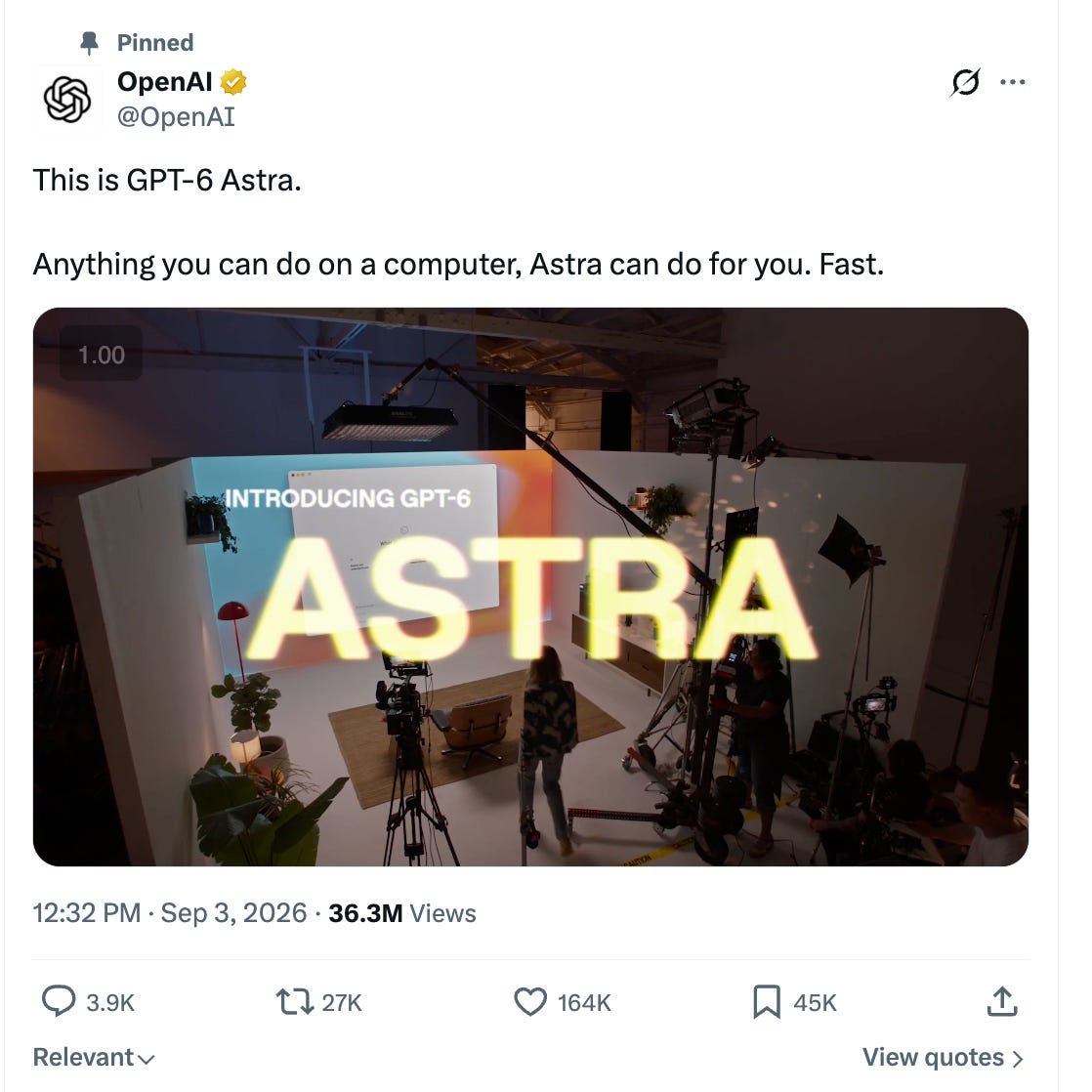
OpenAI launched GPT-6 Astra as its new flagship model, calling it "our most intelligent and aligned model yet." The rollout was bumpy, with delays and unclear access timing, leading the company to offer "banked resets" for paid users lacking access.
Why it matters
This launch marked the first time OpenAI outpaced Anthropic in launch popularity, with 36M views and 164K likes within 9 hours. Benchmark results were mixed: Astra tied Claude Opus 5 and Fable 5 on the Coding Agent Index (67) but scored 5 points lower than Fable 5.1 on intelligence (61), sparking debate over whether gains were uneven or a true step-change.
What to watch
Pricing is $10/$50 per 1M input/output tokens standard, and $20/$100 fast. Astra is rolling out first to limited organizations, then to Plus/Pro/Business/Enterprise, API, and AWS over coming days. Notable third-party results include 99.9% on ARC-AGI-3 with a provider harness and 46.7% on MirrorCode, between Opus 4.7 and Fable 5.
Summaries like this, every morning.
The launch of GPT-6 Astra comes amid intense rivalry with Anthropic, whose models Fable and Opus have recently set high bars. OpenAI's positioning emphasizes computer use, software engineering, math/science, and cybersecurity, but external evaluations tell a more nuanced story. For instance, Artificial Analysis reports Astra ties on coding but lags on intelligence, while ARC Prize highlights a breakthrough with a crucial harness caveat, noting performance jumps from 63% to 99% depending on the setup.
The mixed results have fueled skepticism about benchmark saturation and evaluation-awareness. Some researchers argue visible alignment gains may be "papering over" specific failure modes rather than solving underlying goal misalignment. The system card's discussion of decreased chain-of-thought monitorability adds to concerns, as does UK AISI's finding that Astra can operate without reasoning for far longer than predecessors, potentially evading monitoring.
Despite the debate, the launch's popularity marks a shift in public perception. OpenAI's success with 36M views in under a day suggests that, for the first time, it has matched or exceeded Anthropic's ability to generate excitement. The company's "banked resets" for delayed paid users indicate an attempt to manage expectations, while the staged rollout to organizations before broader access reflects a cautious approach to deployment. As benchmarks saturate quickly—ARC-AGI-4 is coming Q1 2027—the focus may shift from raw capability to cost efficiency and real-world utility, where Astra shows promise but not clear supremacy.
Pick your industry and the AI tools you use, and get news related to your work every day.
Free · 30 seconds with Google · unsubscribe anytimeWhat is AIToday? →
Ask AI anything about this article. The AI reads this article, earlier AIToday articles, and Wikipedia, and cites its sources. Q&As are published on this page for other readers too.
GE Vernova reports Q3 before the open on Oct

Eka Robotics said this week it raised $150 million in Series A funding, led by Andreessen Horowitz and F-Prime…

Block unveiled Dessa, which it says is the first AI model trained entirely on human speech with no text data…

Across five tasks and 18 Ollama calls, Muse Glimmer 30B's 352-character log and Qwen3 30B-A3B's 3,040-characte…

At Anthropic's "Machines of Loving Grace" exhibition and DevelopersIO 2026 TOKYO, Claude and Claude Code power…
A FitLog developer replaced repeated prompt warnings with a harness — a 48-line CLAUDE.md "map" linking six do…