What happened
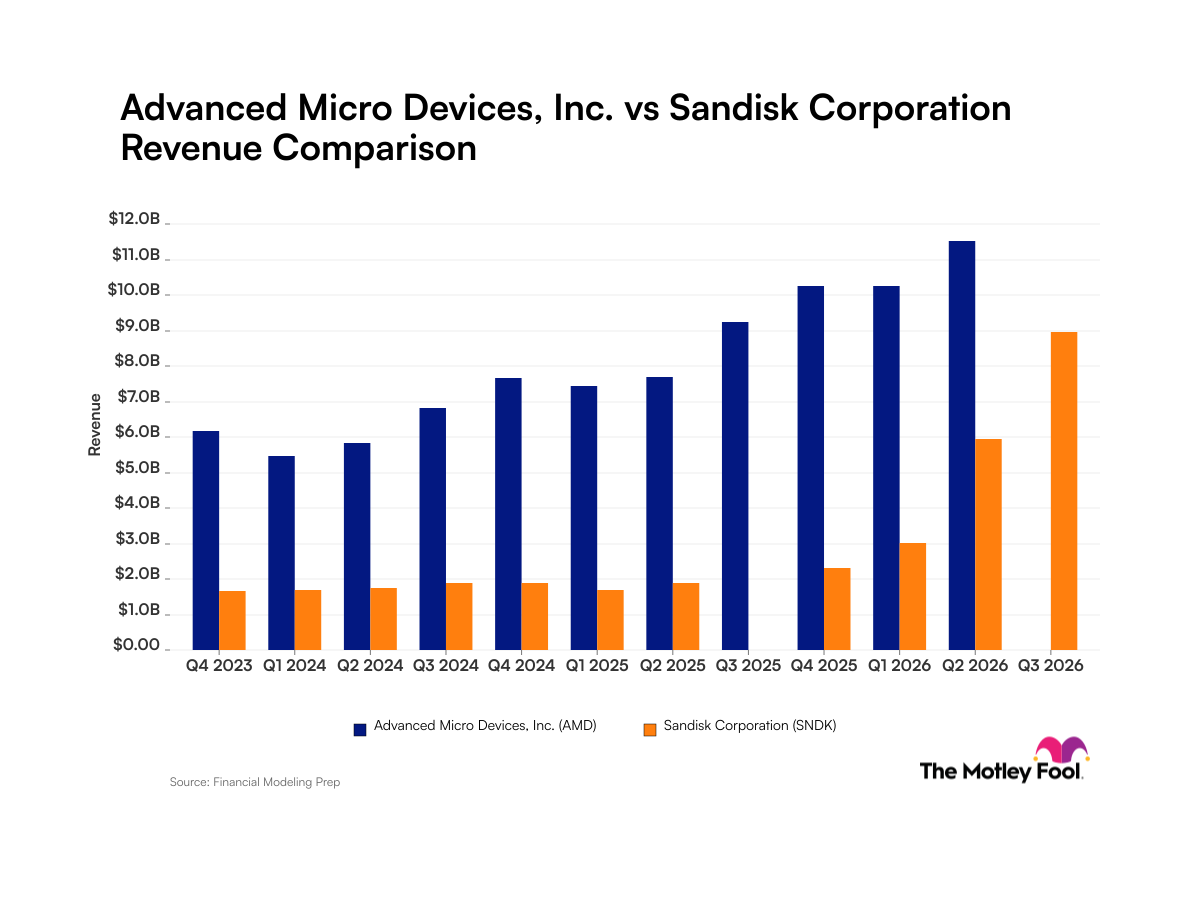
Advanced Micro Devices reported $11.5 billion in revenue for Q2 2026 (ended June), while SanDisk posted $9.0 billion for the same period (ended July). AMD's fiscal 2025 revenue exceeded $34 billion; SanDisk's 2025 revenue surpassed $20 billion. Both companies have logged sequential quarterly gains throughout 2025 and into 2026, driven by demand from AI data centers and cloud customers.
Why it matters
AI data centers are showing relentless demand for semiconductors and memory with no evident seasonality, allowing both chip and storage suppliers to raise prices and expand capacity. SanDisk's stock has gained 2,900% in its share price, vastly outpacing AMD's near-tripling over 12 months, reflecting investor confidence that AI-driven memory and processing demand will sustain this growth trajectory.
What to watch
Wall Street is projecting AMD will reach nearly $51 billion in annual sales for 2026. SanDisk's Q2 2026 revenue of $9.0 billion represents a dramatic jump from $2.3 billion in Q3 2025, signaling whether the company can sustain such steep gains or whether growth moderates in coming quarters.
Summaries like this, in your inbox every morning.
Both Advanced Micro Devices and SanDisk have benefited from the structural shift in semiconductor and storage demand driven by artificial-intelligence infrastructure buildout. AMD, once viewed as a second-tier imitator of Intel, has repositioned itself as a major supplier to AI data centers where demand appears insatiable and unaffected by traditional seasonal patterns. The company logged sequential revenue gains in every quarter of fiscal 2025, and Q2 2026 results ($11.5 billion) continue this upward trajectory, prompting Wall Street to forecast nearly $51 billion in 2026 full-year sales.
SanDisk's ascent is even more dramatic in percentage terms. The company had been a respected but niche player in flash memory for consumer devices such as digital cameras. The AI infrastructure boom has enabled SanDisk to pivot toward premium memory products for large customers—hyperscalers and cloud operators—while also commanding higher prices for standard memory products owing to supply constraints throughout the tech industry. The evidence is stark: SanDisk's Q2 2026 revenue of $9.0 billion represents a roughly fourfold jump from Q3 2025's $2.3 billion. This explosive top-line acceleration underpins the 2,900% stock-price gain that has far outpaced AMD's near-tripling return over 12 months, signaling investor confidence that both companies are riding a secular shift in capital allocation toward AI infrastructure.
For example, today's edition would include:
AI-summarized, only the topics you pick: one digest a day via Email, LINE, or Slack.
Free · 30 seconds with Google · unsubscribe anytimeWhat is AIToday? →
Ask AI anything about this article. The AI reads this article, earlier AIToday articles, and Wikipedia, and cites its sources. Q&As are published on this page for other readers too.
Bank of America announced Payments Insights, a new CashPro capability that analyzes payment efficiency, cross-…

AMD said Monday it agreed to acquire World Labs, Fei-Fei Li's San Francisco AI lab, for about $8.2 billion in…
Dell's AI server backlog rose to $95 billion after a record $60.9 billion in AI server orders in fiscal Q2, wi…
Nvidia released AI safety software, which it says could have stopped the Hugging Face hack

Cantor says Marvell's AI opportunity could expand to $625B by 2030, with revenue growing at up to a 45% CAGR

Meta is reportedly developing AI that could threaten Wells Fargo and other bank stocks, according to a Barchar…