What happened
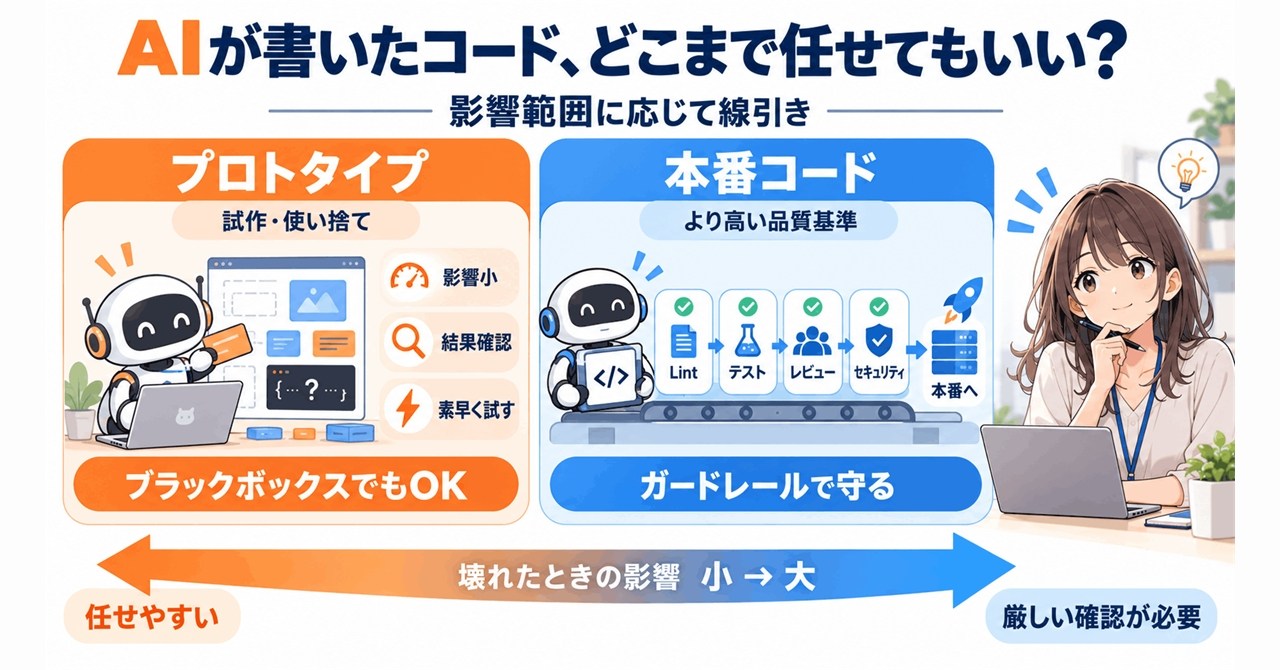
Claude Code's creator Boris Cherny answered a developer's question on September 11, 2026, saying throwaway prototype code can be treated as a black box, but production code should be held to a higher bar than human-written code.
Why it matters
It draws a practical line between prototype and production use, with Anthropic itself relying on Lint, E2E tests, fuzzers and code review — read as a quality bar developers are expected to hold, not lower.
What to watch
The approach hinges on tests and specs being trustworthy, since tests like expect(true).toBe(true) can pass without being meaningful; the writer suggests starting small with reliable tests and the latest specs.
WHO IT HITSDevelopers and engineering leads adopting AI coding tools are the ones affected, since they must decide per code purpose and risk how much of AI-generated code to actually read and review before shipping. Teams with weak test coverage or loose specs face the greatest exposure, based on the safeguards Cherny describes.
Summaries like this, in your inbox every morning.
The question Cherny answered came from a developer with 12 years of experience, who had been weighing two opposing views: that AI-written code should be fully checked by humans, and that code should be treated as a black box and judged only by its output. The developer's frustration was that generating code with AI is easy, but deciding whether a method the AI chose is appropriate for production takes time. Cherny's reply was that there is room for both.
What separates the two camps in Cherny's answer is purpose and risk, not a single rule. He points to Anthropic's own production setup, where Lint, E2E tests, fuzzers, code review, security review and documentation upkeep act as guardrails, and tells developers their job is to hold the bar on code quality. He also notes that as Claude's models get smarter, quality control mechanisms become easier to run.
The writers' own practice is presented as a small-scale case: for prototypes such as data analysis, he does not read AI-generated code in full, though he does not treat it as a complete black box either. He keeps a sense of what code is being written, and asks AI to redo work when execution feels off. His stated priority is not trusting tests blindly, since tests like expect(true).toBe(true) can pass without meaning anything. Whether the black-box approach holds up likely depends on how far teams extend trustworthy tests and written specs — the two starting points he suggests for small teams — as AI takes on more of the coding work.
For example, today's edition would include:
AI-summarized, only the topics you pick: one digest a day via Email, LINE, or Slack.
Free · 30 seconds with Google · unsubscribe anytimeWhat is AIToday? →
Ask AI anything about this article. The AI reads this article, earlier AIToday articles, and Wikipedia, and cites its sources. Q&As are published on this page for other readers too.
1Password CTO Nancy Wang said at Okta's Oktane event that agents need just-in-time, task-based access, and the…

Bhakti Pitre, ServiceNow's VP of AI platform security product, said at Okta's Oktane event that agent "kill sw…

Futurum's report, sponsored by QumulusAI Inc., finds agentic AI can drive token consumption per task 10 to 100…

ITR principal analyst Hiroaki Koumoto said Japanese firms' efforts in harness engineering are 'almost nonexist…

AMD agreed to an $8.2 billion all-stock buyout of World Labs, the San Francisco startup led by Dr

OpenAI's GPT-6 Sol and GPT-6 Luna are now in public preview on Snowflake Cortex AI, improving on their GPT-5.6…