What happened
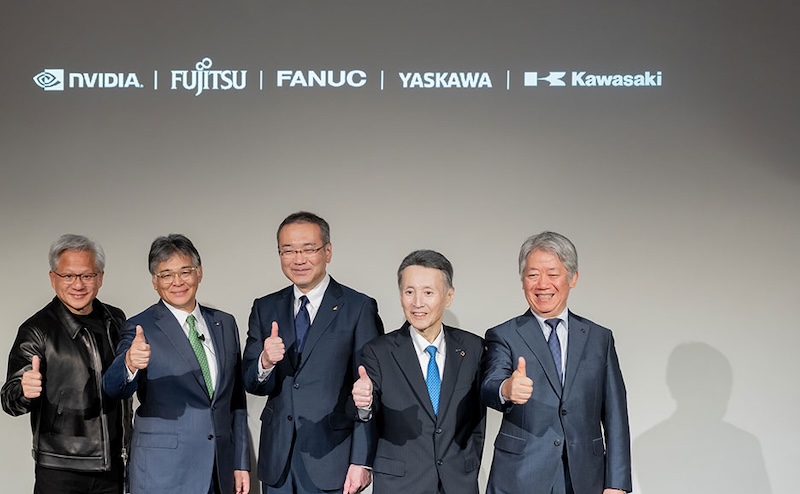
Fujitsu has begun collaboration with Japanese robotics makers Fanuc, Yaskawa Electric and Kawasaki Heavy Industries to develop and deploy physical AI—AI systems that control physical equipment—across manufacturing, logistics and healthcare. The partnership will use Nvidia's physical AI technologies, including Nvidia Cosmos foundation models, Nvidia Omniverse libraries, the Nvidia Isaac robotics platform and the Newton physics engine, to build a collaborative control platform that connects digital systems with robots and other equipment.
Why it matters
The initiative addresses Japan's labor shortages, aging workforce and global manufacturing competition by automating tasks in factories (production planning and factory adaptation), logistics and retail (material handling), and healthcare (pharmaceutical transport, patient reception). Fujitsu CEO Takahito Tokita framed the effort as creating "a new social infrastructure in which people and robots work collaboratively across a wide range of industries." The partners plan to develop an open, sovereign platform designed to work across different robots while meeting cybersecurity, operational resilience and data protection standards.
What to watch
The companies will now develop a roadmap for technology development and commercialization, with the longer-term goal of expanding physical AI deployment globally and strengthening Japan's position in the robotics industry. Specific use cases include optimizing production planning in manufacturing, automating material handling in logistics and retail by combining planning with real-time sales and inventory data, and automating pharmaceutical and specimen transport plus patient assistance in healthcare.
Summaries like this, in your inbox every morning.
Japan's robotics industry is seeking to apply artificial intelligence to physical systems—robots and factory equipment—as a way to offset demographic and competitive pressures. The collaboration between Fujitsu and three of Japan's leading robotics manufacturers reflects a recognition that physical AI requires both established robotics expertise and modern digital platforms. By incorporating Nvidia's full-stack technologies—from foundation models that simulate real-world behavior to the Isaac platform for robot control—the partners are building infrastructure intended to let different robots and systems work together seamlessly.
The stated motivations run deeper than efficiency: labor shortages and an aging workforce are concrete constraints on Japan's manufacturing sector, and physical AI offers a pathway to maintain productivity and global competitiveness. The emphasis on an "open, sovereign collaborative control platform" suggests the partners want to create a standard that can unify disparate equipment while protecting Japanese data and cybersecurity—a significant difference from relying on closed proprietary solutions. The roadmap development phase ahead will determine whether the vision translates into deployable products across the three targeted industries.
Pick your industry and the AI tools you use, and get news related to your work every day.
Free · 30 seconds with Google · unsubscribe anytimeWhat is AIToday? →
Ask AI anything about this article. The AI reads this article, earlier AIToday articles, and Wikipedia, and cites its sources. Q&As are published on this page for other readers too.
Vinci4D provides chip-design simulation software that trains on physics equations instead of customer data, an…

SEMI President and CEO Ajit Manocha told DIGITIMES that the semiconductor industry reached the US$1 trillion r…

CoreWeave fell more than 25% this week, its debt yield briefly rose above 16% on Thursday, and SK Hynix droppe…

Nvidia's AI Enterprise lists at $4,500 per GPU annually, and paid subscriptions add supported software, securi…

Anthropic told investors this week that it is making 85% gross margins, a figure the columnist calls a cash co…
Modal Labs, an AI infrastructure provider, raised $750 million in a Series D led by Accel at a $15.75 billion…