AIToday

Nvidia, Hugging Face expand LeRobot with open robotics AI tools

Robotics & Automation News2h ago
Nvidia, Hugging Face expand LeRobot with open robotics AI tools

Key takeaway

Nvidia and Hugging Face have integrated new AI models and development frameworks into LeRobot, an open-source robotics platform, to make robot development more accessible. The additions include Nvidia Isaac GR00T 1.7 (a vision-language-action foundation model for humanoid robots) and the Isaac Teleop framework, with planned support for Nvidia Cosmos 3. By combining the two companies' developer communities—more than three million robotics developers at Nvidia and 16 million AI developers at Hugging Face—the partnership aims to provide a standardized workflow for collecting data, training models, and deploying AI-powered robots.

Summaries like this, in your inbox every morning.

Sign up free →

3 Key Points

  • What happened

    Nvidia and Hugging Face integrated Nvidia Isaac GR00T 1.7 (a vision-language-action foundation model for humanoid robots) and the Nvidia Isaac Teleop framework into LeRobot, an open-source robotics library. Support for Nvidia Cosmos 3, a world foundation model for physical AI, is planned next.

  • Why it matters

    The integration gives robotics developers a standardized workflow for collecting data, training models, evaluating performance, and deploying AI-powered robots in the open—combining Nvidia's community of more than three million robotics developers with Hugging Face's 16 million AI developers. Thomas Wolf, cofounder and chief science officer at Hugging Face, said open source lets "a field turn advanced research into something people can study, adapt and build on."

  • What to watch

    Future integration of Nvidia Cosmos 3 will let developers generate synthetic robotics data and simulate environments when real-world data is unavailable or too costly to collect. The collaboration also supports Nvidia Jetson Thor on Hugging Face's Reachy 2 humanoid robot.

In Depth

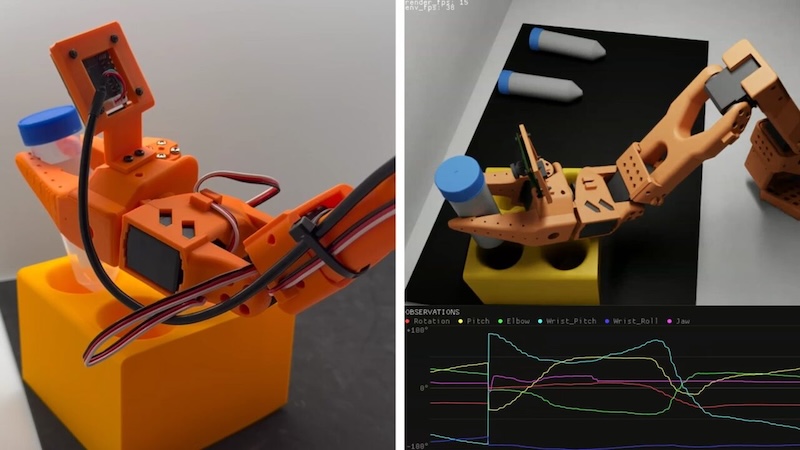
Nvidia and Hugging Face have announced an expanded partnership to accelerate robot development through open-source tools and models. The integration brings two key Nvidia technologies into LeRobot, Hugging Face's open-source robotics library for developing, training, and sharing robot datasets, models, and workflows.

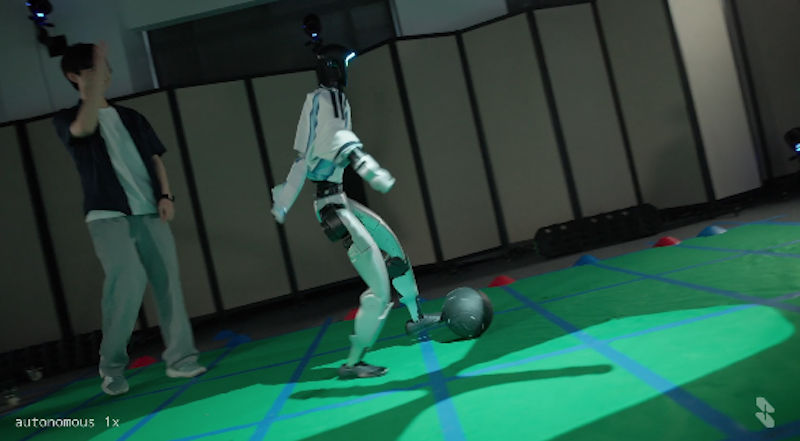
The centerpiece additions are Nvidia Isaac GR00T 1.7, an open vision-language-action (VLA) foundation model designed specifically for humanoid robots, and the Nvidia Isaac Teleop framework, which enables developers to collect human demonstrations from external devices using standardized formats. A third component—Nvidia Cosmos 3, a world foundation model for physical AI—is planned for future integration and will allow developers to generate synthetic robotics data, simulate environments, and develop robot policies when real-world data is unavailable or too costly to collect. Together, these tools provide a standardized workflow for the entire robot development cycle: collecting data, training models, evaluating performance, and deploying AI-powered systems.

Isaac GR00T 1.7 is designed to simplify the post-training and deployment of robot foundation models across different robot types and applications, removing barriers that have historically made robot customization labor-intensive. The expanded partnership builds on existing Nvidia resources already available through LeRobot, including open-source physical AI datasets containing more than 350,000 real and simulated robot trajectories and 57 million grasp samples, as well as simulation environments based on Nvidia Isaac Sim and Isaac Lab. Deployment support extends to Nvidia Jetson Thor running on Hugging Face's Reachy 2 humanoid robot, allowing developers to run vision-language-action models on open-source hardware platforms.

Thomas Wolf, cofounder and chief science officer at Hugging Face, framed the collaboration as a means of democratizing robotics research. "With Nvidia Isaac GR00T 1.7 and Isaac Teleop in LeRobot today, robotics developers can use shared models, data and workflows to train and evaluate robots in the open," he said, adding that "with Nvidia Cosmos 3 planned next, the community will have a path to bring frontier world models into that same collaborative loop." Nvidia estimates the partnership reaches more than three million robotics developers on its side, combining with Hugging Face's 16 million AI developers to form a significantly larger ecosystem for adoption of physical AI technologies.

Context & Analysis

Nvidia and Hugging Face are consolidating their respective developer ecosystems to accelerate adoption of physical AI—the application of AI models to real-world robotics tasks. LeRobot, Hugging Face's open-source robotics library, already provided a framework for developing and sharing robot datasets and models. By integrating Nvidia's foundation models and development frameworks, the partnership removes friction points in the robot development pipeline: data collection (via Isaac Teleop), model training and evaluation (via Isaac GR00T 1.7), and deployment (via Jetson Thor support on Reachy 2). The planned integration of Nvidia Cosmos 3, a world foundation model, will further extend this by allowing synthetic data generation and environment simulation—addressing one of robotics' most persistent challenges, the cost and difficulty of collecting diverse real-world training data.

The collaboration explicitly frames open source as the vehicle for translating research into accessible tools. Thomas Wolf emphasized that openness allows the field to "study, adapt and build on" advanced work. By combining Nvidia's three million robotics developers with Hugging Face's 16 million AI developers, the partnership broadens the addressable audience for physical AI and creates a shared ecosystem where models, datasets, and workflows can be reused across different robot types and applications.

FAQ

What specific tools were added to LeRobot?
Nvidia Isaac GR00T 1.7 (an open vision-language-action foundation model for humanoid robots) and the Nvidia Isaac Teleop framework are now integrated into LeRobot. Support for Nvidia Cosmos 3, a world foundation model for physical AI, is planned next.
What does the Isaac Teleop framework do?
The Isaac Teleop framework enables developers to collect human demonstrations from external devices using standardized formats.
What existing resources are already available through LeRobot?
LeRobot includes open-source physical AI datasets containing more than 350,000 real and simulated robot trajectories and 57 million grasp samples, as well as simulation environments based on Nvidia Isaac Sim and Isaac Lab.

Get the latest Robotics news every morning

AI-summarized, only the topics you pick — one digest a day via Email, Slack, or Discord.

Free · takes 30 seconds · unsubscribe anytime

Discussion

No comments yet. Be the first to share your thoughts!

Log in to join the discussion

Related Articles

Stay ahead with AI news

Get curated AI news from 200+ sources delivered daily to your inbox. Free to use.

Get Started Free

Free · takes 30 seconds · unsubscribe anytime

1 minute a day. The AI essentials.

200+ sources · Email / LINE / Slack

Get it free →