What happened
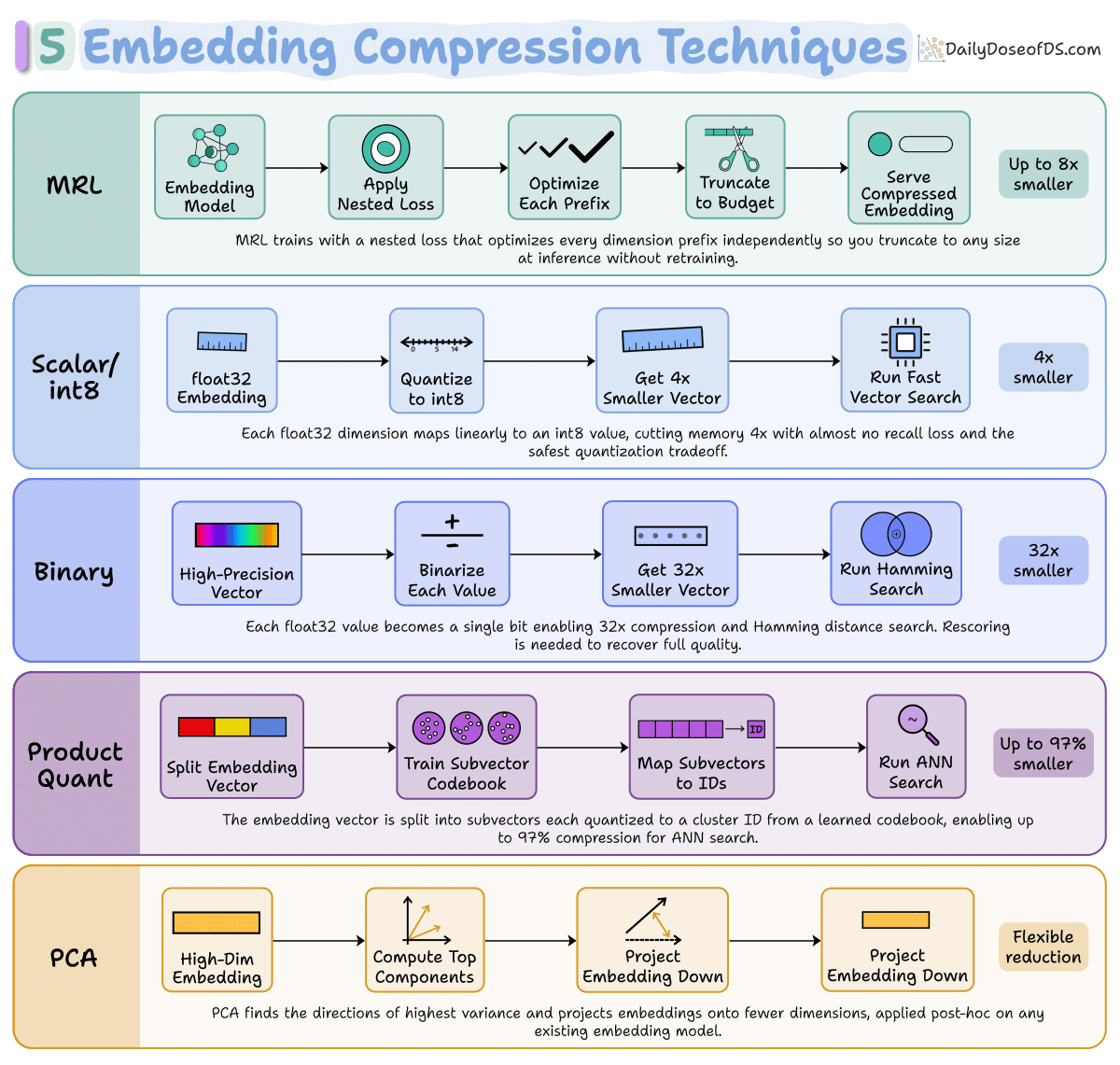
A technical guide explains five methods to compress embeddings (numeric representations of data used in AI search), including PCA, MRL, scalar/binary quantization, and product quantization. Ten million 1,536-dimensional embeddings occupy 62 GB in float32, 15 GB in int8, and 2 GB as packed bits.
Why it matters
These techniques reduce the memory and compute a retriever (a system that finds relevant items for a query) uses once an index holds millions of vectors. Compression works by reducing either the number of dimensions stored or the number of bits per dimension, or both.
What to watch
The test is whether the 2 GB packed-bit format remains usable for retrieval, since lower precision can hurt accuracy despite the memory savings. Watch whether OpenAI’s text-embedding-3-large at 256 dimensions keeps outperforming the 1,536-dimensional ada-002 on MTEB.
Summaries like this, in your inbox every morning.
The guide addresses a real bottleneck: storing millions of high-dimensional embeddings in memory is expensive. The example shows ten million 1,536-dimensional vectors consuming 62 GB in float32, which drops to 15 GB in int8 and 2 GB as packed bits. The actual overhead of an ANN index, metadata, and allocator adds to this.
The five techniques target different parts of the payload. PCA reduces dimensions post-training, while MRL trains the model so prefixes remain usable. Scalar and binary quantization cut bits per dimension, offering 4x and 32x reductions respectively. Product quantization replaces subvectors with centroid IDs.
A key caveat is that compressed representations don't have to produce the final ranking. Retrieving extra candidates and recomputing with higher precision is standard, especially with binary quantization, which loses magnitude information. The tradeoff between memory savings and retrieval quality remains central to production retrieval systems.
Pick your industry and the AI tools you use, and get news related to your work every day.
Free · 30 seconds with Google · unsubscribe anytimeWhat is AIToday? →
Ask AI anything about this article. The AI reads this article, earlier AIToday articles, and Wikipedia, and cites its sources. Q&As are published on this page for other readers too.
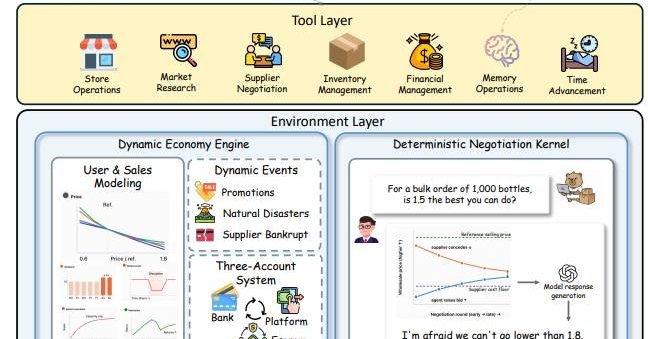
In a benchmark called E-Commerce Bench, 18 AI models ran up to four simulated shops for 365 days, using 18 too…
ITmedia's AI Plus released a 14-page booklet on using Gemini Notebook's (formerly NotebookLM) Studio feature…

IBM Research's ALTK-Evolve turns each customer-service agent trial into short action rules and injects them in…

A consultant who specializes in security recruiting says candidates should sign up for one of ChatGPT Plus or…
After six rounds of tuning TypeSafe AI's Jev for note selection, the author benchmarked it on 100 requests aga…
A Zenn author migrating a ten-year-old PHP/Laravel monolith — hundreds of endpoints and more than 600 shared m…

