
What happened
IBM Research's ALTK-Evolve turns each customer-service agent trial into short action rules and injects them into the next run's instructions without retraining. In retail tasks, average success rose from 78.1% to 82.5%, and four-consecutive-success from 57.5% to 67.5%.
Why it matters
Keeping rules broadly lifted averages in retail, but in the aviation tasks described, broad retention scored higher on average while the short-rule set did better on four-run consistency — so more memory does not automatically mean steadier operations.
Summaries like this, in your inbox every morning.
The ALTK-Evolve result sits inside a broader question running through this roundup: whether adding memory to an agent actually stabilizes work. The method keeps a closed loop — past trials become short rules, the rules become instructions, and the next trial evaluates those instructions — so the rules are hypotheses under test rather than fixed policy. That is why the retail numbers matter in two different ways. The average success rate moved from 78.1% to 82.5%, but the share of tasks that succeeded four times in a row moved from 57.5% to 67.5%, which speaks to repeatability rather than one-off wins.
The aviation comparison in the same study cuts against a simple "more rules is better" reading: broad retention gave a higher average, while a shorter rule set did better on four-run consistency. Combined with the note that rules can be traced back to how many training tasks produced them, the practical takeaway is that rule provenance may matter as much as rule volume. Sakana AI's QD-Rec, also covered here, keeps a different unit — pairs of candidates and the reasons for choosing them — and reports higher-rated, more diverse proposal sets than a baseline that writes reasons from scratch each time. The two are not the same mechanism, though both treat past output as raw material for the next attempt.
Elsewhere, the boundary-setting changes in Claude Code 2.1.305 and 2.1.304 read as operational guardrails rather than capability jumps: searching public Slack channels before Claude joins them, retrying without tool search when a connection refuses it, and adding an isReadOnly flag for tool checks. Alongside these, Anthropic's protein-binder work and OpenAI's low-resource-language evaluation both separate making an output from verifying it — 17 of 211 tested binders met binding criteria, with neutralization unconfirmed, and code generation was scored apart from preserving observable behavior in COBOL migration. That separation is the same discipline ALTK-Evolve's four-run metric is trying to bring to agent memory.
Pick your industry and the AI tools you use, and get news related to your work every day.
Free · 30 seconds with Google · unsubscribe anytimeWhat is AIToday? →
Ask AI anything about this article. The AI reads this article, earlier AIToday articles, and Wikipedia, and cites its sources. Q&As are published on this page for other readers too.
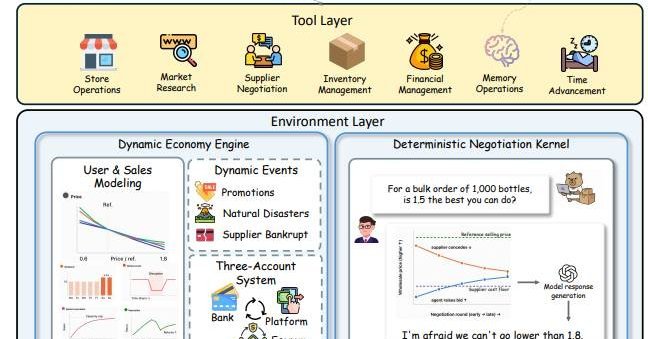
In a benchmark called E-Commerce Bench, 18 AI models ran up to four simulated shops for 365 days, using 18 too…
ITmedia's AI Plus released a 14-page booklet on using Gemini Notebook's (formerly NotebookLM) Studio feature…

Testing Pi 0.84.2 with claude-sonnet-4-5, a hook returning { block: true, reason } on rm produced a normal too…
A Zenn author migrating a ten-year-old PHP/Laravel monolith — hundreds of endpoints and more than 600 shared m…
After six rounds of tuning TypeSafe AI's Jev for note selection, the author benchmarked it on 100 requests aga…
A consultant who specializes in security recruiting says candidates should sign up for one of ChatGPT Plus or…

