What happened
In a Nikkei Money discussion, private investor Okeido said he sets his investing goal years out and basically never sells, keeping TSMC from 2018 even after a tenfold gain.
Why it matters
His approach suggests patient holders may capture long-term gains in AI and semiconductor shares, though he says sharp short-term drops should be expected.
What to watch
Whether the strategy holds hinges on picking companies with revenue pillars beyond semiconductors, such as Mitsubishi Heavy Industries, or dividend-focused names like Kaga Electronics.
WHO IT HITSIndividual investors planning long-horizon bets on AI and semiconductor stocks are the audience here; they get a concrete holding playbook and naming of specific companies from two practitioners.
Summaries like this, in your inbox every morning.
The discussion brings together two very different vantage points. Okeido is an individual investor who says he does not sell what he buys, while Shinagawa runs a semiconductor trading company in Kawasaki, so the two see the market from the buy side and the supply-chain side at once. That split shapes the whole conversation, which was recorded as the second instalment of a series on the growth potential of AI and semiconductors.
Their portfolios show how differently that patience is applied. Shinagawa put money into African e-commerce group Jumia roughly three years ago, when the shares were around 4 dollars; they rose to about 14 dollars at one point and now sit near 7 dollars, and he says he still expects a lot over the very long term. Okeido, in his 50s, prefers MercadoLibre, arguing it could deliver sufficient returns by the time he is in his 60s given each region's pace of economic growth. On the AI-using side, Okeido points to Salesforce, Snowflake and ServiceNow as top-tier names whose sales could rise as AI spreads.
What ties the two views together is a preference for companies that keep winning orders from around the world. Shinagawa cites TSMC's position as the manufacturer that receives the work regardless of which company designs the chip, and names Tokyo Electron, Lasertec, Advantest, Shin-Etsu Chemical and SUMCO as Japanese examples. Okeido adds a practical test for staying calm: whether a stock has several pillars holding up its price. Whether that framing holds up likely depends on how far the next wave of demand actually runs.
For example, today's edition would include:
AI-summarized, only the topics you pick: one digest a day via Email, LINE, or Slack.
Free · 30 seconds with Google · unsubscribe anytimeWhat is AIToday? →
Ask AI anything about this article. The AI reads this article, earlier AIToday articles, and Wikipedia, and cites its sources. Q&As are published on this page for other readers too.
Anthropic launched Claude Sonnet 5.5, a mid-tier model for everyday tasks, priced at $2 per million input toke…

NEAR, the token of the NEAR Protocol, has more than doubled in value over the past two weeks, helped by surgin…
Michael Burry wrote in a Substack chat that Trump's team knows the AI buildout is 'the only thing keeping this…

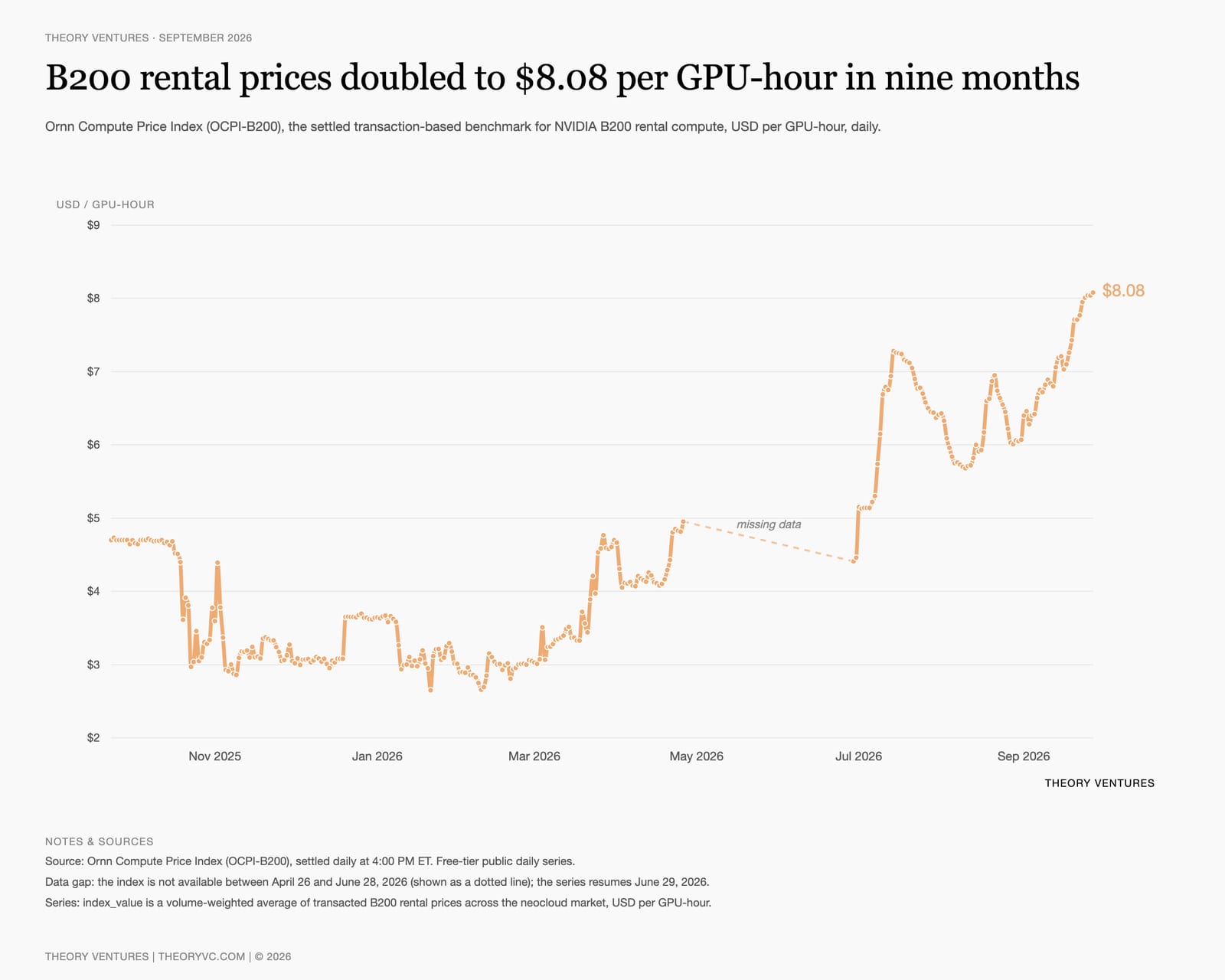
GPU rental prices doubled in six months, from $4.40 to $8.08 per GPU-hour, even as Claude Opus 5.5 costs 40% l…
Anthropic released Claude Sonnet 5.5, which it says runs output more than 30 percent faster and costs up to 30…

The University of Florida found only 10-15% of its data was semantically defined; using NaviGator AI and Snowf…