What happened
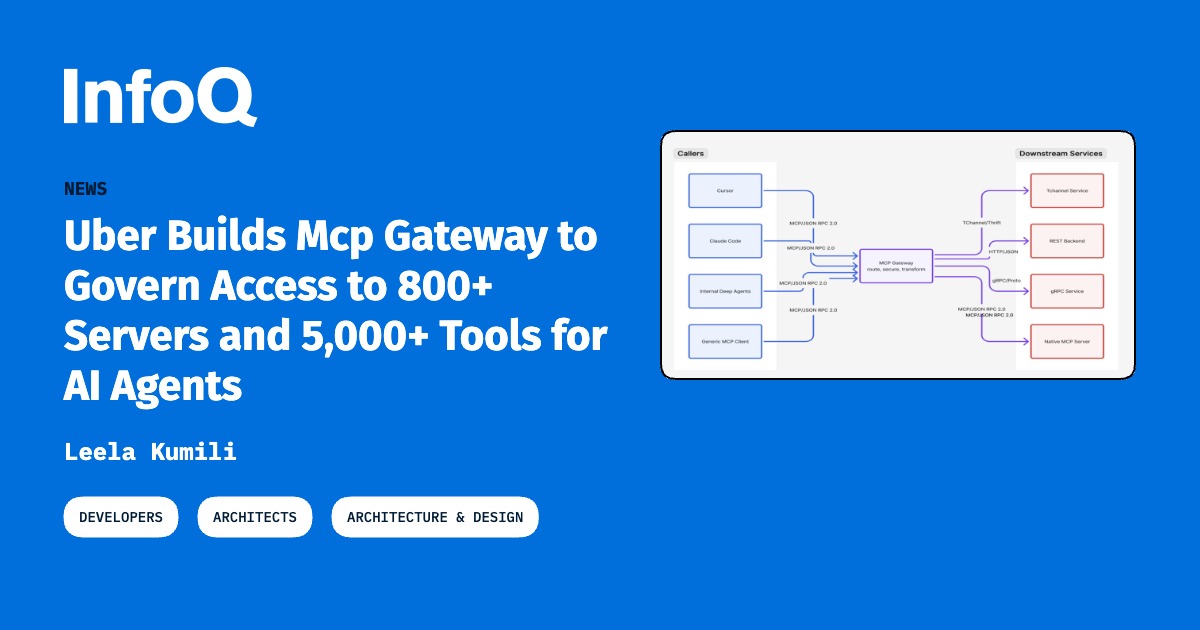
Uber built an MCP Gateway supporting more than 800 MCP servers and 5,000 tools, separating an MCP Registry control plane from a Proxy Gateway that translates requests into HTTP, gRPC, or TChannel calls.
Why it matters
The setup exposes existing services as agent tools without changing the underlying services, aiming to reduce fragmented integrations and inconsistent security practices as agent adoption expands across the company.
WHO IT HITSEnterprise platform and security teams running internal AI agents are the most direct audience here, since the design addresses discovery, authorization, and PII redaction (removing personal data) across a large tool catalog.
Summaries like this, every morning.
Uber's gateway arrives as agent adoption spreads across the company, and the stated problem is a familiar one at scale: fragmented integrations, duplicated infrastructure, and inconsistent security practices. The architecture treats MCP less as a new protocol and more as another surface to govern, splitting control from execution so that tool definitions, schemas, ownership, and enablement settings live in a registry while a proxy handles runtime translation into HTTP, gRPC, or TChannel calls.
The discovery layer is where much of the operational detail sits. AutoCrawler scans internal interface definition language registries and extracts API definitions from Protocol Buffers and Thrift schemas, then generates MCP-compatible schemas and uses a large language model to produce tool descriptions. Newly found tools stay disabled until their owning teams review and enable them, and configuration changes reach the data plane without service restarts or redeployments.
As the catalog grows, loading thousands of tool definitions into an agent's context becomes inefficient. Uber's Omni MCP supports incremental discovery, and Response Projection lets agents request specific response fields rather than complete payloads. Outside observers quoted in the coverage, including Ajay Sharma of Microsoft CoreAI and Kelly Goetsch of Pipe17, compared the design to established API gateway patterns, suggesting the governance questions around agent tools may resemble those teams already know from APIs and GraphQL.
Pick your industry and the AI tools you use, and get news related to your work every day.
Free · 30 seconds with Google · unsubscribe anytimeWhat is AIToday? →
Ask AI anything about this article. The AI reads this article, earlier AIToday articles, and Wikipedia, and cites its sources. Q&As are published on this page for other readers too.
At Expedition 2026, Snowflake unveiled a Business Ontology framework that gives organizations shared approved…

GitHub announced Copilot Code Review Max at GitHub Universe 2026, adding a new 'Max' effort level alongside 'L…
A San Francisco federal judge blocked Perplexity's Comet browser from ordering on Amazon; on Aug
Japan's Internal Affairs and Communications Ministry and the Ministry of Economy, Trade and Industry published…

A preprint led by Renmin University of China describes CoworkOS, an agent harness its authors call "highly com…

Pew Research found 8 percent of US adults used AI chatbots for midterm candidate and policy information, while…