What happened
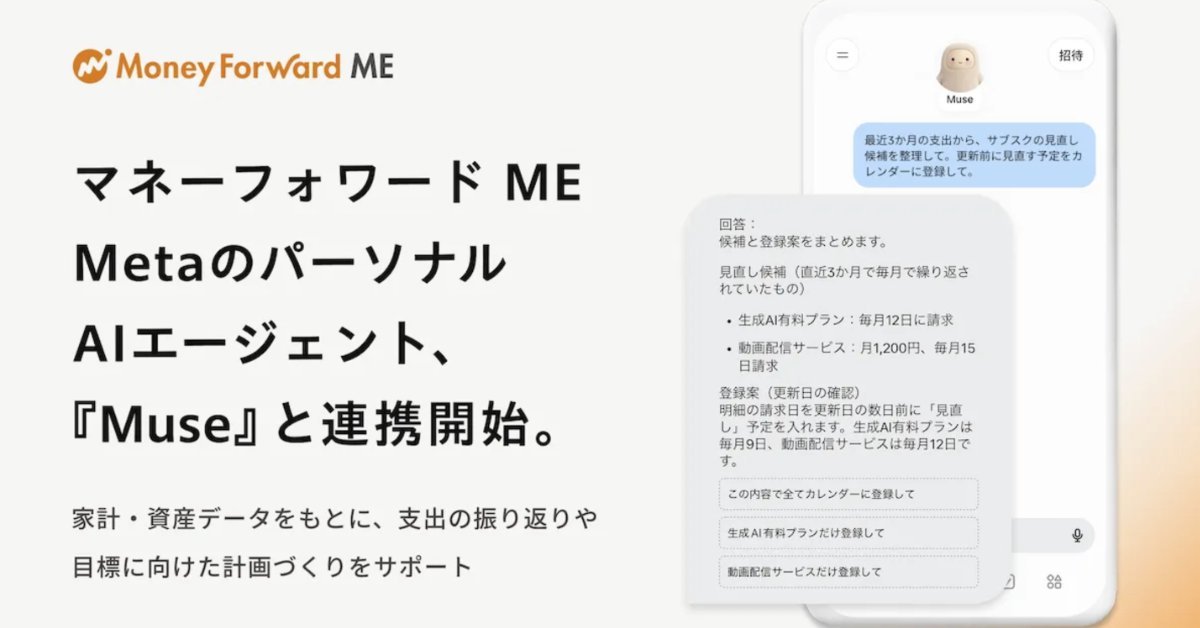
Money Forward ME began providing user-authorized household and asset data to Meta's Muse on October 26, using the MCP standard; ChatGPT access came earlier, and no money currently changes hands between the two companies.
Why it matters
The link lets an autonomous agent like Muse see account balances and transaction histories without the user exporting CSV files or screenshots, so financial advice can be grounded in real data.
WHO IT HITSThis affects individual budgeting-app users who want AI assistants to read their account data, and the SaaS providers deciding whether to open their data to outside AI agents.
Summaries like this, every morning.
Money Forward ME's decision to open its data to outside AI agents follows a broader debate in the SaaS industry. After Microsoft CEO Satya Nadella said at the end of 2024 that conventional business apps would not survive if AI agents became mainstream, software stocks fell more than 20% by early February 2026, and Money Forward shares were sold off too. That episode pushed SaaS companies to ask what remains uniquely valuable when AI can act on its own. One answer is data: holding user data can be a competitive advantage, and pairing it with outside AI is seen as a survival path.
The mechanics are deliberately simple. Money Forward uses MCP, the same standard it used for ChatGPT, and says it is not developing separate features for each AI; the data handed over is identical. That means adding future partners should produce the same output in the same way. Money Forward has not opened its MCP connector to anyone, citing the risk that a lookalike site could be built and leak data. On the AI side, Meta describes controls that let users choose which services Muse connects to and what it can read, and a protection system called Sentinel that watches outbound communications and asks for confirmation before sensitive data is sent. Meta also says Muse conversation data and data in its Muse Secure VM are not shared with its advertising system or used for ad personalization, though it acknowledges that actions like visiting shopping sites on a user's behalf could indirectly influence ads shown. Responsibility and compensation for data leaks or malfunctions are still being confirmed internally at Meta.
Pick your industry and the AI tools you use, and get news related to your work every day.
Free · 30 seconds with Google · unsubscribe anytimeWhat is AIToday? →
Ask AI anything about this article. The AI reads this article, earlier AIToday articles, and Wikipedia, and cites its sources. Q&As are published on this page for other readers too.
Cloudera unveiled a Digital Sovereignty solution combining Cloudera Anywhere Cloud, Open Data Lakehouse, Unifi…

Neura Robotics, the Government of Aragón and Costa Group signed a memorandum of understanding to build Neura G…
Muse, an AI agent, had three local LLMs and Claude Haiku read Chapter 1 of "I Am a Cat" (11,612 characters) an…

On Artificial Analysis' v5.0.1 index, Gemini 4 Neon scored 61, ahead of Claude Opus 5.5 (59), GPT-6 Astra (57)…

Google set February 1, 2027 as when AI agents touching Workspace must go through official MCP servers or Googl…

Taiwan's Directorate-General of Budget, Accounting and Statistics raised its 2026 GDP growth forecast to 13.28…