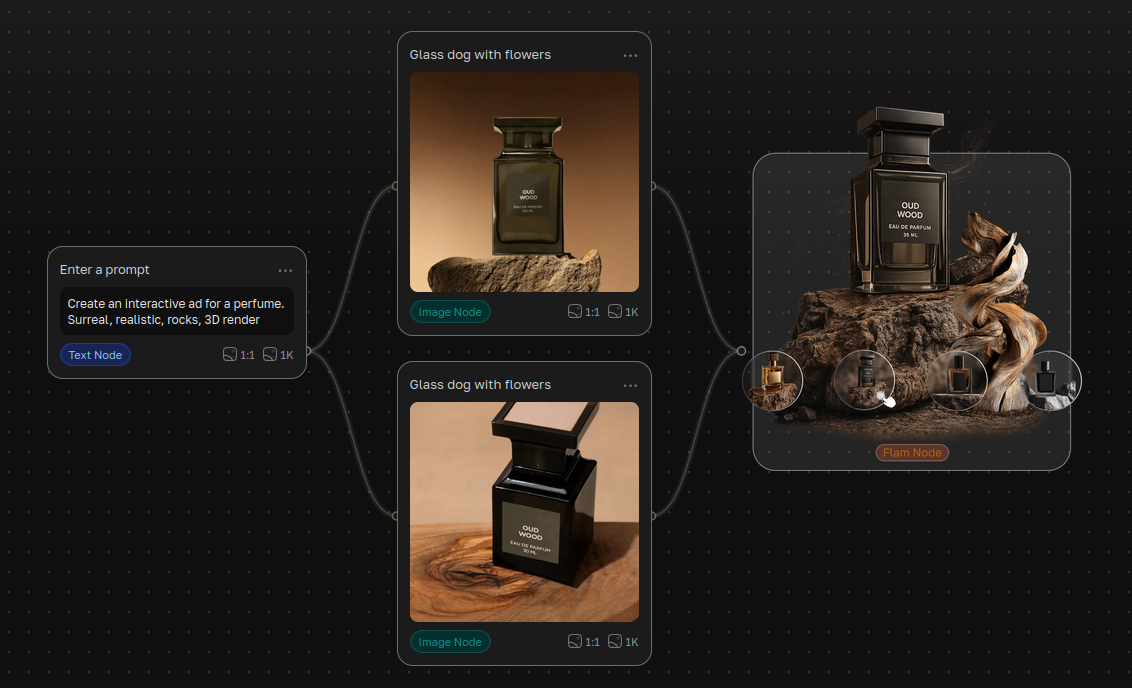
What happened
Flam announced a $40 million Series B led by QED Investors, with Claypond Capital, Australian Gulf Capital, the SRK Family Office and angel investors Martin Chavez and Olivier Pomel participating. Existing backers RTP Global and Dovetail also joined.
Why it matters
The startup says it signed more than 100 enterprise customers including Google in the last year-and-a-half, while operating in stealth mode, and claims to be fast approaching $100 million in annual recurring revenue, a target it hopes to reach next year.
What to watch
QED Investors Managing Partner Nigel Morris said past interactive content startups failed to scale, so the test is whether Flam's enterprise traction holds. Watch the $100 million ARR target, which the company hopes to reach next year.
WHO IT HITSEnterprise marketing and content teams evaluating interactive video and 3D experiences are the likely buyers, since Flam says its platform is deployable without an engineering lift.
Ask the AI about this article →
Summaries like this, in your inbox every morning.
Flam's founder and CEO Shourya Agarwal says he started the company after observing that digital content has evolved in waves — from text to images to video — but each wave produced media that flows only one way, from creators to viewers. He believes demand for interactivity has always existed, but creators lacked a way to deliver it. That gap is what the company is targeting with an infrastructure stack it says is backed by more than 15 patents.
The platform's three formats are Flicks (AI-generated interactive videos), Airboards (high-fidelity 3D content streamed to devices and camera interfaces, generated via text and image prompts using Flam's Fable model), and Visual Agents (hyper-realistic avatars for real-time conversations). The Visual Agents rely on an identity-preservation and motion-transfer model called Fantom alongside a 26 billion-parameter mixture-of-experts model called Falcon, which the company says delivers 30 millisecond time-to-first-token inference speeds.
What stands out is the tension between Flam's stated stealth mode and its commercial traction: more than 100 enterprise customers including Google, and a claim of fast approaching $100 million in annual recurring revenue, a target it hopes to reach next year. QED Investors Managing Partner Nigel Morris said the pattern for prior interactive-content attempts was "compelling demos that never scale," and that Flam's differentiated AI infrastructure, enterprise deployability without an engineering lift, and commercial traction convinced QED. Whether those customer relationships and the ARR target hold up now that Flam is publicly fundraising — rather than the technology itself — is likely to be the measure investors and enterprise buyers watch.
For example, today's edition would include:
AI-summarized, only the topics you pick — one digest a day via Email, Slack, or Discord.
Free · 30 seconds with Google · unsubscribe anytimeWhat is AIToday? →
Ask AI anything about this article. Q&As are published on this page for other readers too.
Meta announced on Sept. 15 the global rollout of Meta One, a subscription combining premium features across it…
Anthropic's second-quarter revenue was above $11.5 billion, up from $4.73 billion in the first quarter and $78…

ECB President Christine Lagarde said eurozone households hold around €440 billion in US tech companies includi…

Capgemini CEO Aiman Ezzat told Fortune that leaders should run small AI tests and pilots, not big-bang bets, b…
Anthropic said on Sept. 16 it will open a Singapore office in October, its first in Southeast Asia and fifth A…
SAP CEO Christian Klein says voice recognition in large language models is strong, and SAP predicts typing dat…