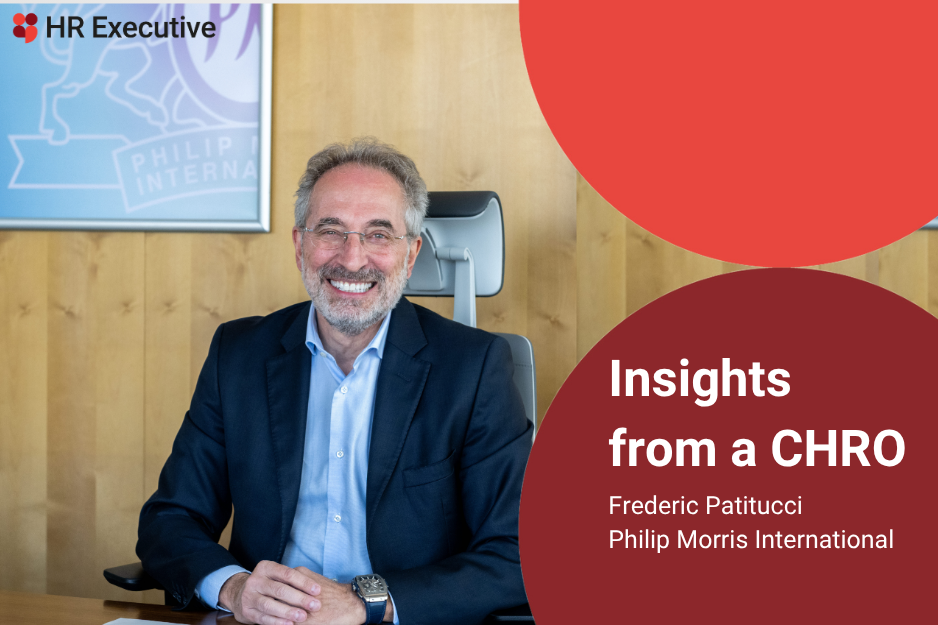
Philip Morris International's chief people officer says successful AI adoption depends on embedding the right culture and learning mindset first—not just deploying the technology.
Over the past three years, PMI has run companywide initiatives to establish three core values (collaboration, game-changing, care) and foster a growth mindset across its 80,000+ employees, rejecting the temptation to chase quick efficiency gains in favor of sustainable, long-term business impact.
What happened
Philip Morris International's chief people and culture officer Fredric Patitucci has spent the past three years embedding a new cultural framework—called PMI DNA, centered on collaboration, game-changing, and care—across the company's 80,000+ employees to prepare the organization for AI integration. The effort included a 350-person workshop to define values for the smoke-free era, followed by annual roadshows introducing the culture shift and, most recently, a focus on growth mindset.
Why it matters
Patitucci argues that AI adoption is fundamentally a mindset and leadership challenge, not a technology one—and that lasting transformation requires culture and learning appetite to align before workflows change. He points out that many leaders still operate within functional silos rather than taking an organization-wide view, a gap that HR must address by pushing the company perspective across departments.
What to watch
PMI is deliberately resisting the pressure to chase immediate efficiency gains from AI, instead taking a five- to ten-year view of business impact. Patitucci acknowledged the company is not yet seeing measurable efficiency improvements, but argues that organizations betting only on speed will "go faster, but not farther."
Fredric Patitucci, a 35-year veteran of Philip Morris International, has been the company's group chief people and culture officer for about three years. He came into the role at a moment of transition: PMI had already spent years shifting its product portfolio toward smoke-free alternatives, with smoke-free products growing from zero net revenue to more than 40% today. The business transformation was well underway, but Patitucci recognized that the company's culture had not evolved at the same pace.
To close that gap, he brought together 350 people across PMI's global workforce to collectively define what the company's culture should stand for in the smoke-free era. That effort yielded the PMI DNA—three core values: "We're better together. We're game-changers. We care." The shift was deliberate: moving from a "very security driven" mentality to one suited for smoke-free product alternatives. Patitucci emphasizes that the emphasis on collaboration built into these values became essential as the company began preparing for AI integration. "AI is not really a tech play—it's a mindset play, a leadership play," he says.
Following the initial culture-setting workshop, Patitucci's team staged a global roadshow two years ago to introduce employees to the PMI DNA. Last year's roadshow focused on developing a growth mindset—another capability Patitucci sees as critical for AI adoption. This year's roadshow again centered on that growth mindset. Together, these cultural initiatives laid groundwork for what Patitucci calls the "sustainable way" AI adoption needs to land in an organization: a combination of culture, learning mindset, and workflow redefinition.
However, Patitucci observes that many leaders remain trapped in functional silos, still looking primarily at their own department's metrics and priorities. For AI to work across an enterprise—particularly one as complex as PMI, with 80,000+ employees spread across diverse geographies, job categories, and functions—organizations must adopt a broader lens. He argues that HR should take the lead in pushing leaders to "take the company perspective and try to disassociate yourself from your own stream." Only from that bird's-eye view can organizations identify where AI will have the most impact and redesign workflows responsibly.
Critically, PMI is not chasing immediate efficiency gains. Patitucci acknowledged that the company is not yet seeing measurable efficiency improvements from its AI work, and he openly questions whether organizations betting primarily on short-term speed will succeed. "I don't think that the companies that are betting on efficiency gains will go far. They may go faster, but not farther," he says. Instead, PMI is taking a longer strategic view, evaluating consequences five and ten years out. That deliberate restraint—remaining "calm but determined"—reflects a conviction that sustainable AI transformation requires cultural alignment first, and that the rush to efficiency can undermine the leadership, collaboration, and learning mindset on which lasting change depends.
PMI's approach reflects a deliberate inversion of how many organizations pursue AI: rather than deploying AI tools first and hoping culture catches up, Patitucci positioned culture and mindset as the foundation. This strategy emerged from PMI's decade-long transition from traditional tobacco to smoke-free products, during which the organization shifted from a security-driven posture to an innovation-focused one. By 2021, when Patitucci took the CHRO role, that smoke-free transformation was already years underway, but the cultural evolution had lagged. The 350-person workshop to codify PMI DNA was the turning point—it reframed the company's identity around collaboration and growth rather than hierarchy and stability, creating a readiness for the rapid change AI would bring.
Patitucci's insistence that AI is "a mindset play, a leadership play" rather than a technology play suggests he views the real risk not as insufficient tooling but as organizational fragmentation. His observation that "people still are looking at their own functional vertical" touches on a common failure mode: departments adopt AI in isolation, optimize local workflows, and miss cross-functional dependencies and long-term consequences. By positioning HR as the steward of a company-wide perspective—asking leaders to step out of their streams and see end-to-end processes—he is arguing that culture work and process redesign must run in parallel, and that both require patience. The explicit rejection of "faster, not farther" is a hedge against chasing efficiency metrics that feel good in quarterly reports but create technical debt or organizational misalignment over years.
AI-summarized, only the topics you pick — one digest a day via Email, Slack, or Discord.
Free · takes 30 seconds · unsubscribe anytime
The TAIONE Open Source Foundation was officially launched and will deploy NT$300 million(約480億円) in private-se…
China Steel Corporation affiliate CSCC has developed 6N high-purity isotropic graphite blocks for 8-inch and 1…
The 2026 World Artificial Intelligence Conference (WAIC) revealed that the automotive industry is moving away…

Central Taiwan Science Park's Erlin Park will begin operations of its first standard factory building in the s…
Hitachi announced the Agentic AI Integration Platform, which applies AI agents across the entire systems integ…
Amazon reported second-quarter net sales up 20%, with AWS cloud revenue rising 37% year over year to $42 billi…
The AI news that matters, in one minute each morning.
Sign up free