What happened
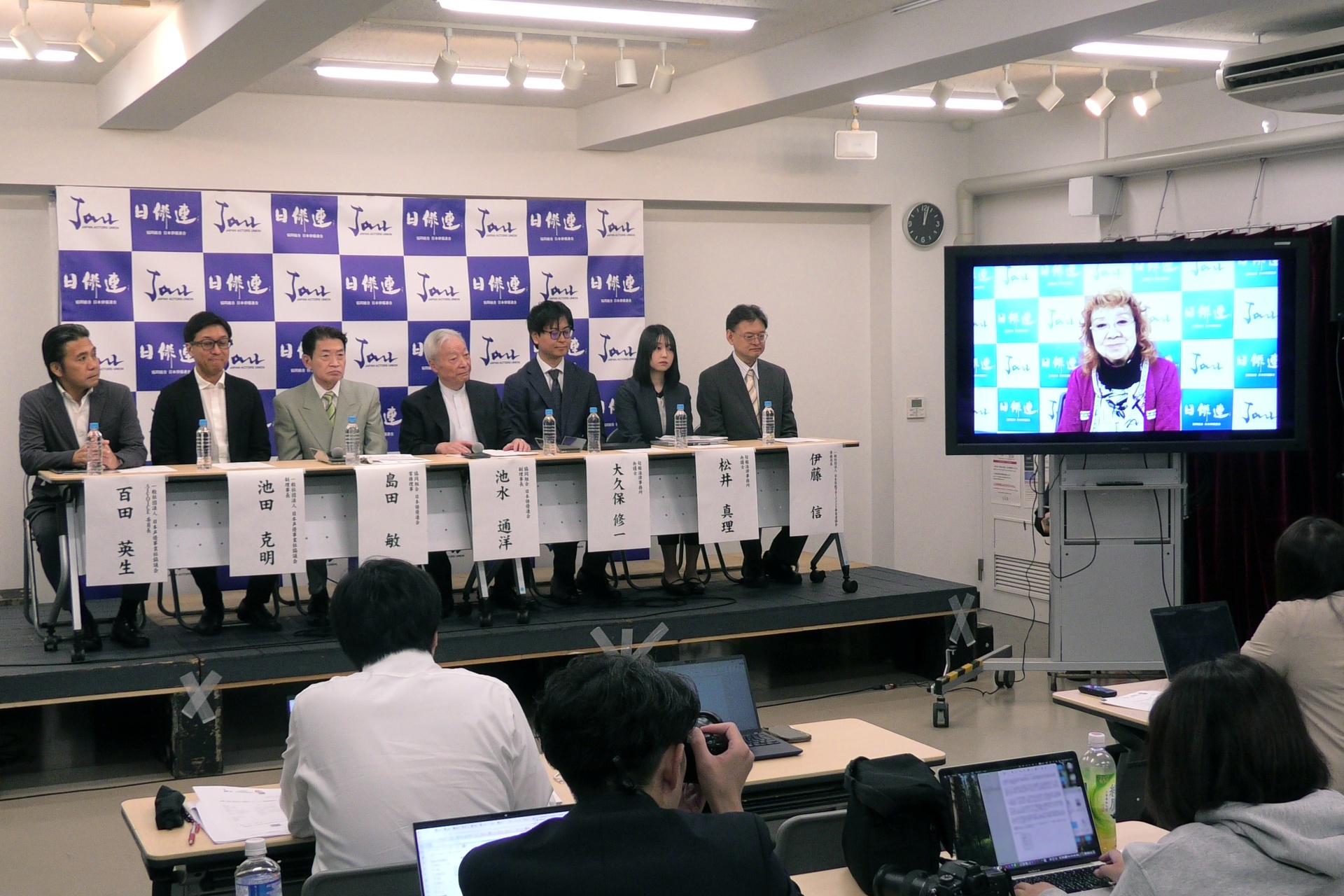
ELYZA announced ELYZA RSI Research at a Tokyo press conference on October 2, 2026, and also showed ELYZA Voice Agent and physical AI work. It said LLM accuracy on simple tasks plateaued in 2024.
Why it matters
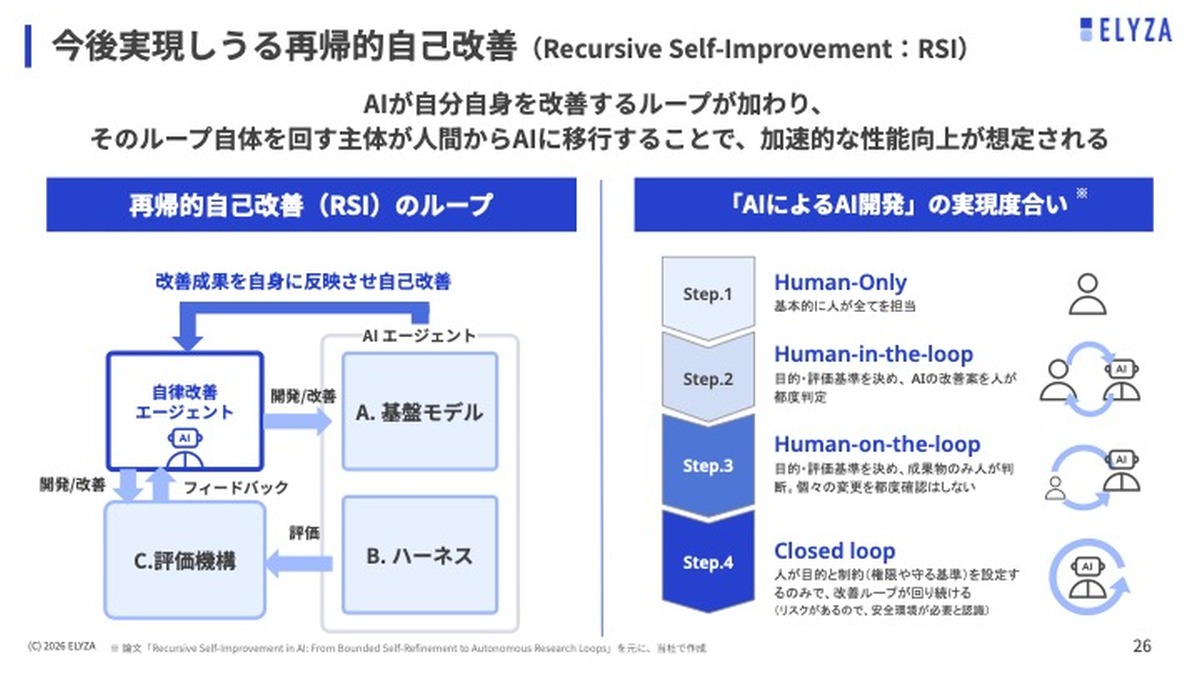
RSI would move the improvement loop from humans to AI itself, which ELYZA expects to speed gains further. It is framed as a research push, not a shipped product, so the practical payoff looks years out.
What to watch
ELYZA argues Japan should pursue RSI research alongside full-scratch sovereign AI, but government regulation or frontier labs slowing down could limit public access to frontier models. Watch whether those slowdown talks change the timeline.
WHO IT HITSThis lands on Japanese enterprises and public-sector buyers weighing domestic AI options, and on policy officials shaping AI rules, since ELYZA is pitching RSI research as a national capability question. Researchers and engineers working on agent infrastructure may also see a new domestic venue for that work.
Summaries like this, in your inbox every morning.
ELYZA's pitch rests on a shift it says has already happened in AI research. By its account, LLMs hit an accuracy ceiling on simple tasks back in 2024, and the frontier has since moved to "AI for Science" — using AI for drug discovery, materials and mathematics — and to "Long Horizon" tasks that span multiple steps a person would need hours or days to finish. Benchmarks have followed, with advanced reasoning, mathematical proof, coding, task completion and reliability now the main talking points.
The company points to concrete progress behind that shift. On September 3, 2026, OpenAI released GPT-6 Astra, which it says markedly improved "Computer Use" — the ability to operate a PC across multiple steps. Chinese firms, meanwhile, are pushing ahead with developing and open-sourcing foundation models, which ELYZA describes as arriving with roughly a two-month lag. Against that backdrop, ELYZA says AI-driven AI development has been accelerating since early 2026, and RSI is what comes next.
Soneoka also framed agent development as more than a foundation-model problem, saying harnesses — the surrounding systems that handle complex processing — and evaluation mechanisms matter just as much, and that humans still build and tune both today. That gap is where the stakes sit: whether self-improvement arrives on ELYZA's timeline hinges on how fast those human-built pieces can be automated, and on whether regulation or frontier-lab caution keeps the resulting models out of general public use.
Pick your industry and the AI tools you use, and get news related to your work every day.
Free · 30 seconds with Google · unsubscribe anytimeWhat is AIToday? →
Ask AI anything about this article. The AI reads this article, earlier AIToday articles, and Wikipedia, and cites its sources. Q&As are published on this page for other readers too.
ElevenLabs completed a $300 million employee tender at a $22 billion valuation, and co-founder Mati Staniszews…

Nichiren announced its generative AI voice usage guideline on October 15, built on three pillars: prior notice…
A walkthrough shows Irodori-TTS, an open Japanese-only TTS model by Aratako, running on Databricks Model Servi…
A solo developer built Yurune, a web app that plays synthesized rain, wave and forest sounds and lets users ta…

The developer benchmarked Moonshine Voice's Japanese "Small Streaming" model against faster-whisper's small mo…

The Japan Actors Union adopted a generative AI guideline for voice on October 15, requiring prior consent from…