What happened
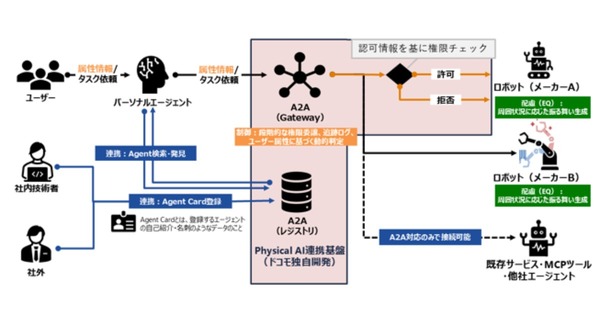
NTT Docomo announced on Oct 27, 2026 that it developed a Physical AI Coordination Platform linking personal AI agents to multiple robots via the A2A protocol, with its own permission control, action-history tracking and context-aware behavior generation.
Why it matters
The platform automatically blocks disallowed robot actions before execution by checking a user's age and other attributes against venue-specific rules, and it avoids actions that make people uneasy—Docomo says such safeguards are needed before robots and AI agents can share human spaces.
What to watch
A demonstration of the platform is scheduled at NTT R&D FORUM 2026, held Nov 18–20 and Nov 24–25, 2026, at the NTT Musashino R&D Center.
WHO IT HITSRobot makers and food-service operators exploring service robots are the near-term audiences, since Docomo plans joint research with robot manufacturers and trials with various businesses. Consumers interacting with robots via a personal agent would be the end users the permission checks are designed to protect.
Summaries like this, every morning.
Docomo frames the problem as three gaps: robots each use different connection methods, there is no mechanism to judge and stop actions a user or setting should not allow, and robot motion can make people anxious or uncomfortable. The platform answers these by standardizing the connection on the existing A2A protocol and adding three functions Docomo developed itself—permission control, action-history tracking, and behavior generation tuned to surrounding conditions. Notably, user attribute data stays inside the platform, and only motion instructions are sent to the robot.
The company positions this as groundwork for robots that act automatically and appropriately for the person and situation. Its stated next steps—internal rollout, joint research with robot manufacturers, and trials with businesses—suggest the announcement is a first step toward validating real-world use rather than a product launch.
Pick your industry and the AI tools you use, and get news related to your work every day.
Free · 30 seconds with Google · unsubscribe anytimeWhat is AIToday? →
Ask AI anything about this article. The AI reads this article, earlier AIToday articles, and Wikipedia, and cites its sources. Q&As are published on this page for other readers too.
Gomumari will start offering its Master Data Management AI Agent on November 2, 2026, at an initial build cost…

Apple outlined plans to charge for heavier use of certain Apple Intelligence features from 2027, with usage ca…
Google said a satellite running its TPU processor received a response from the open model Gemma 4 after a grou…
A Dell Technologies survey of 2,950 business and IT decision-makers in 35 countries found 58% of Japanese comp…
CData's guide walks through creating a SELECT-only Snowflake role called claude_role, setting up an OAuth secu…
Oracle announced on Oct 28, 2026 an expanded partnership with OpenAI and a new product lineup spanning four ar…