What happened
NVIDIA announced cuPotential, a new CUDA-X library for AI agents that simulate atomic and molecular interactions. Tests showed a further 2–3× speedup for already GPU-optimized workflows, and using NanoVDB hit a 30× speedup in a Lam Research simulation.
Why it matters
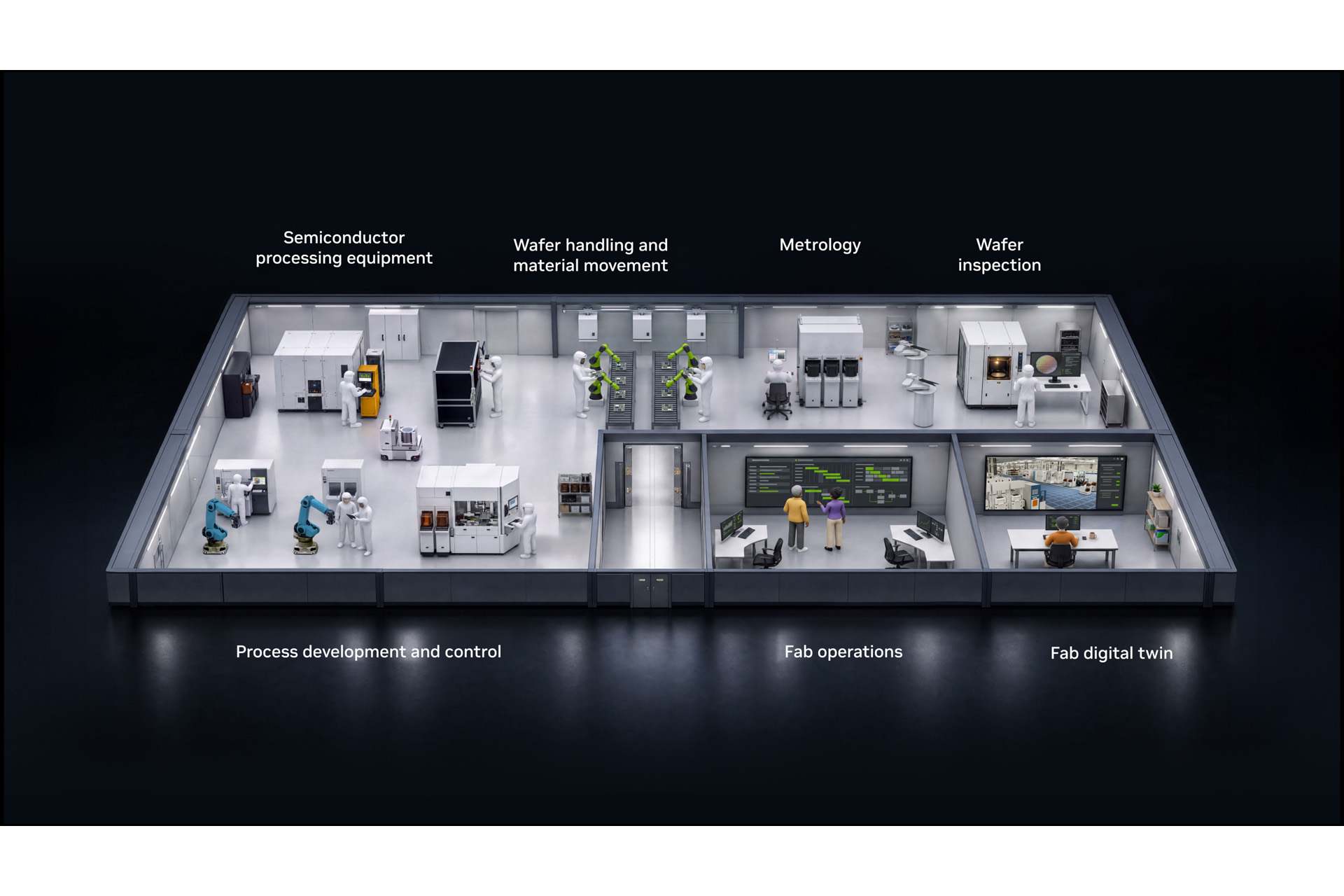
These tools aim to automate engineering work from chip design through manufacturing and predict process behavior to lift yields, which may help fabs handle increasingly complex production as demand for advanced chips rises.
WHO IT HITSChip designers and semiconductor process engineers stand to gain faster simulation and testing before committing changes to real production lines, and equipment makers such as Lam Research are already seeing measured speedups.
Summaries like this, in your inbox every morning.
NVIDIA is pushing AI deeper into the chipmaking process itself, not just the chips it sells. The new cuPotential library is aimed at researchers who need to model electrical forces and other interactions among vast numbers of atoms, with tests showing a further 2–3× speedup on workflows already tuned for GPUs. Separately, NanoVDB, an open-source library for handling 3D data, sped up a semiconductor manufacturing simulation at equipment maker Lam Research by 30×.
The context is that advanced chip demand in the AI era is rising, and fabs must scale output while managing ever more complex processes. Engineers need new ways to test material modeling, inspection-data analysis and process changes on digital twins before applying them on the production floor. NVIDIA's expanded CUDA-X portfolio is meant to serve that need by supplying accelerated tools for semiconductor simulation, 3D data processing and image analysis.
Quality control is part of the same push. AI-defined fabs need to analyze inspection images alongside test data to find defects, maintain equipment and improve yields, and NVIDIA NPP and RAPIDS cuDF are positioned to speed up those testing and quality-control workflows. cuPotential is in early access, NanoVDB is open source inside OpenVDB, NPP ships through the CUDA Toolkit, and the NanoVDB-accelerated SEMulator3D features are targeted for release by the end of this year.
Pick your industry and the AI tools you use, and get news related to your work every day.
Free · 30 seconds with Google · unsubscribe anytimeWhat is AIToday? →
Ask AI anything about this article. The AI reads this article, earlier AIToday articles, and Wikipedia, and cites its sources. Q&As are published on this page for other readers too.
ServiceNow announced AI Passport, a cryptographically signed credential defining an agent's identity, permitte…
Chairman and CEO C.C. Wei announced TSMC has raised its full-year 2026 US dollar revenue growth guidance to ap…

Japan selected a GlobalFoundries-led project for its third round of U.S

Eric Francia, co-founder and CEO of Uniplay, writes that AI has made knowledge accessible at unprecedented sca…

Modal crossed $1B in annualized run rate and raised a $750M Series D at a $15.75B valuation led by Accel

In a Fortune commentary, the Dentons CEO says the firms that will thrive must balance moving faster with inves…