What happened
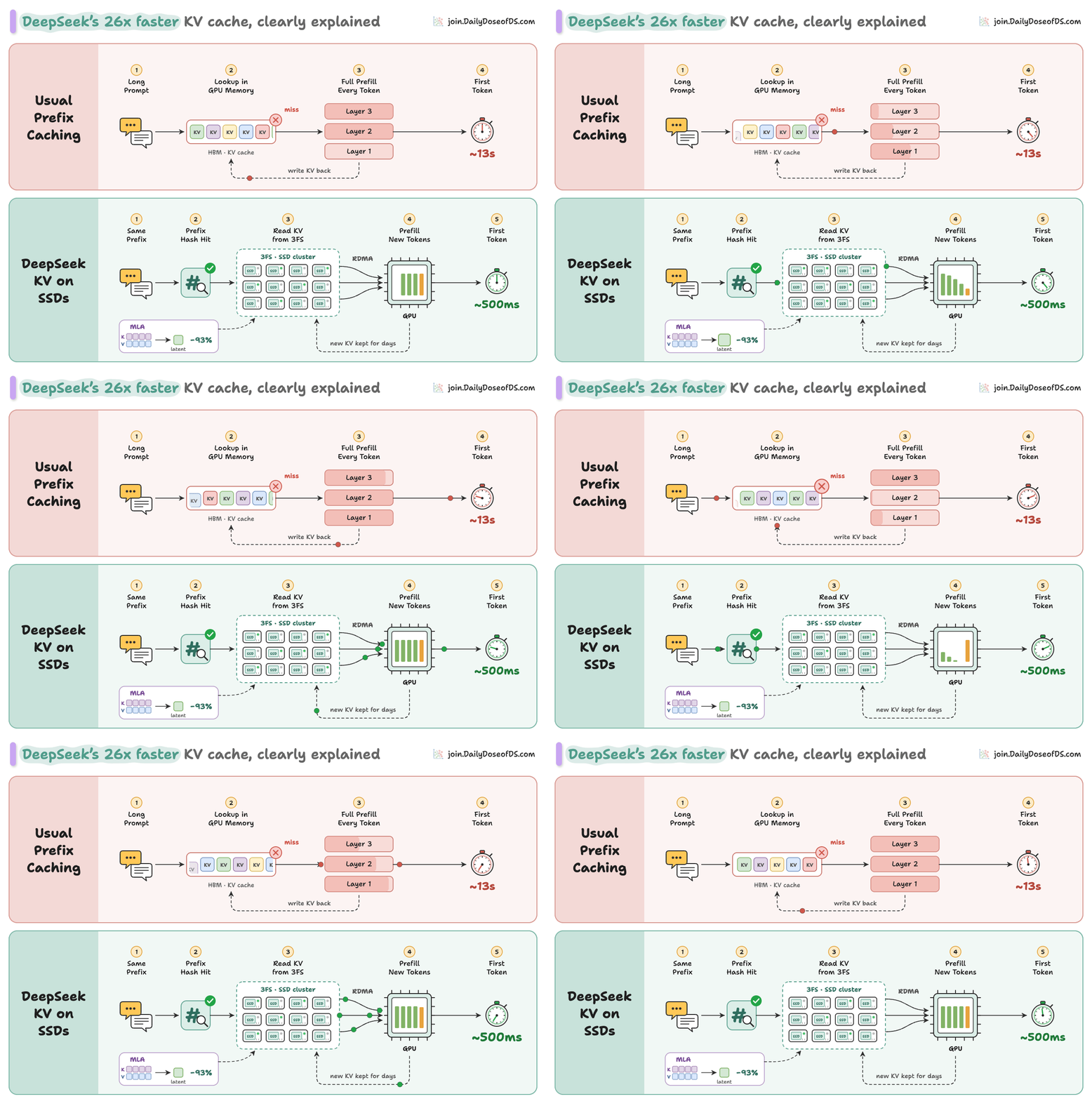
DeepSeek open-sourced DeepInfer, the inference stack behind cache hits that return a first token up to 26x faster. It relies on Multi-head Latent Attention (MLA), which cut the KV cache by 93.3% compared to DeepSeek's earlier 67B model.
Why it matters
That smaller cache made it feasible to store cached prefixes on low-cost disk rather than in GPU memory, so repeated prompts can skip recomputation and return a first token in 500ms instead of 13s for a 128K-token prompt that hit the cache.
Summaries like this, every morning.
DeepSeek's move to open-source DeepInfer reveals how the company turned an architectural choice into a serving advantage. The V2 paper's Multi-head Latent Attention cut the KV cache by 93.3% compared to DeepSeek's earlier 67B model, shrinking the data that must be moved on every cache hit. That reduction is what made disk storage viable in the first place, since reading a full per-head KV cache from disk could take longer than recomputing it on the GPU.
The second ingredient is 3FS, DeepSeek's own distributed file system, which splits files into chunks across thousands of SSDs so a read pulls from many drives in parallel. When a request arrives, the system matches its prefix against cached blocks and fetches them into host memory, then copies them to the GPU layer by layer while the model is already running. Because every prefill machine can reach every cached prefix, a request does not have to return to the machine that served it last. Disk is also cheap, so cached prefixes can stay for days, which the DeepInfer docs put at 3 days for agent traffic and 7 days for chat.
The pricing effect is visible on deepseek-flash, where a cache hit costs 50x less than a miss today. For API users, that creates a practical incentive to order prompts so the stable parts, such as system prompts, tools, and documents, sit at the front, since only an exact match from the very first token counts as a hit.
Pick your industry and the AI tools you use, and get news related to your work every day.
Free · 30 seconds with Google · unsubscribe anytimeWhat is AIToday? →
Ask AI anything about this article. The AI reads this article, earlier AIToday articles, and Wikipedia, and cites its sources. Q&As are published on this page for other readers too.
Meta deployed Catching JiTTests — LLM-generated tests designed to fail on buggy code — and says they caught 74…
GIGAZINE installed Ollama on a Windows PC with an Intel Arc Pro B70 32GB and ran Qwen3.8-27B, confirming via '…
Ben Tossell wrote that he has felt stuck for about 10 months, circling on business ideas, and will spend the n…

Anthropic filed its S-1 to list on the Nasdaq, targeting a valuation of $1.5 trillion to $2 trillion, and disc…

Anthropic's S-1 discloses revenue grew fourteen times to $16.3 billion between the first half of 2026 and the…

Wabi, now describing itself as a 'personal agent,' said it raised $55 million at a $1.25 billion valuation, in…