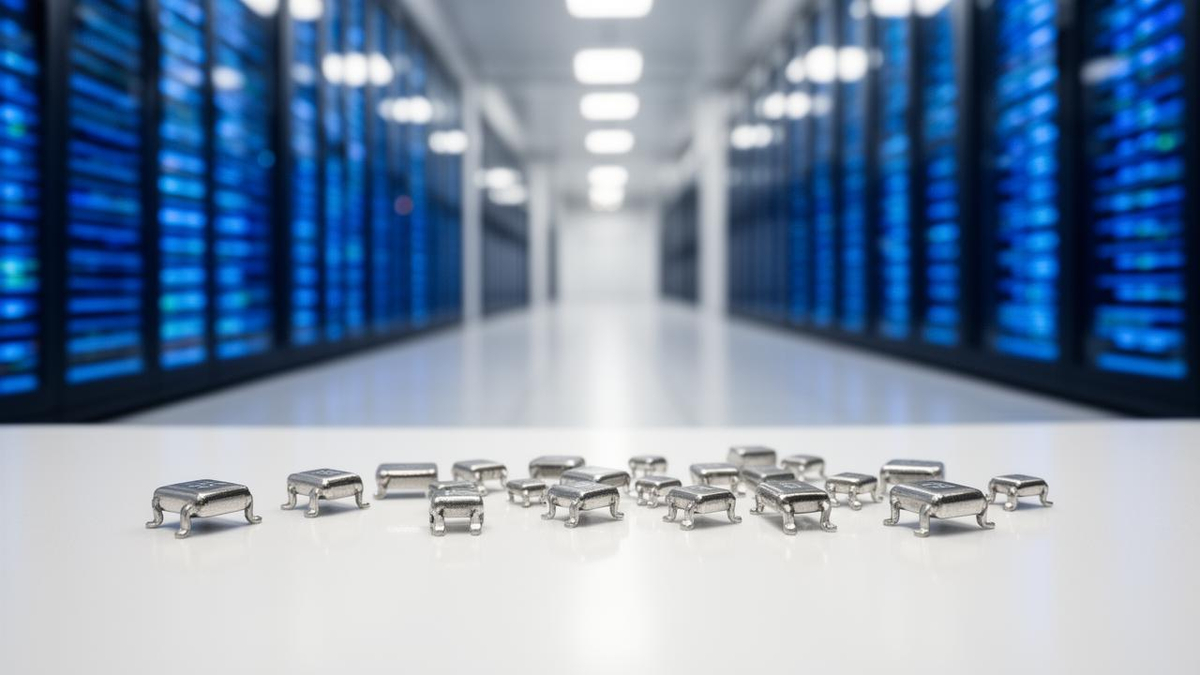
Explosive demand for AI data center servers is creating a critical shortage of multilayer ceramic capacitors (MLCCs), tiny electronic components that stabilize voltage in graphics processors. Japanese manufacturers Murata Manufacturing and TDK Electronics dominate high-performance MLCC supply, with TDK's CEO calling the demand "scary." Each AI server requires up to 28,000 units—roughly 13 times more than a standard server—because modern GPUs consume enormous power and require immediate voltage correction. Supply is so tight that order-to-shipment ratios exceed 1.3 for all major suppliers, forcing customers to sign three-to-five-year contracts with no-cancellation clauses and driving MLCC prices higher.
Summaries like this, in your inbox every morning.
Sign up free →What happened
Demand for multilayer ceramic capacitors (MLCCs)—tiny electronic parts essential to AI servers—is exploding, with each server requiring up to 28,000 units. Japanese companies Murata Manufacturing and TDK Electronics control the majority of high-performance MLCC supply, and TDK's CEO described the demand as "scary." Long-term supply contracts (LTAs) are now standard; Samsung Electronics secured three major MLCC deals in consecutive months (May–July), worth approximately ¥510 billion and ¥330 billion respectively.
Why it matters
Each AI server requires roughly 13 times as many MLCCs as a standard server and 30 times more than a smartphone, because GPUs consume massive power and require voltage stabilization via "decoupling." Supply shortages are severe—order-to-shipment ratios (BB ratios) exceed 1.0 for all three major suppliers, meaning new orders outpace shipments. Prices are rising, and the "no cancellation, no refund" (NCNR) clause is now standard, shifting inventory risk to customers.
What to watch
MLCC demand per GPU is doubling with each generation—Nvidia's next-generation Rubin chip will need 12,000 units per board versus 6,500 in the prior generation. Global AI server shipments are forecast to grow 28.3% in 2025, more than double the 12.8% growth rate for servers overall. Both Murata (adding ¥80 billion to its investment plan through 2028) and Samsung (investing ¥2.1 trillion in Vietnam and Busan) are racing to expand capacity, but supply gaps persist.
Generative AI and the race to build massive data centers have exposed a production crisis in one of the world's smallest but most essential electronic components: the multilayer ceramic capacitor (MLCC). According to reporting from Bloomberg and Trendforce, each AI server requires up to 28,000 MLCCs—roughly 13 times the number found in a standard server and 30 times more than in a smartphone. This staggering disparity stems from the power architecture of modern graphics processors, which consume vast amounts of electricity and cause rapid, severe voltage fluctuations as they perform calculations. To prevent these swings from destabilizing the system, engineers must place thousands of tiny capacitors directly adjacent to the GPU in a technique called "decoupling," allowing the capacitors to absorb and smooth out the electrical noise in microseconds.
The supply crisis centers on high-performance MLCCs for servers, a market where two Japanese companies hold decisive power. Murata Manufacturing controls roughly 40% of the global MLCC market overall, but in the critical segment of AI-grade high-performance capacitors, Murata and its rival TDK Electronics together command the vast majority of worldwide supply. TDK's CEO Katsuya Sase told Bloomberg that the surge in orders for his company's AI server components was "scary," adding: "If even one company stumbles, we might immediately fall behind. The pressure is extremely intense." This pressure is mounting because GPU designs are fundamentally changing. Nvidia's prior-generation GB200 accelerator required 6,500 MLCCs per board; the next-generation Rubin, due later this year, will need 12,000—nearly double. AMD is following a similar trajectory: its upcoming MI450 platform originally called for aluminum electrolytic and tantalum capacitors on the board layout, but Trendforce reports that the company has replaced all of them with MLCCs, resulting in a jump from 1,440 to 10,544 units of a specific high-performance type—a 7.3-fold increase.
The shortage is reshaping commercial practice across the industry. Long-term supply agreements (LTAs), which guarantee multi-year purchase commitments, have become the norm. Samsung Electronics exemplifies this shift: in May, it secured a silicon capacitor contract worth approximately ¥1.7 trillion; in June, an MLCC supply deal worth approximately ¥510 billion; and in July, another MLCC contract for approximately ¥330 billion. These consecutive multi-billion-yen MLCC agreements represent an unprecedented concentration of long-term commitments. Suppliers are also introducing "no cancellation, no refund" (NCNR) clauses into contracts, which prevents customers from unilaterally canceling orders or requesting refunds. While this protects suppliers by guaranteeing demand for their capital investments, it shifts inventory and demand-forecasting risk entirely onto customers, who may end up with excess stock if their own sales slow.
Despite aggressive investment, supply remains critically short. Samsung Electronics is investing approximately ¥2.1 trillion in new facilities in Busan and Vietnam to expand high-performance substrate production for servers and AI, and has announced a longer-term plan to invest approximately ¥1.7 trillion in Busan and approximately ¥900 billion in Sejong by 2040. Murata is adding ¥80 billion to its existing ¥680 billion MLCC investment plan through 2028. Yet the market remains starved. According to Trendforce, the order-to-shipment ratio (BB ratio) for MLCCs stands at 1.31 for Samsung Electronics, 1.30 for Murata Manufacturing, and 1.25 for TDK Electronics—all significantly above 1.0, indicating that new orders consistently outpace shipments. Prices are beginning to rise: TDK notified customers in May of price adjustments for MLCC and other major product lines. With AI server shipments expected to grow 28.3% in 2025—more than double the 12.8% growth forecast for servers overall—the supply gap is unlikely to close soon. Meanwhile, a second major demand driver is emerging in electric vehicles: advanced EVs with level 2 or higher autonomous driving features require over 10,000 MLCCs per vehicle. The converging demands of AI servers and electrified transport are sparking what industry observers describe as a global scramble for rice-grain-sized components.
The explosive growth of AI data centers has created an unexpected bottleneck in a component so small and ubiquitous that the industry calls it "the rice of electronics." MLCCs have been a commodity for decades, but the power demands of modern graphics processors have fundamentally altered their role. As GPU performance increases with each generation, the voltage swings they produce grow wider, forcing engineers to deploy exponentially more capacitors to stabilize power delivery. Nvidia's roadmap illustrates this escalation: the prior-generation GB200 board uses 6,500 MLCCs, but the upcoming Rubin will require 12,000—a near doubling in just one generation. AMD has replaced nearly all alternative capacitor types with MLCCs in its next-generation MI450 platform, jumping from 1,440 to 10,544 units per board.
This demand shock has empowered a small group of suppliers. While Murata Manufacturing holds about 40% of the global MLCC market overall, the race for high-performance server-grade parts reveals a Japanese duopoly: Murata and TDK control the vast majority of supply. The shift from commodity transactions to long-term contracts reflects a supplier-dominant market. Samsung Electronics, despite its own manufacturing strength, has signed three major MLCC supply deals in three months—a sign of how critical and scarce these parts have become. The industry has rapidly adopted the "no cancellation, no refund" clause, a practice common in semiconductors but now spreading to passive components, effectively locking customers into multi-year commitments while suppliers accumulate the certainty they need for billion-dollar capacity expansions.
The strain shows no sign of easing. Global AI server shipments are projected to grow 28.3% in 2025, more than double the growth rate for servers as a whole, and GPU designs will continue demanding more capacitors per unit. EVs add a second massive source of demand—advanced autonomous vehicles require over 10,000 MLCCs each. Murata, Samsung, and others are investing tens of billions in new factories, yet order-to-shipment ratios remain stuck above 1.25, indicating that even aggressive capacity growth is failing to close the gap between supply and demand.
AI-summarized, only the topics you pick — one digest a day via Email, Slack, or Discord.
Free · takes 30 seconds · unsubscribe anytime
No comments yet. Be the first to share your thoughts!
Log in to join the discussion


Get curated AI news from 200+ sources delivered daily to your inbox. Free to use.
Get Started FreeFree · takes 30 seconds · unsubscribe anytime
