What happened
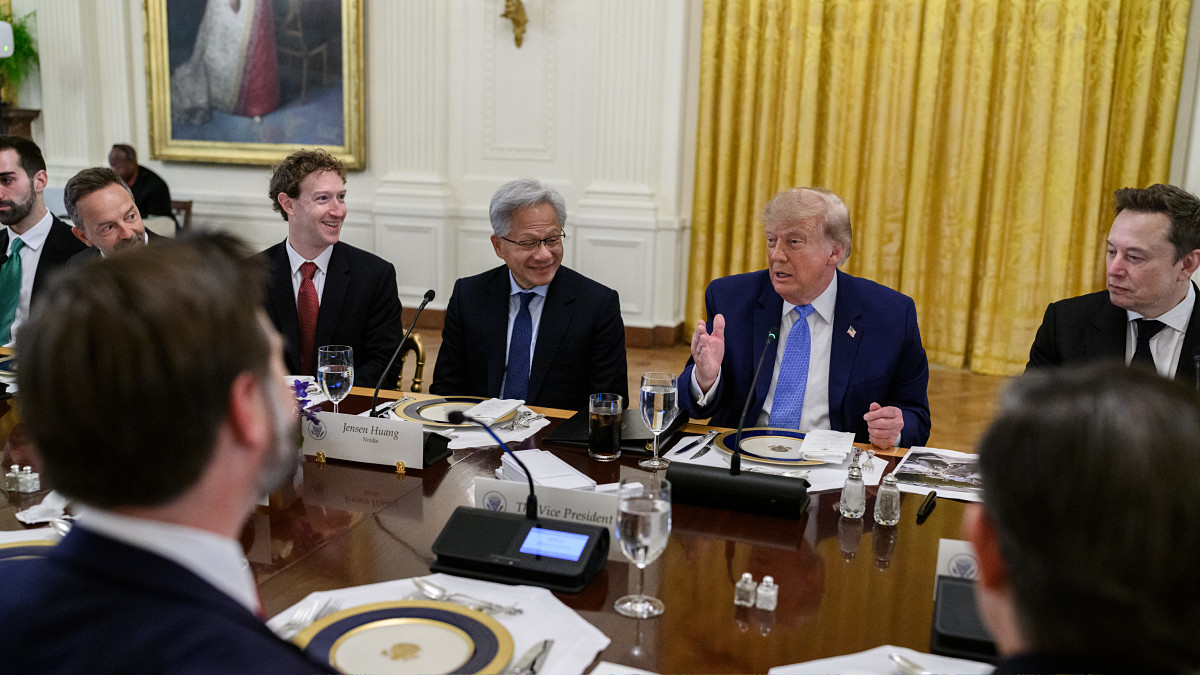
At a White House meeting on September 30, 2026, President Donald Trump, Google's Sundar Pichai, Anthropic's Dario Amodei, Meta's Mark Zuckerberg, OpenAI President Greg Brockman, SpaceXAI's Elon Musk and NVIDIA's Jensen Huang signed the White House Accord on Super Intelligence.
Why it matters
The accord commits the companies to four practices, including monitoring so models do not perform unintended hacking or work tied to cybersecurity and biological weapons, and cooperating with outside independent auditors.
What to watch
The accord is a statement of commitments, not a regulator, so its weight hinges on whether the independent audits and board committees actually surface and correct problems.
WHO IT HITSThe commitments land on the AI safety, security and compliance staff at the signing companies, and on their boards, which are now asked to set up independent committees to receive internal and external audit findings.
Summaries like this, in your inbox every morning.
The meeting and the signing were closely held: the main documentation of who attended comes from an image posted on X by AMD CEO Lisa Su and a video from aide Margo Martin, which places Anthropic's Dario Amodei at the left end of the table. That matters because the accord is a commitment by named people, not a piece of legislation, so the record of who was in the room is the record of who is bound.
The four points move in one direction: from internal controls outward to external validation. Companies are asked to monitor their own models during development and deployment, give internal oversight teams real authority, bring in outside independent auditors, and then route those findings to a new independent board committee. OpenAI is represented by President Greg Brockman rather than a CEO, and SpaceXAI by Elon Musk, whose other ventures have their own AI work.
The stakes hinge on the last two points. Internal controls and internal teams are self-reported by design, so the question a reader should hold is whether the external audits and the board committees are given enough independence to flag a failure and see it corrected. Nothing in the accord as described establishes an enforcement body, so its practical weight is likely to rest on how seriously each signatory treats those reviews.
Pick your industry and the AI tools you use, and get news related to your work every day.
Free · 30 seconds with Google · unsubscribe anytimeWhat is AIToday? →
Ask AI anything about this article. The AI reads this article, earlier AIToday articles, and Wikipedia, and cites its sources. Q&As are published on this page for other readers too.
HBM is approaching half the cost of a GPU-HBM CoWoS package, prompting the question of whether memory remains…
DeepSeek is bringing more of the software it uses to develop its AI models to Huawei Technologies' Ascend 950…
Among respondents at companies with 1,001+ employees, 50.0% said AI is used company-wide, and 46.0% flagged AI…
Oracle invoked "force majeure" to delay payment on its Project Jupiter data center, and its 2056 bonds then tr…
Nvidia released the Open Agent Safety Platform on September 28, days after CEO Jensen Huang called warnings fr…
The Tokyo District Court dismissed Kenjiro Tsuda's demand that TikTok remove AI voice-clone videos, citing pri…