What happened
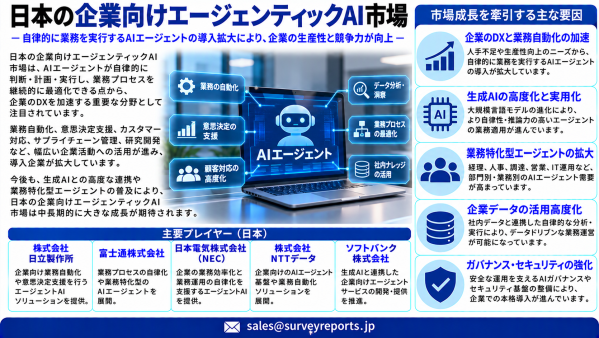
The Japan enterprise agentic AI market was valued at $149.6 million in 2025 and is projected to grow at a 46.9% CAGR over 2026–2036, exceeding $2.1859 billion by the end of 2036.
Why it matters
This forecast implies that spending on AI systems that can execute multi-step business workflows — not just generate text — is expected to expand sharply in Japan, creating opportunities for software vendors, consultants, and systems integrators serving large enterprises and SMEs.
Summaries like this, every morning.
Japan's enterprise agentic AI market is emerging as companies move beyond generative AI experiments toward systems that can actually execute tasks across business applications. The forecast of a 46.9% CAGR from 2026 to 2036 reflects growing interest in AI agents that can plan and coordinate workflows, rather than simply generate text or answer questions. This shift is supported by Japan's demographic pressures — an aging workforce and labor shortages — which are pushing organizations to seek automation for repetitive administrative work. At the same time, many Japanese companies run complex legacy systems, so successful adoption will likely depend on integration services and strong data governance. Surveys cited in the report show that a significant share of firms plan to increase AI investment, but also reveal gaps in data readiness and confidence in implementation. Early use cases are expected to focus on lower-risk, repetitive workflows such as document processing and internal knowledge search, with more complex processes like procurement and supply chain management following as governance and integration improve. Competition is intensifying among domestic technology firms, global software vendors, cloud providers, and systems integrators, with differentiation increasingly centered on Japanese-language support, industry-specific features, and the ability to deliver measurable business outcomes.
Pick your industry and the AI tools you use, and get news related to your work every day.
Free · 30 seconds with Google · unsubscribe anytimeWhat is AIToday? →
Ask AI anything about this article. The AI reads this article, earlier AIToday articles, and Wikipedia, and cites its sources. Q&As are published on this page for other readers too.
After the post-election market rout, Sozzi says fundamentals at Nvidia, Micron, Sandisk and other AI names wer…

Berkshire Hathaway, now led by CEO Greg Abel, has seen its stock rise 13.58% year to date through the November…

Cisco IT deployed a multi-tenant AI factory across its global data centers, raising average GPU utilization fr…

At the Next-Gen AI for Energy Summit in Houston on 3 November, Anthropic's Boaz Nur said AI will take over the…
Visa launched its Agentic Commerce Benchmark, a framework to evaluate AI-powered shopping experiences for cons…

Democrat Gina Hinojosa, who wants an immediate moratorium on data centers in Texas, beat Republican Gov