AIToday

研究者、言語モデルの性格特性を数式で操作できることを実証

LessWrong AI13h ago
研究者、言語モデルの性格特性を数式で操作できることを実証

Key takeaway

Researchers have shown they can systematically encode and manipulate personality traits in large language models using mathematical operations on model weights, opening a path to safer and more controllable AI systems. By training low-rank adapters that represent Big-5 personality dimensions, they demonstrated the ability to amplify, suppress, or combine behavioral traits—and even discovered unexpected personality traits that standard psychology frameworks do not predict.

Summaries like this, in your inbox every morning.

Sign up free →

3 Key Points

  • What happened

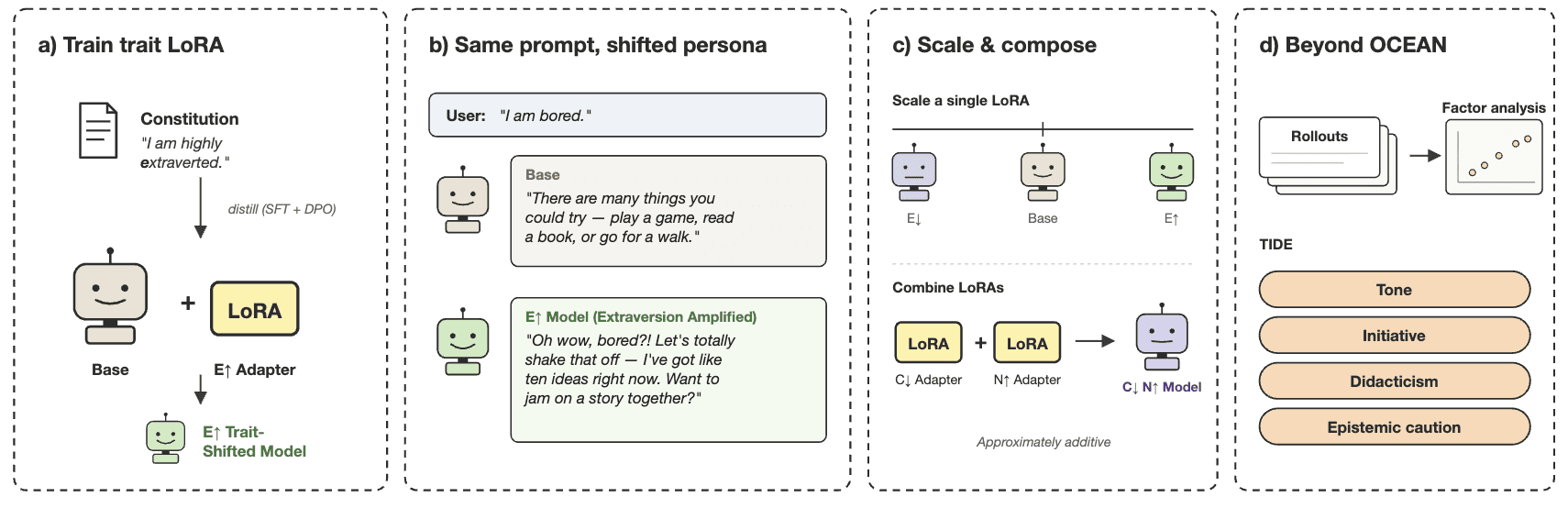
    Researchers developed a method to instill Big-5 OCEAN personality traits into large language models across multiple model families (Llama 3.1, Qwen3, Gemma3) at sizes 4B–32B parameters using a modified Open Character Training pipeline and low-rank adapters (LoRAs). They demonstrated that these trait-encoding components can be scaled, inverted, and combined using simple weight matrix arithmetic to amplify, suppress, and blend different behavioral traits.

  • Why it matters

    Understanding and controlling LLM character is important for safety—the goal is to ensure models are well-behaved by disposition. The ability to manipulate personality traits at the weight level suggests a path to more predictable model behavior and to mitigate common LLM pathologies, which could improve reliability in deployed systems.

  • What to watch

    The researchers also proposed an unsupervised approach to discovering persona-trait LoRAs that were not predefined, suggesting that LLMs may possess unexpected personality dimensions beyond standard human psychological frameworks. This finding hints that model personalities may be more complex and less predictable from human psychology than initially assumed.

Context & Analysis

The research addresses a fundamental challenge in AI safety: making language models not just capable but reliably well-behaved. Rather than attempting to control behavior through prompting or fine-tuning alone, the researchers took a deeper approach by treating personality traits as manipulable components within the models' weight matrices. By using low-rank adapters—a computationally efficient technique—they were able to isolate and control specific behavioral dimensions without retraining entire models.

The ability to combine traits using arithmetic operations (scaling, inverting, and blending LoRAs) is significant because it suggests personality structures in neural networks may follow predictable mathematical patterns. However, the discovery of unsupervised persona-trait dimensions that deviate from human psychometrics adds a crucial caveat: models may develop or contain personality-like behaviors that human psychology frameworks do not anticipate. This implies that complete control over model behavior may require more sophisticated understanding of how neural networks construct identity and disposition.

FAQ

Which language models were tested in this research?
The research covered Llama 3.1, Qwen3, and Gemma3 models in sizes ranging from 4B to 32B parameters.
What practical problem does this solve?
The paper states that understanding and controlling the character of LLMs is important for safety, as the goal is to ensure models are good by disposition. The technique offers a way to mitigate some common LLM pathologies.

Discussion

No comments yet. Be the first to share your thoughts!

Log in to join the discussion

Related Articles

Stay ahead with AI news

Get curated AI news from 200+ sources delivered daily to your inbox. Free to use.

Get Started Free

Free · takes 30 seconds · unsubscribe anytime

1 minute a day. The AI essentials.

200+ sources · Email / LINE / Slack

Get it free →