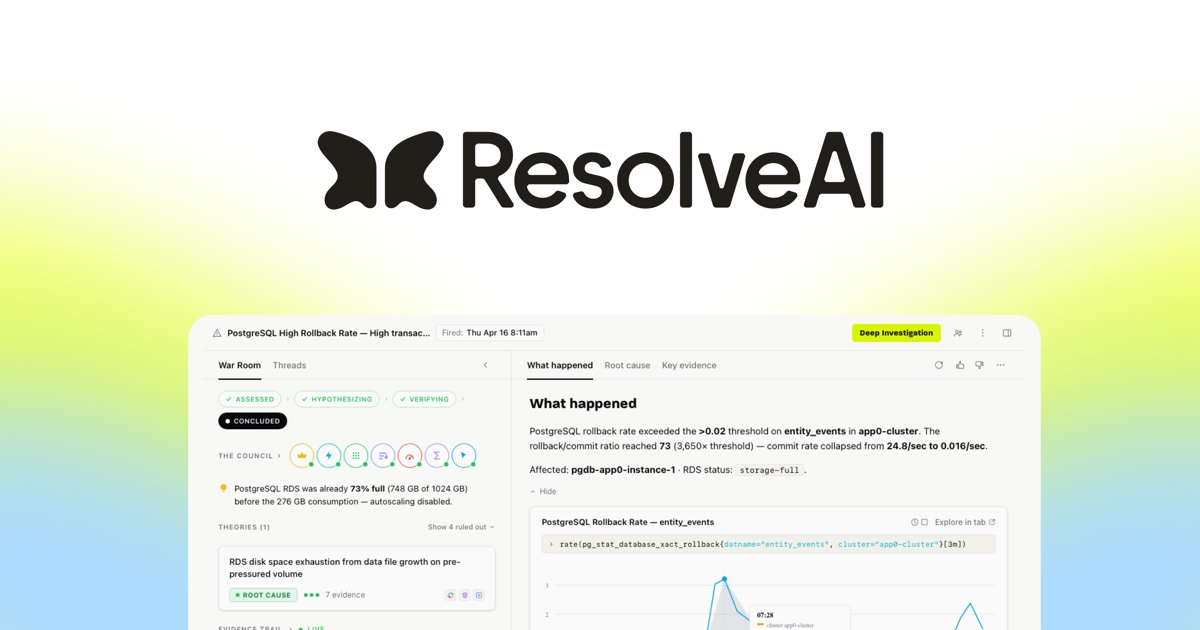
What happened
Resolve AI announced SRE-1, a 27 billion-parameter open-weights model trained by 16 researchers over 7.4 days, whose single-investigation pass rate rose from 6.9% to 38.8%.
Why it matters
The gain came from reinforcement learning alone, which Resolve AI says addresses production's lack of a public training corpus, since each company's incidents stay private.
WHO IT HITSSite reliability engineers and on-call staff at software companies stand to see fewer pages escalated, with Resolve AI claiming up to 80% of alerts handled without escalation and customers reporting a tenfold improvement in mean time to resolution.
Summaries like this, every morning.
Resolve AI frames its launch around a gap: AI has transformed how software gets written, but has barely touched how software gets run. The company's argument is that production has no public training corpus to match the published code that models learned from, because incidents at each company stay private. SRE-1 is the company's answer to that gap, and the reported jump in single-investigation pass rate from 6.9% to 38.8% is measured on the same incidents before and after training, which used reinforcement learning alone.
The model was built with Snowflake Inc.'s Cortex Training service, and Snowflake Senior Vice President of Engineering Vivek Raghunathan said Resolve AI was the first design partner for it. Resolve AI also tested an ensemble of five SRE-1 investigations on 49 difficult live production cases, each run five times, and says the ensemble matched the strongest frontier model tested at a lower cost.
Primary On-call is the commercial vehicle for that research, and Resolve AI says customers have reported root-cause accuracy of up to 95% and a tenfold improvement in mean time to resolution. The company has raised more than $190 million to date, including a $40 million extension to its Series A round in April led by DST Global and Salesforce Ventures, valuing it at $1.5 billion. Whether on-call engineers beyond early users like Salesforce embrace an agent on the critical path may depend on how the shadow mode's recorded calls compare with human judgment.
Pick your industry and the AI tools you use, and get news related to your work every day.
Free · 30 seconds with Google · unsubscribe anytimeWhat is AIToday? →
Ask AI anything about this article. The AI reads this article, earlier AIToday articles, and Wikipedia, and cites its sources. Q&As are published on this page for other readers too.
Oxide Computer Co., which raised $445 million in October to expand rack production, built its business on the…
OpenAI now requires gateways and routers that provide third-party access to its AI models to be reviewed and a…
A Zenn article by Hiromi lays out Continuous Reasoning Acquisition (CRA), a design for capturing veteran judgm…

Running the official harness, Claude Opus 5.5 wrote an ARC model with no gradient descent and no forward calls…

Major US tech companies are refocusing generative AI competition from answer quality toward agent capability…

At the Open Source AI for Science Summit, Meta's FAIR team said the Digital Brain Project, run with the Rothsc…