What happened
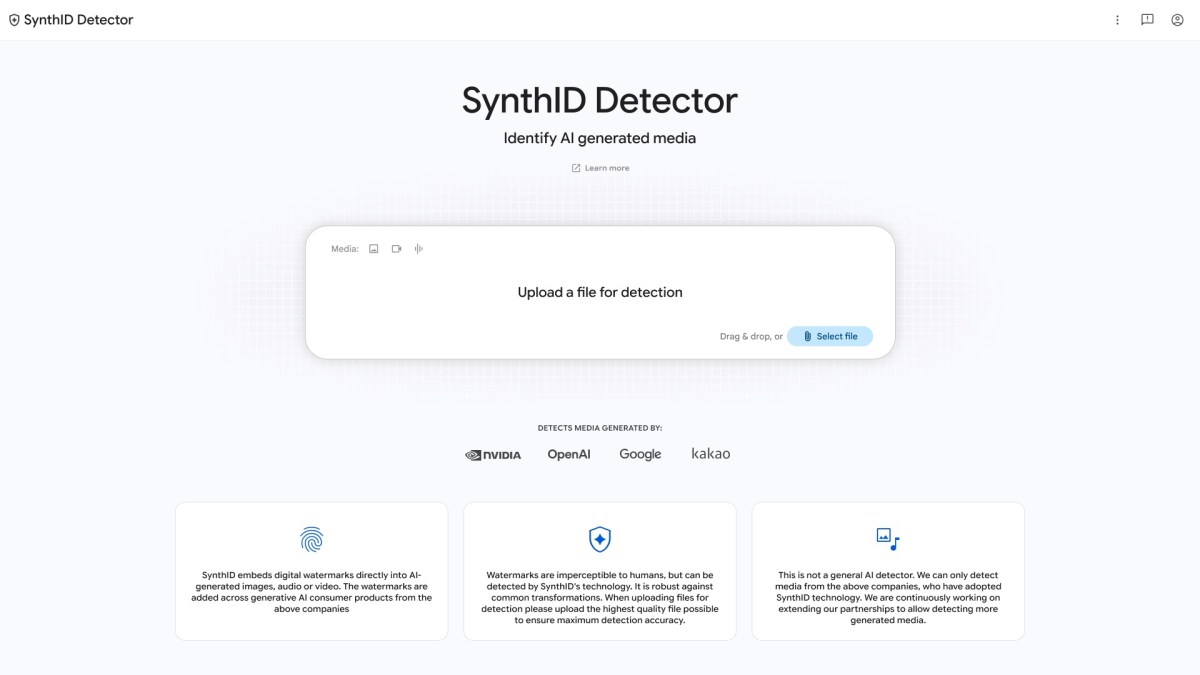
Google made its SynthID detector available globally to anyone with a Google, OpenAI, or Apple account, with a daily quota of approximately 10 image, video, and audio checks per user.
Why it matters
The login requirement limits how much the tool can be used, and Google engineers have said limiting access is necessary to prevent people from using the checks to develop SynthID removal tools.
What to watch
Plenty of AI content will still go unidentified, since some providers use different watermarking tech and others use none; the website itself will carry a disclaimer saying as much.
WHO IT HITSJournalists, fact-checkers, and social media reviewers who verify images and video now have a single free destination to check for Google's watermark, though the daily cap constrains heavy use. Marketing and trust-and-safety teams relying on watermark detection may still find content from providers that use other or no watermarking goes unidentified.
Summaries like this, in your inbox every morning.
Google's SynthID detector now puts watermark checking for its own tools, plus those of partners like OpenAI and Apple, into a single login-gated website. That convenience is real, but the design choices reveal the tension: Google engineers have told Ars that limiting access is necessary to prevent people from using the checks to develop SynthID removal tools, and the fuzziness about the exact number is likely because the system may lock you out sooner if you're checking multiple images that are very similar, which could signal someone is trying to tune a bypass workflow.
The tracker's reach is inherently partial. Some model providers use different watermarking tech, while others use no watermarks at all, and open-weight models that people can run on their own hardware produce increasingly realistic AI content that doesn't even include simple metadata labeling. That means plenty of AI content will not be identified as AI in the SynthID tool, and the website will have a disclaimer saying as much. It's also plausible that despite Google's efforts, someone will find a way to remove SynthID, making existing AI content look more legit — not a perfect system, but the reality of relying on proactive watermarking for AI images proliferating across the Internet.
An alternative path is to label real images, video, and audio at creation using cryptographic technologies like C2PA, which Google's Pixel phones are among the few devices doing. In the meantime, SynthID is the best bet you've got to identify AI fakes, though its usefulness hinges on whether the quota and the login gate keep determined bad actors from probing the system.
Pick your industry and the AI tools you use, and get news related to your work every day.
Free · 30 seconds with Google · unsubscribe anytimeWhat is AIToday? →
Ask AI anything about this article. The AI reads this article, earlier AIToday articles, and Wikipedia, and cites its sources. Q&As are published on this page for other readers too.
Kore.ai Inc. launched Autoloop, which adjusts AI agents toward goals customers set for task completion, busine…

OpenAI launched a Decisions API that evaluates text, images, or both, returning yes/no probabilities, category…

Google launched Playground, a browser-based AI platform that lets adults in the US create games using only tex…

In August, DoorDash emailed Bay Area restaurants warning they may be listed on Bites without consent, with ter…

Google launched a new public site using SynthID to verify whether an image, video, or audio clip is AI-generat…
At MIT Future Fest, Tony Fadell said the Rabbit R1, Humane Ai pin, and Limitless pendant failed because they "…