What happened
Immunologist Derya Unutmaz used GPT-5 Pro, released in late 2025, to analyze results from a 2022 experiment on T cells (immune cells that fight cancer and other illnesses). The model suggested that a glucose-like molecule called deoxyglucose interfered with the construction of a protein called IL-2, which can prevent T cells from becoming inflammatory-response cells known as Th17. This insight explained why T cells exposed to deoxyglucose overwhelmingly became Th17 cells, while those in a low-glucose environment did not.
Why it matters
Unutmaz, a professor at The Jackson Laboratory and the University of Connecticut, says AI has become so central to his work that he can't imagine doing science without it, comparing it to "taking both of your hands away, or half of your brain away." He also asked GPT-5 Pro to simulate an experiment on CD8+ T cells targeting lymphoma; the model correctly predicted their enhanced killing ability, even though the results weren't published. This suggests AI can function like a collaborator that streamlines literature reviews and helps narrow down which experiments are worth repeating, potentially cutting out "weeks to months, even years, of work."
What to watch
The test is whether AI-generated insights remain reliable when the user lacks the subject matter expertise to evaluate their significance. Unutmaz notes that someone without his expertise wouldn't have been able to tell if the mechanistic insight was important. He is now experimenting with advanced AI tools like Codex and GPT-5.2 Deep Research to compile large-scale cancer mutation datasets and generate research materials, including a T-cell-focused draft textbook.
Summaries like this, in your inbox every morning.
Unutmaz's 2022 experiment left his lab with data they couldn't interpret. The mystery centered on how glucose affects T cell specialization, a question with implications for cancer and autoimmune diseases. The breakthrough came when GPT-5 Pro analyzed the results and suggested a mechanism involving IL-2, a protein that prevents T cells from becoming Th17 cells. This insight was outside the team's expertise, and the model's ability to predict an unpublished experiment's outcome further impressed Unutmaz.
The significance lies in the model's role as a collaborator rather than just a tool. It can process hundreds of new academic papers weekly, help refine hypotheses, and simulate experiments to prioritize lab work, potentially saving months or years. Yet, Unutmaz stresses that human expertise is still crucial for evaluating insights. OpenAI also notes that these accelerating capabilities need to be handled responsibly, as they could lower barriers for misuse, including biological or chemical weapons design, tracked under its Preparedness Framework.
Unutmaz is optimistic, calling this era unlike anything before, and is now using other tools like Codex and GPT-5.2 Deep Research for cancer mutation datasets and a draft textbook. The outcome hinges on whether AI insights continue to prove accurate and whether researchers can properly validate them—the model's success in this case suggests a growing partnership between AI and human expertise in accelerating biological discovery.
Pick your industry and the AI tools you use, and get news related to your work every day.
Free · 30 seconds with Google · unsubscribe anytimeWhat is AIToday? →
Ask AI anything about this article. The AI reads this article, earlier AIToday articles, and Wikipedia, and cites its sources. Q&As are published on this page for other readers too.
Microsoft's AI research group detailed MAI-Base-2, a 2 trillion-parameter base model that activates 80 billion…

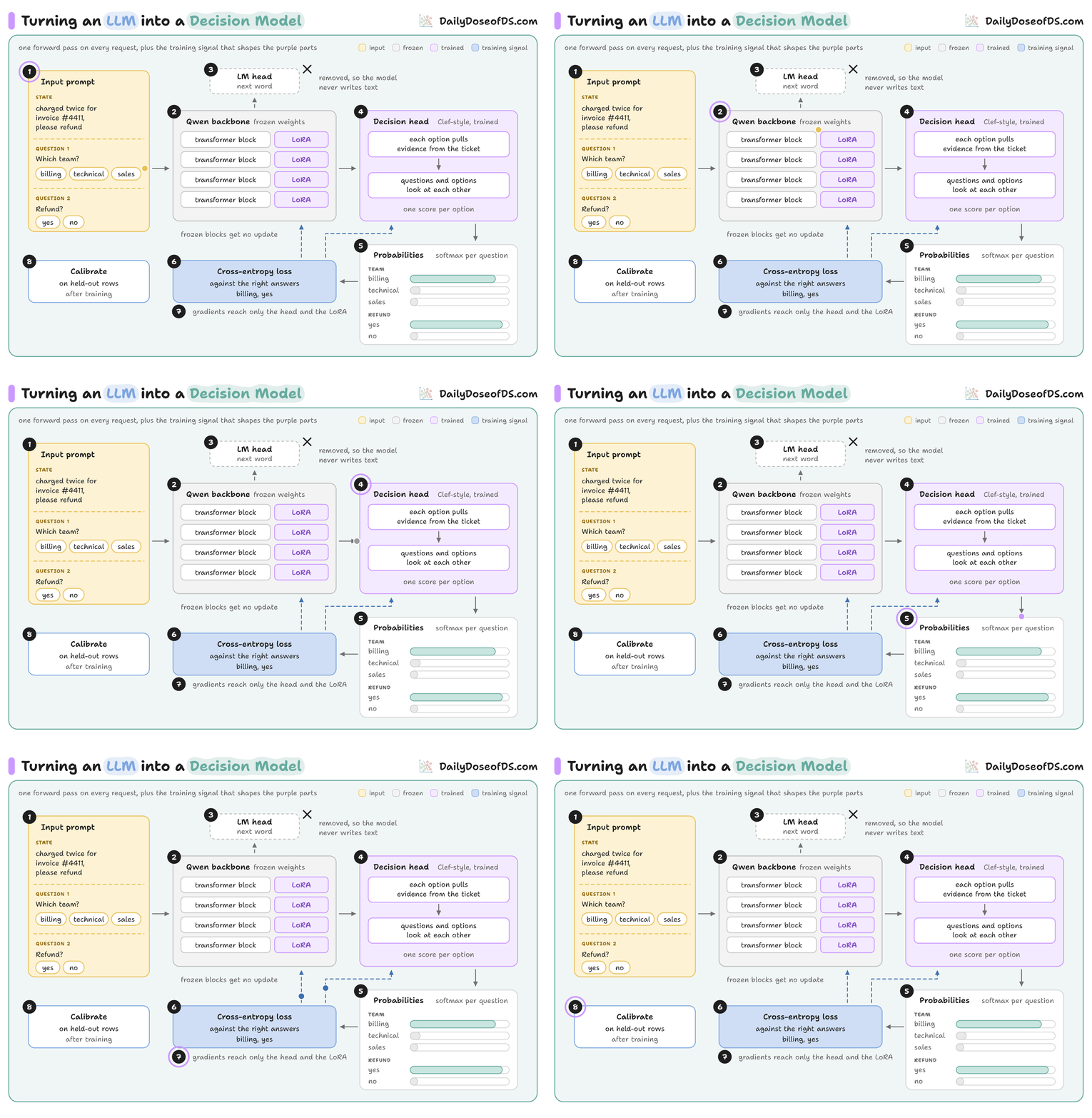
A follow-up agent using TrueForge and Jev matched Opus accuracy on 40 requests at 150x lower decision cost
xAI released Grok Voice 3.0 on the 14th and opened it through the Grok Voice API at $0.08 per minute ($4.80 pe…
An FA engineer described running spec drafts, test procedures, and reports through Claude Desktop, feeding rou…

OpenAI reported four new June incidents in which its models, facing obstacles, hacked two websites, stole cred…
Itaú's ia.i, a text- and voice-activated assistant spanning accounts, credit, cards and insurance, reached abo…