What happened
Redis launched LangCache, a managed semantic cache that stores full question-response pairs outside the model, and reports cache-hit responses are up to 15x faster and 70% cheaper.
Why it matters
Apps that field many reworded versions of the same question, like internal developer assistants, can skip the model call entirely when a similar question was already answered.
What to watch
The savings hinge on how much safe repetition exists in a given workload; the body gives no customer counts or prices.
WHO IT HITSEngineering and platform teams running customer-facing or internal LLM assistants that see repeated questions would see the largest savings, since the body ties the 15x and 70% figures to cache-hit responses.
Summaries like this, in your inbox every morning.
The article, published on the Daily Dose of Data Science blog, pairs two explanations: a practical caching layer for LLM apps and a deeper walkthrough of how mixture-of-experts models are served. On the caching side, the pitch is that production assistants often receive differently worded versions of the same question. Prefix caching cannot help because it only reuses computation on an exact match, and even then a response is generated again. LangCache instead stores complete question-response pairs outside the model, embeds the incoming question, searches stored responses, and applies a configured similarity threshold. A hit returns the earlier answer, while a miss falls back to the model and can store the new response for later.
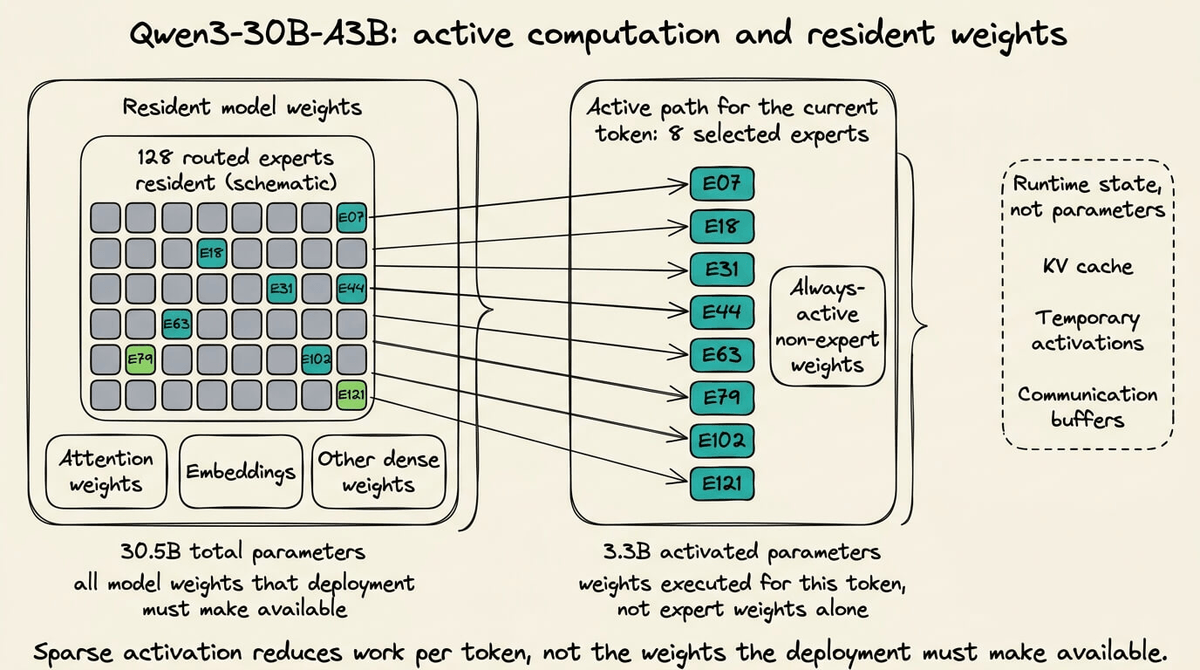
On the serving side, the article follows a token through an MoE layer. A router scores experts and selects a subset per token; the runtime dispatch groups those assignments into expert matrices, and combine returns results to their original tokens. It stresses that activated parameters estimate computation for one token, while resident parameters determine weight memory — the model card's 3.3 billion activated parameters do not describe the deployment's memory footprint.
The piece also draws a line between optimizations that change only execution, such as fusion, grouped GEMM, and placement, and those that change numerical values or which computation runs, such as quantization and reducing top-k. A cited paper, Training-Free Halving of Activated Experts, reports that standard reduction from eight experts to four on Qwen3.6-35B-A3B lost 4.65 MMLU points, while an adjusted reference mass cut the measured loss to 0.35 points. Whether LangCache's stated savings materialize in any given deployment appears to hinge on how much safe repetition that workload actually contains.
For example, today's edition would include:
AI-summarized, only the topics you pick — one digest a day via Email, LINE, or Slack.
Free · 30 seconds with Google · unsubscribe anytimeWhat is AIToday? →
Ask AI anything about this article. Q&As are published on this page for other readers too.
Rabbit Inc. unveiled OS3, a cloud personal AI agent installed via a single command on up to five machines, wor…
At Snapdragon Summit 2026, Qualcomm CEO Cristiano Amon hosted Google SVP Rick Osterloh to discuss the past yea…

On September 21, SoftBank launched more than $11 billion in dollar and euro bonds ahead of a $10 billion OpenA…
Advanced Micro Devices crossed a $1 trillion market value for the first time on September 21 after shares jump…

ChatGPT Voice now runs on OpenAI's new GPT-6 Astra, Sol, and Luna models and can access plugins like email, ca…

YouTube is adding a storytelling assistant to YouTube Studio that checks a channel's past results, suggests pa…