AIToday

AGIBOT unveils four robot models for real-world factory and service work

The Robot Report14h ago
AGIBOT unveils four robot models for real-world factory and service work

Key takeaway

AGIBOT unveiled four new embodied AI products at the World Artificial Intelligence Conference in Shanghai, including the A3 Ultra humanoid robot, the G2 Max heavy-payload industrial task robot, the OmniHand 3 Ultra-M dexterous hand, and the X2 EDU educational platform. The company emphasized that its robots are designed for reliable, continuous operation in real-world manufacturing and service environments rather than isolated demonstrations — evidenced by G2 Max robots already integrated into Longcheer's factory production line, where they have maintained less than 4% downtime over 64 hours of cumulative continuous operation.

Summaries like this, in your inbox every morning.

Sign up free →

3 Key Points

  • What happened

    AGIBOT yesterday presented four new embodied AI products at the World Artificial Intelligence Conference in Shanghai: the A3 Ultra humanoid (1.74 m tall, 60 kg, 51 degrees of freedom), the G2 Max heavy-payload industrial robot, the OmniHand 3 Ultra-M dexterous hand (20 degrees of freedom, 630 g), and the X2 EDU educational platform. The company, founded in 2023, produced its 15,000th robot last month.

  • Why it matters

    AGIBOT co-founder Peng Zhihui stated that the industry should judge embodied AI "by whether it can be manufactured, delivered and integrated reliably into real operating environments" — not by one-time demonstrations. The A3 Ultra supports up to eight hours of continuous operation with autonomous charging; the G2 Max is already deployed in Longcheer's Nanchang factory for tablet quality inspection, completing a closed-loop workflow with less than 4% downtime over 64 hours of cumulative operation. This marks a shift from research prototypes to production systems integrated into existing factory lines.

  • What to watch

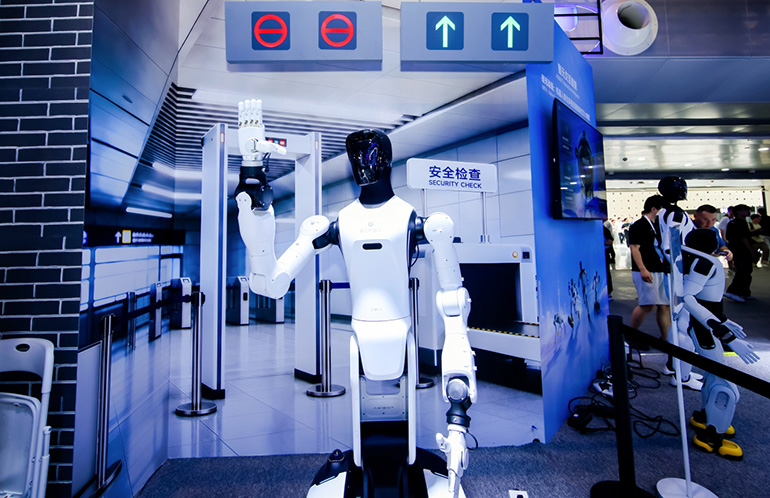
    Integration with Longcheer took 36 hours and the system has inspected about 3,000 units per shift. AGIBOT also presented tourism and transportation applications with partners Sichuan Cultural Tourism and Guangzhou Railway. More than 30 AGIBOT robots provided visitor guidance and demonstrations across WAIC venues.

In Depth

AGIBOT unveiled four new embodied AI products at the World Artificial Intelligence Conference (WAIC) in Shanghai yesterday, part of a broader company push toward manufacturing-scale robotics. The A3 Ultra, a full-size humanoid standing 1.74 m tall and weighing 60 kg, features 51 active degrees of freedom and is designed for long-duration operation in public-facing and service environments. It can operate for up to eight hours on a charge and supports battery replacement and autonomous charging, allowing it to remain available for extended service workflows rather than isolated appearances. The robot is powered by NVIDIA Thor for high-level embodied AI processing and includes a suite of perception systems: 3D lidar, RGB-D cameras, fisheye cameras, binocular vision, and positioning support (GPS, RTK, UWB) for navigation across different environments. Each arm can carry a 5 kg payload.

The G2 Max is AGIBOT's first heavy-payload, force-controlled industrial task robot, designed for material handling, palletizing, and production-line work. It combines higher load capacity with force-controlled arms, adjustable working height, and omnidirectional wheeled mobility to operate alongside existing production equipment without requiring manufacturers to rebuild their lines. The OmniHand 3 Ultra-M is a direct-drive dexterous hand integrating 20 active degrees of freedom into a form factor weighing 630 g, with tactile sensing at the fingertips and palm to detect contact, force, and object position. It can grip up to 5 kg and opens or closes in approximately 0.3 seconds with ±0.2 mm repeatability. The X2 EDU is an educational humanoid platform standing approximately 1.3 m tall with 29 degrees of freedom (7 in each arm) and a fully modular, reconfigurable architecture for teaching and research.

AGIBOT's shift from demonstration to production is evident in its industrial deployments. At Longcheer Technology's factory in Nanchang, China, AGIBOT integrated G2 robots into a tablet quality-inspection line, automating a closed-loop workflow of material collection, precision placement, equipment interfacing, and finished-product return. Integration took 36 hours. The system has inspected approximately 3,000 units per shift over more than 64 hours of cumulative continuous operation, maintaining downtime below 4%. AGIBOT also presented applications with Sichuan Cultural Tourism and Guangzhou Railway covering guided tours, route guidance, and visitor interaction. At WAIC, more than 30 AGIBOT robots provided visitor guidance and information services across the conference venues.

During live demonstrations at the company's 200-sq.-m booth, AGIBOT showcased dynamic motion (robots playing table tennis and boxing), human-robot collaboration (beverage service combining perception, navigation, manipulation, and task sequencing), and multi-step commercial service tasks. Co-founder and chief technology officer Peng Zhihui stated: "The industry should no longer judge embodied AI by whether a robot can complete an impressive demonstration once, but by whether it can be manufactured, delivered and integrated reliably into real operating environments." Founded in 2023, AGIBOT said it has produced 15,000 robots to date and integrates its "Three Intelligences in One" architecture — locomotion, interaction, and manipulation — into a unified system. The company hosted the WAIC 2026 Embodied AI Forum to discuss scaling robots from research into real-world applications, and last month presented its robots for U.K. deployment at UK APC2026.

Context & Analysis

AGIBOT's announcement reflects a broader industry shift from one-off robot demonstrations to production-ready systems that can integrate into existing manufacturing workflows. The company, founded in 2023, has moved quickly from development to deployment: the production of its 15,000th robot last month and the integration of G2 robots into Longcheer's tablet quality-inspection line signal that the market is testing embodied AI for practical, repetitive industrial work. The Nanchang deployment is particularly significant because it shows a complete workflow — material collection, precision placement, equipment interfacing, and product return — sustained over 64 hours with less than 4% downtime, demonstrating that reliability and integration time (36 hours in this case) are now measurable constraints, not hypothetical future challenges.

Peng Zhihui's statement — that robots should be judged on manufacturability and reliable integration, not impressive one-time feats — positions AGIBOT against the narrative of autonomous breakthroughs in favor of incremental, production-grade engineering. The company's portfolio now spans humanoids (A3 Ultra), heavy-payload industrial systems (G2 Max), dexterous manipulation (OmniHand 3 Ultra-M), and education (X2 EDU), suggesting a deliberate strategy to address different economic segments. The presence of 30+ AGIBOT robots providing guidance and services across WAIC venues, combined with ongoing partnerships with Sichuan Cultural Tourism and Guangzhou Railway, indicates that commercial and hospitality deployment is already underway in parallel with factory automation.

FAQ

What is the A3 Ultra humanoid robot designed for?
The A3 Ultra is a full-size humanoid robot designed for long-duration operation in public-facing, commercial, and service environments. Standing 1.74 m tall and weighing 60 kg, it features 51 active degrees of freedom, a 5 kg payload capacity per arm, and up to eight hours of combined operating time, with support for autonomous charging.
Where are AGIBOT robots already deployed in real operations?
At Longcheer's factory in Nanchang, China, AGIBOT has integrated G2 robots into a quality-inspection line for tablets, completing a closed-loop workflow covering material collection, precision placement, equipment interfacing, and finished product return. The system has inspected about 3,000 units per shift for more than 64 hours of cumulative continuous operation, with downtime loss kept below 4%.
What does the OmniHand 3 Ultra-M do?
The OmniHand 3 Ultra-M is a direct-drive dexterous hand with 20 active degrees of freedom, weighing 630 g, designed for embodied AI training, teleoperation, demonstration capture, and contact-rich manipulation. It supports a whole-hand load of up to 5 kg with a typical opening or closing time of 0.3 seconds and repeatability of ±0.2 mm, and includes vision-based tactile sensors at the fingertips and a tactile array in the palm.

Get the latest Robotics news every morning

AI-summarized, only the topics you pick — one digest a day via Email, Slack, or Discord.

Free · takes 30 seconds · unsubscribe anytime

Discussion

No comments yet. Be the first to share your thoughts!

Log in to join the discussion

Related Articles

Stay ahead with AI news

Get curated AI news from 200+ sources delivered daily to your inbox. Free to use.

Get Started Free

Free · takes 30 seconds · unsubscribe anytime

1 minute a day. The AI essentials.

200+ sources · Email / LINE / Slack

Get it free →