What happened
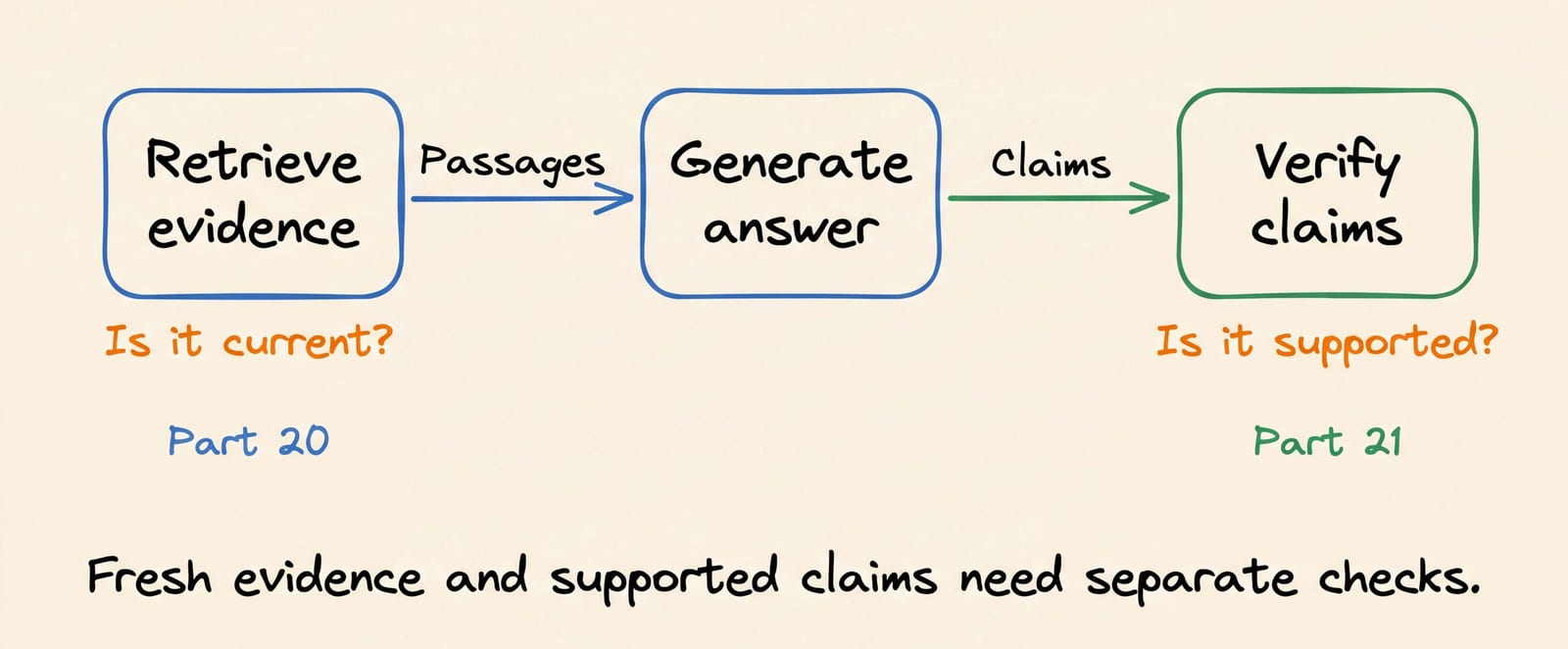
Parts 20 and 21 of the hands-on RAG Systems course are now available. Part 20 covers the evidence entering the system; Part 21 covers the claims leaving it.
Why it matters
The course argues that owning a RAG system after launch needs different skills from building the first version, since documents change and generated answers can remain unsupported even when retrieval succeeds.
Summaries like this, every morning.
The course frames the shift as one from assembling components to owning the system. Connecting a retriever to an LLM is enough to build a first version of a RAG application, but the material argues that operating it after launch is a different job: documents change, embedding models get replaced, evaluation data becomes stale, and generated answers can stay unsupported even when retrieval works.
The two parts are deliberately split along that fault line. Part 20 develops the operational side — data and model lineage, evaluation design, revision handling, migration gates, aliases and rollback paths. Part 21 adds the applied ML side — classifier evaluation, probability calibration, selective prediction, risk bounds, serving latency, and the trade-off between answer coverage and error rate. The stated link between them is that a verifier can confirm an answer follows from its passages but cannot detect that those passages are outdated, so retrieval freshness and answer support need separate controls.
The material is presented as transferable beyond any single vector database or framework, aimed at helping an AI engineer locate a failure before changing the pipeline — whether the quality drop comes from an outdated document, a mixed embedding index, a query distribution shift, a retrieval miss, or a generator that made an unsupported claim.
Pick your industry and the AI tools you use, and get news related to your work every day.
Free · 30 seconds with Google · unsubscribe anytimeWhat is AIToday? →
Ask AI anything about this article. The AI reads this article, earlier AIToday articles, and Wikipedia, and cites its sources. Q&As are published on this page for other readers too.
Anthropic introduced Claude for Manufacturing on November 12, a plugin for Claude Team or Enterprise plans tha…

The ninth AIF-C01 prep article covers task 3.1 on design considerations for foundation model applications, lis…

In a blog post, OpenAI chief scientist Jakub Pachocki argued that perplexity — which measures how well a model…
A Chinese-nexus actor's Cairn AI agents autonomously discovered a zero-day vulnerability, according to Amazon…

Oracle stated that its infrastructure deal with OpenAI is fully funded following a final capital raise, Reuter…

A traveler writing for Upgraded Points says trusting AI for visa advice cost them hundreds of dollars