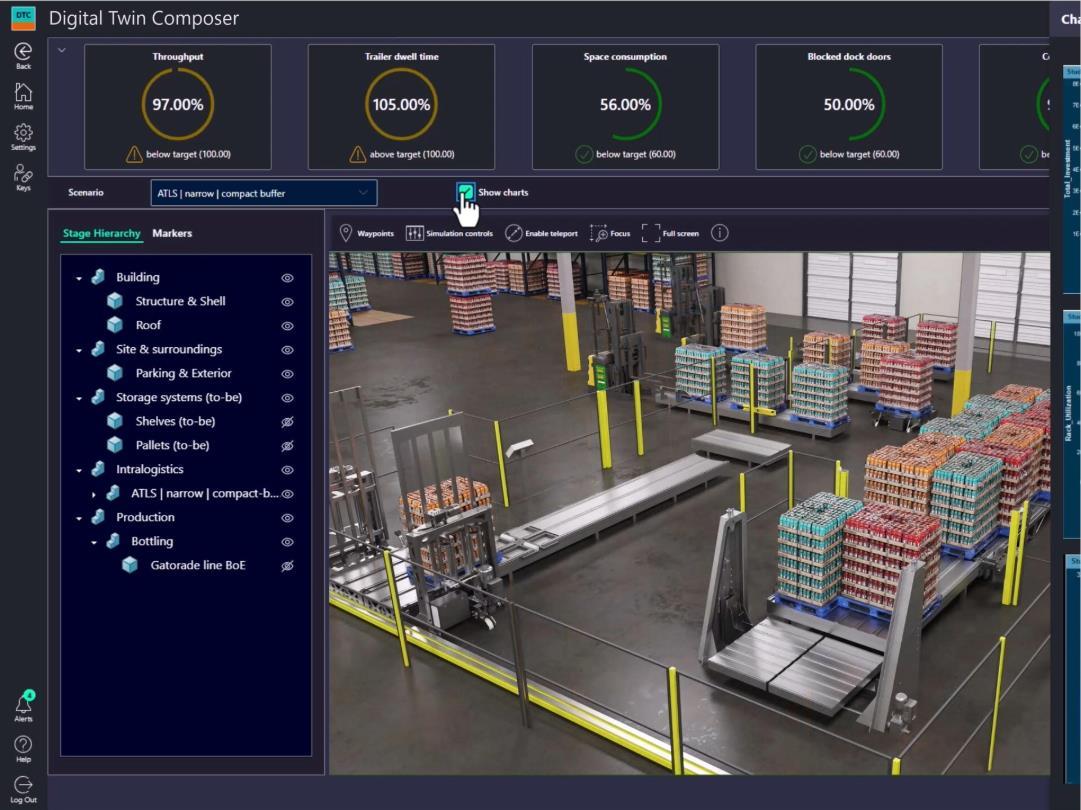
What happened
PepsiCo announced a multi-year collaboration with Siemens and NVIDIA on digital twin technology, using Siemens' Digital Twin Composer built on NVIDIA Omniverse, with early U.S. pilots reporting a 20% throughput increase and 10%-15% capex cuts.
Why it matters
PepsiCo says it can now recreate machines, conveyors and operator paths with physics-level accuracy, letting AI agents test changes virtually before any physical build, which it calls a first-of-its-kind move for a global CPG company.
What to watch
PepsiCo says design validation reached nearly 100% in initial deployment, but whether the gains hold as the program scales globally is not yet clear.
WHO IT HITSThis lands on plant and supply-chain operations teams at large manufacturers, who may face pressure to adopt digital-twin planning tools from Siemens and NVIDIA, as well as industrial software vendors competing for the same factory-floor budgets.
Summaries like this, in your inbox every morning.
PepsiCo's move fits a wider pattern among consumer goods companies testing digital twins and AI on packaging and plant decisions. Nestlé unveiled an in-house AI service last summer, built with Accenture Song, that generates 3D replicas of physical products and has reached a baseline of 4,000 3D digital master products, mainly for brands like Purina, Nescafé Dolce Gusto and Nespresso. The following month, Unilever, Amcor and Asahi disclosed trials of Deepnest, Greyparrot's AI waste intelligence platform, which uses AI-camera systems in material recovery facilities to track whether packaging units are sorted, recycled or lost.
PepsiCo's collaboration goes further upstream, into facility design itself. The company says it is shifting to a digital-first planning strategy that uses physics-based digital twins and AI agents as co-designers, recreating every machine, conveyor, pallet route and operator path with physics-level accuracy. Siemens' Digital Twin Composer, built on NVIDIA Omniverse libraries, is the vehicle for that: a way to combine 2D and 3D digital twin data with real-time physical information in a photorealistic virtual scene.
What is not yet settled is how far the early U.S. results travel. The throughput, design-validation and capex figures come from initial deployment, and PepsiCo has said only that it plans to scale globally. Whether the same gains appear across other facilities and regions will depend on how well the digital models match local equipment, constraints and operating practices — and that remains the test to watch.
Pick your industry and the AI tools you use, and get news related to your work every day.
Free · 30 seconds with Google · unsubscribe anytimeWhat is AIToday? →
Ask AI anything about this article. The AI reads this article, earlier AIToday articles, and Wikipedia, and cites its sources. Q&As are published on this page for other readers too.
Ghost AI raised $11 million, led by Andreessen Horowitz with Abstract, Audacious Ventures, Nova and SV Angel…
Moonshot AI closed its final private round at about a $50 billion valuation and is aiming for a Hong Kong IPO…
OpenAI told Fortune it is piloting a 'mission interview' for candidates on certain teams, starting with market…

Reactor said it added Nvidia's venture capital arm and Sapphire Ventures to its cap table, bringing its total…
A Stanford, Carnegie Mellon, UC Berkeley, and Microsoft Research team ran 6,800+ math, coding, and science tas…
Reflection AI launched Beam, a 501 billion-parameter open-source LLM