What happened
OpenAI announced GPT-Live, a new real-time voice model that enables full-duplex conversation—users and the AI can speak and listen simultaneously, mimicking natural human dialogue. The model rolls out across ChatGPT mobile and web apps starting July 8, with GPT-Live-1 for paid plans and a lightweight GPT-Live-1 mini for free users.
Why it matters
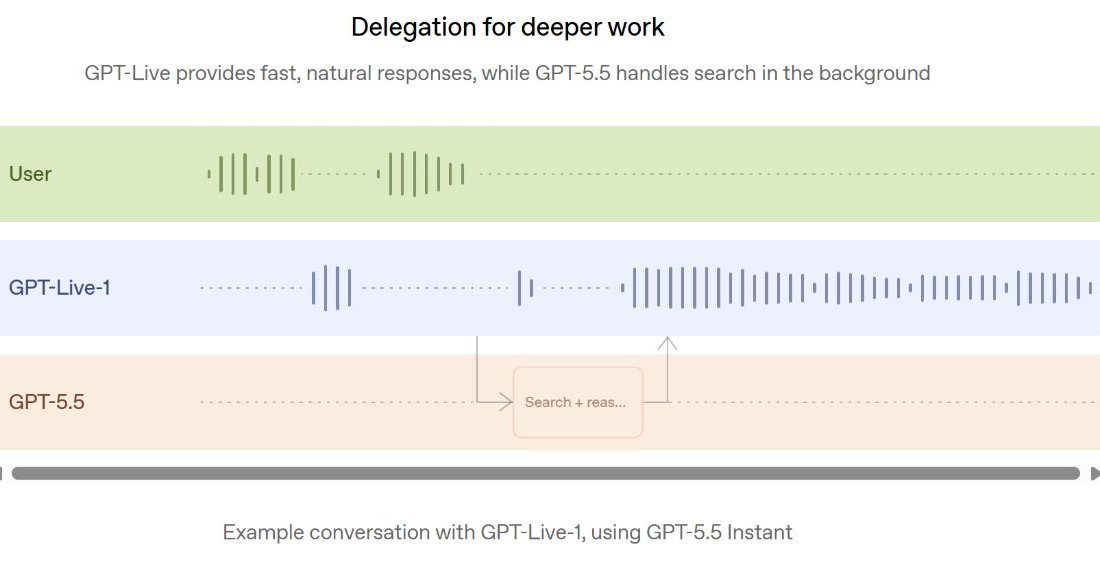
Previous voice modes required turn-based exchanges (user speaks, then AI responds), and even the advanced version had latency issues and awkward interruptions. GPT-Live makes dozens of decisions per second about whether to speak, keep listening, or stay silent—and can delegate complex questions to a more powerful backend model (GPT-5.5) while conversation continues. For developers and enterprises, this indicates OpenAI is moving toward more fluid, real-time AI interaction; API access is coming soon, though pricing details are not yet public.
What to watch
GPT-Live will not be available in Business, Enterprise, or Edu workspaces at launch, and does not support video or screen-sharing initially. The safety measures include real-time risk detection, age-appropriate behavior for teens, parental controls, and protections against voice impersonation. One safety metric—emotional dependence on the AI—showed slight decline (not statistically significant) compared to prior models.
Summaries like this, in your inbox every morning.
OpenAI's shift from turn-based to simultaneous speech-and-listen interaction addresses a long-standing friction in voice AI: latency and unnatural pauses. The original ChatGPT Voice chained speech recognition, language model, and speech synthesis sequentially, creating lag; the advanced successor cut delays but still struggled with false-conversation-endings. GPT-Live's architectural change—making dozens of micro-decisions per second about conversation state—aims to close that gap.
A second architectural choice underscores the company's broader product direction: the "delegation" pattern. While GPT-Live-1 mini handles fluent conversation, a more capable backend (GPT-5.5) handles deep reasoning and web search in the background, with results fed back into ongoing dialogue. This separation allows OpenAI to swap out the backend reasoning model as newer versions ship, without rebuilding the entire voice layer—a scalability advantage for a company releasing frontier models at a rapid cadence.
The safety design reflects OpenAI's public commitments around child protection and misuse prevention. Emotional dependence metrics declined slightly (though not significantly) versus prior models, and voice-impersonation safeguards are explicit. The model is not available to Business, Enterprise, or Edu workspaces at launch, suggesting OpenAI is validating real-world behavior before broader enterprise rollout. API pricing and terms remain undisclosed, leaving open how developers and businesses will be charged—a key detail for companies considering voice integration.
Pick your industry and the AI tools you use, and get news related to your work every day.
Free · 30 seconds with Google · unsubscribe anytimeWhat is AIToday? →
Ask AI anything about this article. The AI reads this article, earlier AIToday articles, and Wikipedia, and cites its sources. Q&As are published on this page for other readers too.
In Q2, billionaires or their funds sold six 'Magnificent Seven' AI stocks

Nvidia was rising early Friday, even as the wider chip sector kept falling, Barron's reported

ElevenLabs completed a $300 million employee tender at a $22 billion valuation, and co-founder Mati Staniszews…

On October 15, OpenAI announced the Rosalind Academic Plan, giving approved US university labs free access to…
Neostellar Capital principal Evan Schlossman said CoreWeave's $103.7 billion in remaining performance obligati…

A Qiita article compared automated red-teaming methods for LLM apps — GCG, PAIR, and TAP — using mock implemen…


