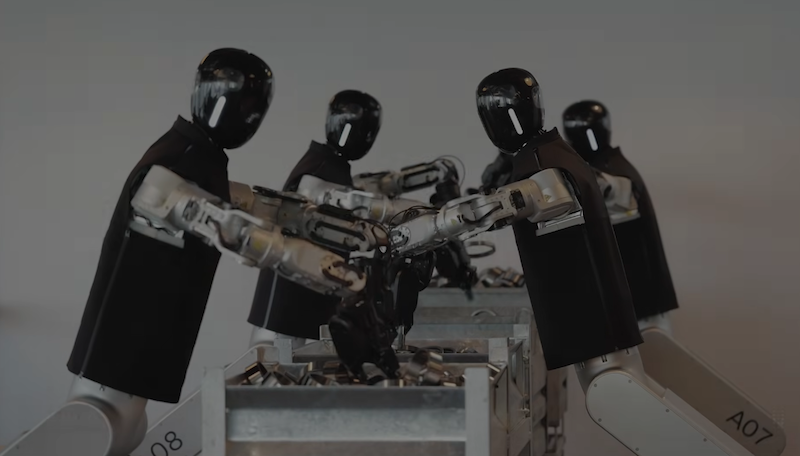
UK robotics startup Humanoid introduced KinetIQ Ascend, a reinforcement learning system that dramatically improves robot task performance within days of training.
In real-world tests, the system increased throughput by 42 to more than 100 percent across picking, handoff, and two-armed manipulation tasks while raising success rates to 98–99 percent.
The scalable approach removes the need for months of manual tuning, allowing robots trained on human demonstrations to outperform those demonstrations quickly.
What happened
UK robotics firm Humanoid unveiled KinetIQ Ascend, a reinforcement learning system that improves robot manipulation reliability to 99.9 percent. Tested on picking, handoff, and two-armed handling tasks, the system boosted throughput by 42 percent in machine feeding, 85 percent in item picking, and more than doubled throughput in tote handling—all after only a few days of training.
Why it matters
The system enables robots to learn and improve directly on real industrial tasks rather than requiring months of manual tuning. Success rates rose sharply (80 percent to 98 percent in picking; 78 percent to 99 percent in two-armed tasks), suggesting robots can now move from human demonstrations to deployment-ready capability without expensive human engineering overhead.
What to watch
Humanoid's CTO noted that robot performance improves predictably as training time increases, similar to how large language models improve with more compute and data, and that the company's method scales all the way to 100 percent reliability. The company has published a technical report covering the full methodology.
Ask the AI about this article →
Humanoid built KinetIQ Ascend on top of its previously announced KinetIQ platform by adding trial-and-error learning—a reinforcement learning approach—that lets robots refine their skills directly on industrial tasks. The results are striking: throughput gains ranging from 42 percent to more than 100 percent, coupled with success rate improvements that in one case represent a roughly twentyfold reduction in failures. Across three real-world scenarios—high-speed single-arm picking, cluttered picking with handoff, and complex two-armed handling—the pattern held, suggesting the method generalizes across diverse manipulation challenges.
The company's framing of this as a "capability factory" reflects a shift in how robot capabilities are built. Rather than spending months collecting training data and tuning every new skill by hand, engineers can now start with a basic behavior and let the system iteratively refine it into production readiness. This approach mirrors how large language models scale: Humanoid observed that robot performance improves predictably as training time increases, and simulation experiments support the claim that the method scales all the way to 100 percent reliability. Two additional findings—that improving only the hardest part of a workflow can improve the entire task, and that robots generalize to unseen objects—point to a system robust enough for real deployment, not just lab validation.
For example, today's edition would include:
AI-summarized, only the topics you pick — one digest a day via Email, Slack, or Discord.
Free · takes 30 seconds · unsubscribe anytimeWhat is AIToday? →
Ask AI anything about this article. Q&As are published on this page for other readers too.
Visko raised $10 million in pre-seed funding from Llama Ventures and opened public access to its first foundat…

K-Safety Expo 2026 will be held at BEXCO in Busan from September 2–4, featuring AI, robots, sensors, and conne…

U.S. markets ended August higher, with the S&P 500 up 2.6% and the Nasdaq up 3.9%

Neurovia AI, an Abu Dhabi-based company, is pitching Saudi security agencies software that it says can compres…

AI company Runway has unveiled Solaris, the first model in a new category it calls "Interface World Models." I…

John Deere introduced JD, a conversational AI tool that lets farmers ask open-ended questions about their hist…