Summaries like this, in your inbox every morning.
Sign up free →Yunzhu Li, an assistant professor at Columbia University and co-founder of SceniX, specializes in robotics simulation and robot learning. SceniX is developing tools for robotics companies to generate training data, build simulation environments, and evaluate robot performance to accelerate deployment from lab to real-world settings.
Li distinguishes locomotion from manipulation: walking across a room requires a robot to model and control its own body, while manipulation demands understanding of objects, materials, geometry, contact, and how the environment changes through interaction. Handling deformable objects, organizing clutter, and reliably manipulating unfamiliar items in new environments remains much harder because small errors can quickly change task outcomes.
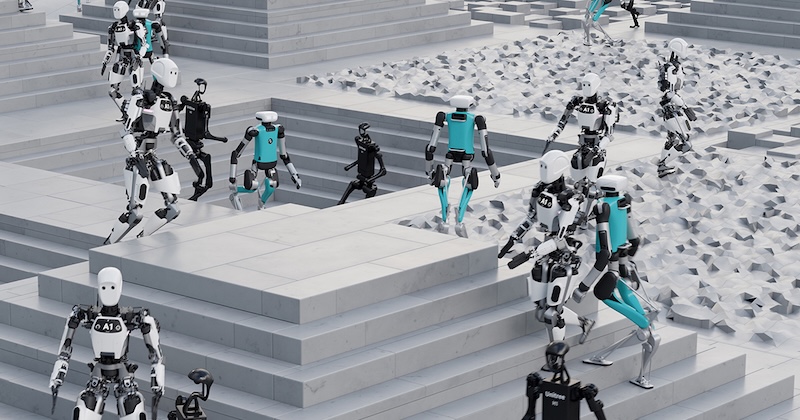
Simulation is especially important for physical AI because collecting real-world robot data is slow, expensive, and difficult to scale safely. In simulation, robots can generate diverse training data, test edge cases, and learn about environments they need to interact with before real-world deployment. Li argues that while robots themselves are relatively easy to model, the real world—with its diverse objects, materials, contact dynamics, and constant changes—is not.
AI-summarized, only the topics you pick — one digest a day via Email, Slack, or Discord.
Free · takes 30 seconds · unsubscribe anytime
No comments yet. Be the first to share your thoughts!
Log in to join the discussion


Get curated AI news from 200+ sources delivered daily to your inbox. Free to use.
Get Started FreeFree · takes 30 seconds · unsubscribe anytime
1 minute a day. The AI essentials.
200+ sources · Email / LINE / Slack
