What happened
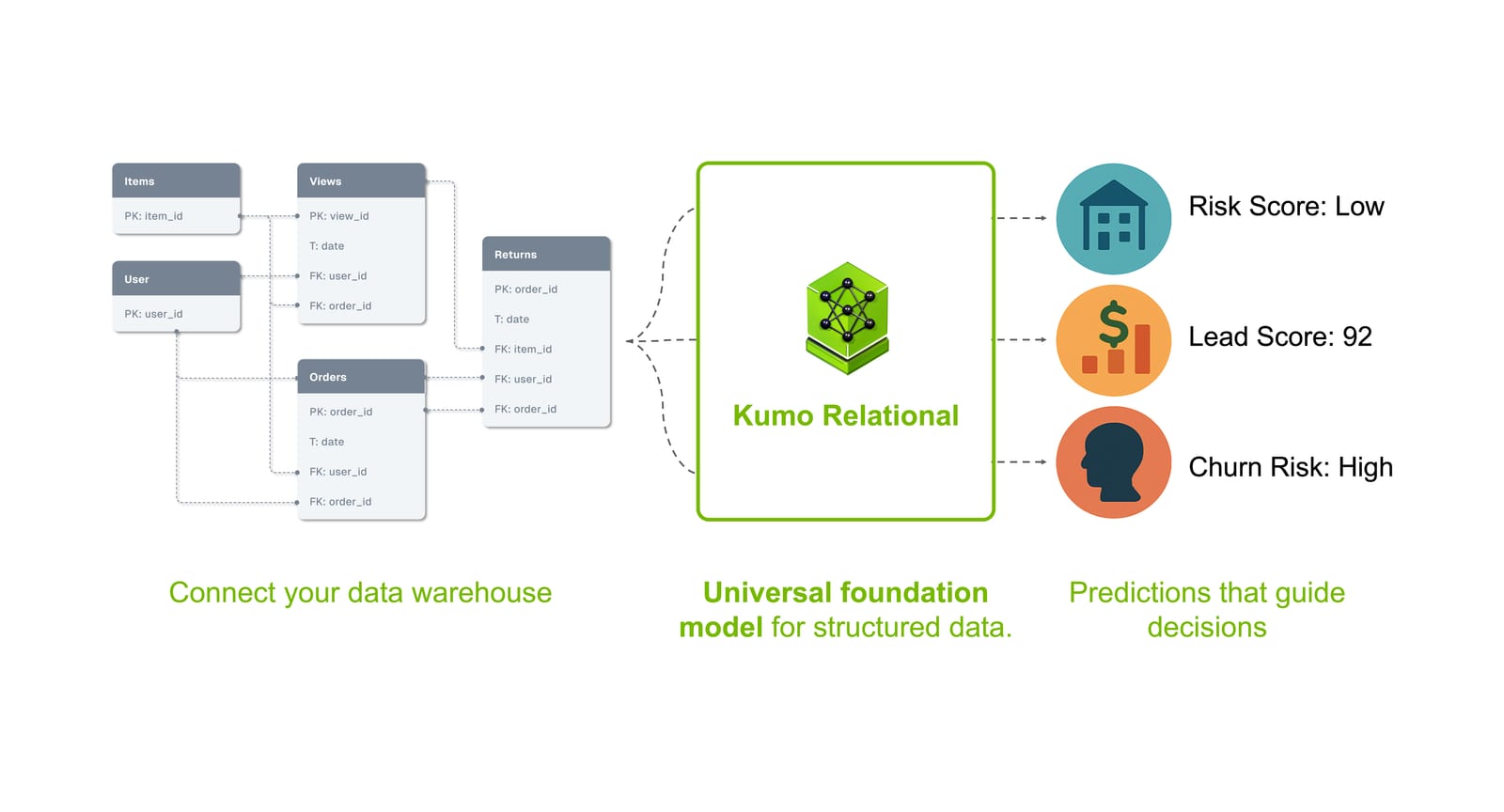
NVIDIA released Kumo Relational, a pre-trained model that predicts churn, demand or fraud directly on enterprise databases. Across 41 tasks on 15 databases, it beat supervised deep learning and expert-engineered gradient-boosted tree pipelines, and surpassed AutoGluon ensembles by 8% in mean reciprocal rank on the SAP SALT benchmark.
Why it matters
It replaces weeks of feature engineering and per-task training with a single query, which could let data teams take on prediction projects that were previously too laborious to build, and it is built to be called by AI agents.
What to watch
Kumo Relational is available today through NVIDIA's open-source structured-data-models library or as an NVIDIA NIM, with code under the Apache 2.0 license.
WHO IT HITSData science and ML teams running production XGBoost pipelines on relational databases are the most directly affected, since the model is positioned as a drop-in replacement that skips feature engineering and task-specific training.
Summaries like this, in your inbox every morning.
The release extends to relational databases the same shift that large language models brought to text: one pre-trained model replacing a separate pipeline for each task. NVIDIA argues the parallel holds on three counts — better accuracy than the best task-specific models, far simpler production deployment, and flexibility that opens new applications. For structured data, the company says the practical payoff is that a new prediction becomes a query rather than a project.
The model is pre-trained entirely on synthetic relational data, generated by a system built on the PluRel approach, which extends single-table data generators to full relational databases. Members of the Kumo team helped develop PluRel and co-authored the original paper. Because generation is lightweight, NVIDIA says pre-training data is effectively unlimited, and the PluRel paper shows pre-training loss follows a power law as synthetic databases are added, with gains carrying over to real databases.
On the RelArena-α leaderboard, which compares relational models and systems on RelBench V1, Kumo Relational sits on the accuracy-efficiency Pareto front out of the box: about 17 seconds and Elo 1,842, versus the highest-scoring entry, rt-plurel, at Elo 1,878 and about 7,300 seconds — roughly 430 times slower. The paper also reports the model holds up under hard conditions, performing well with as little as 0.2% of the training data as context, staying stable when up to 75% of foreign-key links are removed, and barely degrading when many noisy columns are added.
Pick your industry and the AI tools you use, and get news related to your work every day.
Free · 30 seconds with Google · unsubscribe anytimeWhat is AIToday? →
Ask AI anything about this article. The AI reads this article, earlier AIToday articles, and Wikipedia, and cites its sources. Q&As are published on this page for other readers too.
China set up National Data Group, a state-owned enterprise headquartered in Xiong'an, Hebei province, with Vic…

Anthropic's draft IPO prospectus disclosed first-half revenue of $16.3 billion alongside an $80.7 billion net…

OpenAI said the PHP vulnerability, fixed the same day, was found using GPT-5.6 Sol through its Patch the Plane…

Klique announced platform support for NVIDIA Nemotron 3.5 Super VL, OpenShell, Dynamo, and NeMo Switchyard, le…

In Q3 2026 results on Oct

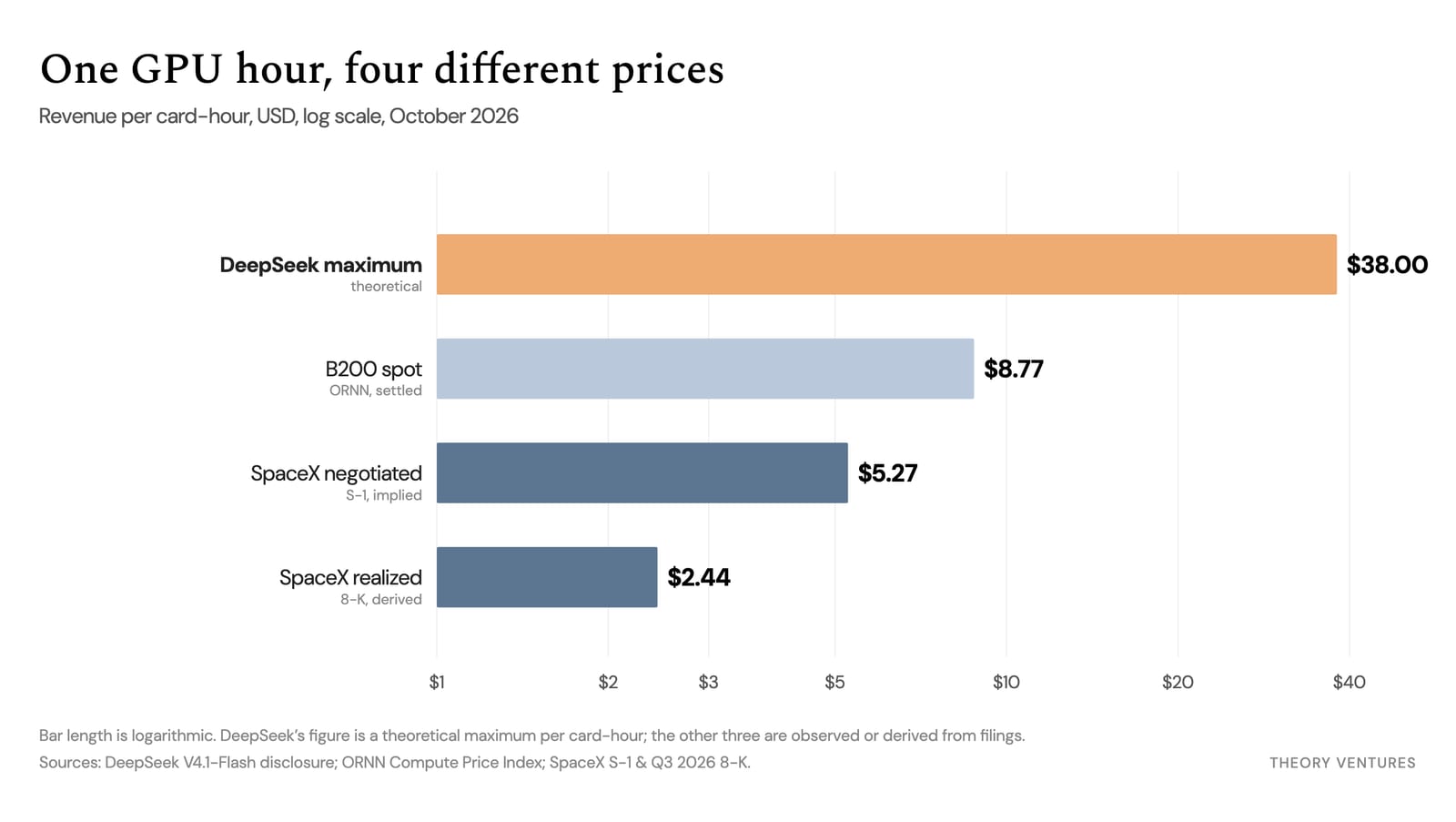
Tom Tunguz laid out a GPU pricing ladder from DeepSeek's theoretical $38.00 per card-hour maximum down to Spac…