What happened
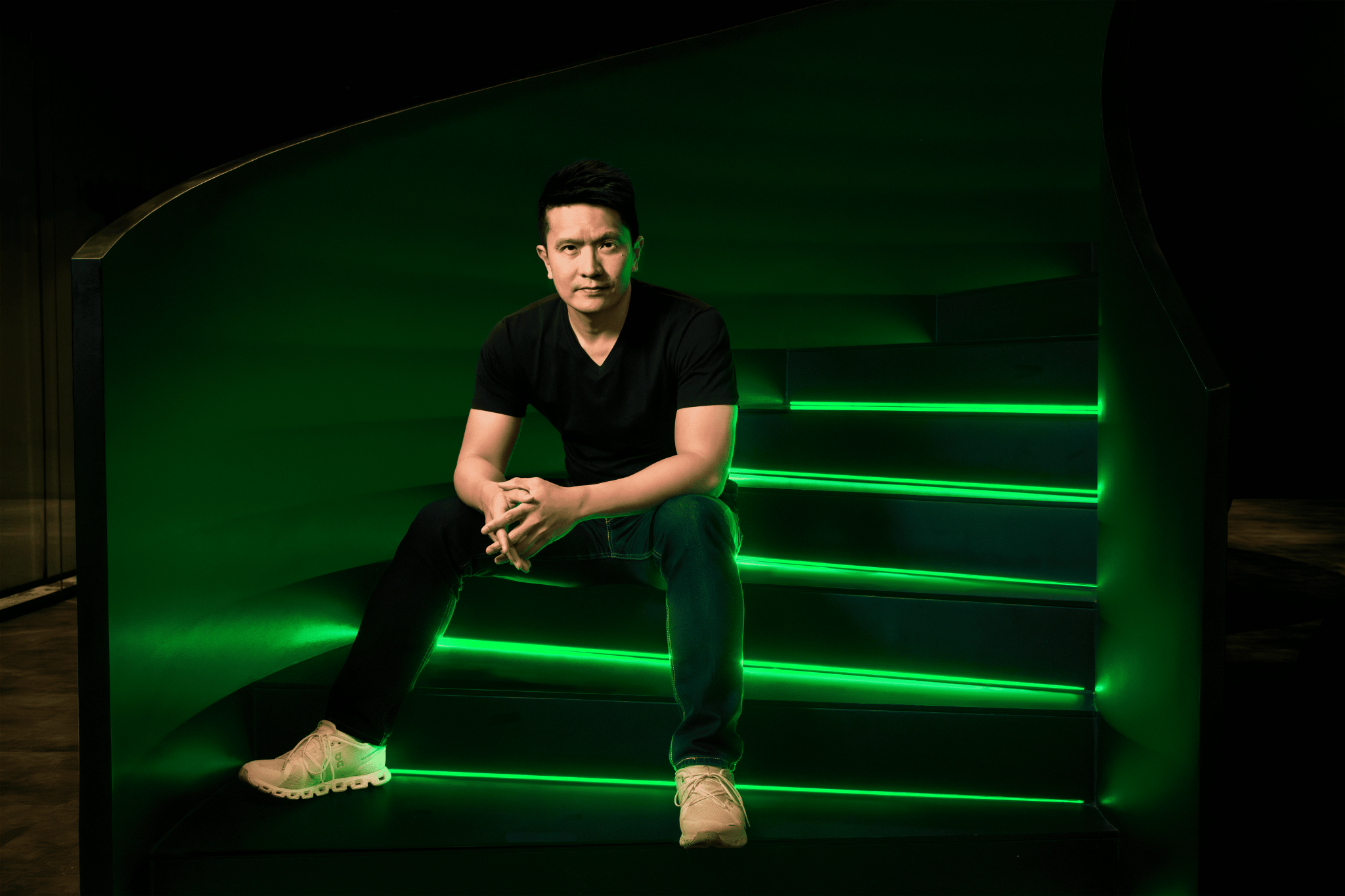
Razer CEO Min-Liang Tan says AI will make gaming a trillion-dollar industry, up from roughly $188.8 billion in revenue last year. The company unveiled the Barracuda AI headset on Sept. 28 and previewed its Razer AVA AI avatars.
Why it matters
Razer, a gaming hardware brand, is repositioning itself as an AI company. Tan predicts Razer will become 'one of the largest AI hardware companies on the planet,' betting on wearables, AI avatars and game development tools.
Summaries like this, in your inbox every morning.
Razer spent two decades building a cult following around gaming hardware, with a brand identity tied to its three-headed snake logo and a fanbase willing to tattoo it on themselves. That era is now framing a harder pivot. Tan, a lawyer by training who built the Boomslang mouse with American businessman Robert Krakoff in 1999, has long argued that everyone would eventually become a gamer. His latest claim extends that logic: the industry's roughly $188.8 billion in revenue last year is a floor, not a ceiling, and AI is the mechanism he believes gets it to a trillion dollars.
The shift is partly structural. Razer went private in 2022 with CVC Capital Partners after five years on Hong Kong's stock exchange, which Tan says freed him from quarterly reporting and let the company pursue 'cognitive gaming' without public-market scrutiny. That freedom is visible in the product lineup: a wearable headset with cameras and multi-model AI compatibility, a desktop companion with avatars that have scripted personalities, and a game-testing tool.
But the same AI that Razer is betting on is already reshaping the games market in ways that may be harder to control. Studies find that one in five games released on Steam last year disclosed generative AI use, and separate research suggests AI-made games account for up to 90% of growth in monthly releases. Almost none make money. Tan's response is to position Razer on the quality side of that divide, with tools aimed at fixing bad AI output rather than adding to it.
Pick your industry and the AI tools you use, and get news related to your work every day.
Free · 30 seconds with Google · unsubscribe anytimeWhat is AIToday? →
Ask AI anything about this article. The AI reads this article, earlier AIToday articles, and Wikipedia, and cites its sources. Q&As are published on this page for other readers too.
ServiceNow announced AI Passport, a cryptographically signed credential defining an agent's identity, permitte…
Chairman and CEO C.C. Wei announced TSMC has raised its full-year 2026 US dollar revenue growth guidance to ap…

Japan selected a GlobalFoundries-led project for its third round of U.S

Eric Francia, co-founder and CEO of Uniplay, writes that AI has made knowledge accessible at unprecedented sca…

Modal crossed $1B in annualized run rate and raised a $750M Series D at a $15.75B valuation led by Accel

Microsoft Agent Framework has ported Semantic Kernel's Python vector-store work forward, keeping typed records…